Those card works fine, afaik - it’s the one that additionally has SATA onboard that allegedly has problems.Here's to hoping, having USB and Firewire on one card would be great. Limited room in those things.


Those card works fine, afaik - it’s the one that additionally has SATA onboard that allegedly has problems.Here's to hoping, having USB and Firewire on one card would be great. Limited room in those things.
A user of a rev C ROM Beige G3 reports that applying the cache line size and master latency timer fix that exists in the rev D ROM for PCI bridges improves performance.It looks like it is, but I can’t see any new features or behaviour having run it for a little while in my G3.
ChatGPT says:
This line sets the cache line size for PCI-PCI bridges during configuration. It was likely added in Rev D to ensure proper initialization, enhance performance, or fix compatibility issues with specific devices.
dev pci/pci-bridge
.propertiesreg 00006000 00000000 00000000 00000000 00000000reg property. You want the non-zero address that ends in 00 which in the above example is 6000.dev pci
\ get the vendor and device IDs and verify that they match those of the PCI bridge.
6000 config-l@ 8 u.r
\ get the cache line size and the master latency timer.
600c config-l@ 8 u.r000120080000 600c config-l! \ set cache line size and master latency timer to 0.2008 600c config-l! \ set cache line size to 32 and master latency timer to 8.Probably not. I did find an issue with PCI controllers that don't have a PCI Option ROM with Open Firmware fcode (USB and FireWire controllers). I made a patch to fix this which I added to the ROM extender that I mentioned atCould it have possibly been a fix for the Rev C incompatibility with the Sonnet Tango Trio?
A user of a rev C ROM Beige G3 reports that applying the cache line size and master latency timer fix that exists in the rev D ROM for PCI bridges improves performance.
Necroing this thread a bit.I had unsoldered the chips and scanned them in by using a chip-programmer. I had to clean the chip-legs to get a good contact. Maybe something went wrong at some point?
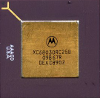
Now on to the real reason I hunted down this thread.There is someone on eBay right now who sells original Apple PPC 4Mb 3.3V Flash ROMs. The seller had about 100 of these Roms. The origins are unknown. I have bought 10 of them to experiment.
Now on to the real reason I hunted down this thread.
I bought one of these in late 2024. I can't find the darned thing. Can I please get someone to check the resistance between...
Never mind. Typing that out seems to have triggered a memory. Found the thing on top of my Beige G3. Duh. Two many boxes of snips and snails distracted me as possible hiding places.
What are you checking?
Wouldn't the G3 DIMMs be wired similar to PowerSurge DIMMs (except the voltage source)? Schematics at:How the WE_ pins are wired. I know where they are on the chips and on the DIMM edge. Are the connected? Or do they run through some of those blank resistor positions on the board? Are the chip WE_ tied high? If so, how high (with what resistance)?
The chips must be held high during operation (reads) or they wouldn't work. Does the DIMM do that, or does it rely on the host machine to supply HIGH on the WE_ pins of the DIMM?
read 'XCOF' (128) ":Objects:xcoffResources:CopyToFlashPDM.xcoff";
read 'XCOF' (129) ":Objects:xcoffResources:CopyToFlashTNT.xcoff";
read 'XCOF' (130) ":Objects:xcoffResources:CopyToFlashCAT.xcoff";
read 'XCOF' (131) ":Objects:xcoffResources:CopyToFlashPBX.xcoff";
read 'XCOF' (132) ":Objects:xcoffResources:CopyToFlashM2.xcoff";
read 'XCOF' (133) ":Objects:xcoffResources:CopyToFlashPSX.xcoff";
read 'XCOF' (134) ":Objects:xcoffResources:CopyToFlashTanzania.xcoff";
read 'XCOF' (135) ":Objects:xcoffResources:CopyToFlashOpus.xcoff";
read 'XCOF' (136) ":Objects:xcoffResources:CopyToFlashGossamer.xcoff";
read 'XCOF' (137) ":Objects:xcoffResources:CopyToFlashPEx.xcoff";I'll take a look at those schematics. That is another route to the information that I want. Thankyou. It sounds like WE_ is just wired from chips to DIMM pin and then the chips rely on the motherboard to provide the proper WE_ level. But I did not want to assume that. It is entirely possible that the DIMM is meant to pull WE_ on the chips slightly high (through large value resistor) and that during Write operation the motherboard would drag it low by asserting a stronger (less resistance to GND) Low signal.
Working on a programmable DIMM. I did a Read-only DIMM (program chips before soldering) 20 years ago. The bright software folks seem to have a need for a programmable DIMM in this format now, so I'm adapting the design. But there are details.What are you interested in doing? Or what’s the info for?

The FlashRom CE line is on pin 12 of the chip. These pins go to contact 115 on the Rom-socket (through a 0-Ohm R1), which is RCS0 (rom select 0). A resistor (R2) can be changed so that RCS1 (rom select 1) is connected (contact 35 on the socket). Both select lines go to the Grackle.Also found that CE_ of the Flash chips on the 820-0961 module are floating, not tied low, not connected to a DIMM pad. They're routed to an unpopulated resistor that would go to pin 35, which is not GND, but is something called RCST# on the schematic.
https://www.macdat.net/files/pdf/apple/schematics/apple/powermac_g3_gossamer.pdf
R7 (unpopulated) connects the RY/BY# pin to contact 116 (Flash detect) which does not seem to be connected to anything on the Rom-socket. R8 (populated) connects the RY/BY# signal of the Flash-chips to contact 122 (BurstCap_). RY/BY# is also connected to a capacitor against ground.
Would it be possible to have a jumper or something on the flash ROM so that it appears as 4 MB at FF800000 instead of 4 MB at FFC00000 so that both ROMs can work at the same time? Then one can boot with the normal ROM to flash the flash ROM. This way, the switch doesn't need to be changed while the power is on to do a flash.
Could “BurstCap” be short for “burst capability”?