
-
 Hello Guest! We're hosting a challenge to welcome vintage Intel macs to the MLA during the month of July! See this thread for more information.
 -
We've made some quality of life improvements to the Trading Post. More info here.
You are using an out of date browser. It may not display this or other websites correctly.
You should upgrade or use an alternative browser.
You should upgrade or use an alternative browser.
Tearing down an SE/30 - is there a trick to getting the power plug out?
- Thread starter ben68
- Start date


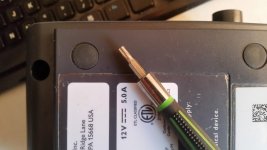


Did you remove all 4 Torx (2 in handle, 2 on back), and remove the programmers switch if installed? If so, use a soft plastic "case cracker" to gently seperate the face from the bucket. Careful not to damage the plastic. It's easily marred, especially by harder materials. Alternatively, there's the shake smartly with screen parallel to the floor about 2" height over soft towel. The idea is to have the weight of the crt/internals break the bucket free. Careful not to smash it against the floor!

Yeah - I'm in, but I didn't know (should have known) that the power harness to the MB has a clip. I hope I didn't break anything. I'm now in to the floppy drive and cleaning it inside and out.
What do you recommend for lube? I'm following this youtube and he uses lithium grease. Someone else used Vaseline, but I'm afraid to use petroleum anywhere near plastic.
What do you recommend for lube? I'm following this youtube and he uses lithium grease. Someone else used Vaseline, but I'm afraid to use petroleum anywhere near plastic.

I know the problem's been fixed but here are some tips when working on compacts:
1/ Opening the case up
While some people have their own technique, I prefer to lay the Mac down on its face (preferably on a rug to avoid any scratches).
First, remove the programmer's switch (except for the Classic and onward). It'll break if you don't remove it.
I own 11 B&W compacts now (one of each form factor), and I never had to use the case cracker tool. It's a little more difficult to remove the rear bucket on the Classic/ClassicII/Performa200 machines due to their curved bezel. But after removing the 4 or 5 screws (5 on the 128k-512k-Plus and 4 on the rest of the range), it should be fairly easy to pop the back out. If needed, try to separate the two halves with your fingers. Place your two hands in between the bezel and the bucket and gently try to pry the two halves apart. Do that on all 6 corners: two at the top, two at the bottom, two around that twisty bit (you'll see what I mean by looking at the side of the unit, you can't miss it!).
2/ Once you're in
Touch the chassis with your two hands. That will get rid of the static energy on your fingers. You don't want to fry your logic board... Most of the time, my anti static wrist wrap is nowhere to be found. I can only find it when I don't need it but never manage to find it when I really need it. Anyway, I think you don't really need that as long as you ground yourself by touching the chassis. Again some people will disagree with what I say, but in my defence, I take apart a Mac nearly every week end and never had any issues.
Be extremely carful with the CRT's neck. It will break if you hit it too hard with your hand or with the rear bucket.
Next if you want to take the logic board out, you'll have to pry on the little tab located on the logic board connector. That's the tab you couldn't see at first. On the SEs/SE/30s/Classics etc, the tab is quite small and you don't have to apply too much force to remove the cable. On the 128ks/512ks/Pluses, it's a little trickier as the tab is considerably larger. The safest method for the latter Macs is to do one side of the tab at a time.
For all machines, once the tab is released, swing the connector left and right back and forth. Don't pull too much on it or you'll break the neck of the CRT which is located dangerously close to that connector.
Then proceed to the floppy and scsi cable (if applicable). Those are easy to remove.
On the 128k/512k/Plus/Classic, you need to slide the motherboard all the way up whereas on the SEs (and SE/30) you only need to slide it about a third of the way, then swing it towards you. On the SEs and the SE/30, don't forget to remove the speaker connector!
WHILE WE'RE ON THE SUBJECT OF LOGIC BOARDS: HAVE YOUR SE/30 BOARD RECAPPED IMMEDIATELY AND PLEASE FOR THE LOVE OF GOD REMOVE THE OLD, PERISHED BATTERY. Some members can replace those little SMD capacitors for you for a reasonable sum. Do it now before it's too late. These SE/30 boards need a bit of servicing these days.
Otherwise, this will happen:

Removing the Floppy/HD brackets is fairly easy. It's important though to mention that it's a little more difficult to put them back in correctly. The floppy bracket needs to sit perfectly flat on the chassis, NOT at an angle (otherwise the hole for the floppy disk on the bezel won't match up properly with the drive and you might damage it. As for lube, I use silicon spray. It works rather well but I know a lot of people use lithium grease. It works great too.
3/ Moving on to the Analog Board.
This is where you'll find all the quite dangerous voltages. It's preferable not to touch anything Analog board related (CRT, Yoke cable=red cable and its flyback transformer, deflection yoke=copper part of the CRT, etc). Wait at least two weeks before taking that part. Leave the unit unplugged during that time. If you are very confident with what you're doing you can skip the waiting bit and discharge the flyback transformer yourself but that takes some learning. I see you're a newbie (and by the way welcome to the 68kmla!! ), and if I were you, I would wait a bit.
You can clean the fan though, and add a drop of motor oil if it's really noisy.
I think that's it for the moment... the analog board and PSU will have to be recapped but perhaps not as soon as the logic board. If you have no sound coming from your speaker, then you really really need to recap it before things get any worse.
Oh and sorry for the long post, I know it's hard to digest.
1/ Opening the case up
While some people have their own technique, I prefer to lay the Mac down on its face (preferably on a rug to avoid any scratches).
First, remove the programmer's switch (except for the Classic and onward). It'll break if you don't remove it.
I own 11 B&W compacts now (one of each form factor), and I never had to use the case cracker tool. It's a little more difficult to remove the rear bucket on the Classic/ClassicII/Performa200 machines due to their curved bezel. But after removing the 4 or 5 screws (5 on the 128k-512k-Plus and 4 on the rest of the range), it should be fairly easy to pop the back out. If needed, try to separate the two halves with your fingers. Place your two hands in between the bezel and the bucket and gently try to pry the two halves apart. Do that on all 6 corners: two at the top, two at the bottom, two around that twisty bit (you'll see what I mean by looking at the side of the unit, you can't miss it!).
2/ Once you're in
Touch the chassis with your two hands. That will get rid of the static energy on your fingers. You don't want to fry your logic board... Most of the time, my anti static wrist wrap is nowhere to be found. I can only find it when I don't need it but never manage to find it when I really need it. Anyway, I think you don't really need that as long as you ground yourself by touching the chassis. Again some people will disagree with what I say, but in my defence, I take apart a Mac nearly every week end and never had any issues.
Be extremely carful with the CRT's neck. It will break if you hit it too hard with your hand or with the rear bucket.
Next if you want to take the logic board out, you'll have to pry on the little tab located on the logic board connector. That's the tab you couldn't see at first. On the SEs/SE/30s/Classics etc, the tab is quite small and you don't have to apply too much force to remove the cable. On the 128ks/512ks/Pluses, it's a little trickier as the tab is considerably larger. The safest method for the latter Macs is to do one side of the tab at a time.
For all machines, once the tab is released, swing the connector left and right back and forth. Don't pull too much on it or you'll break the neck of the CRT which is located dangerously close to that connector.
Then proceed to the floppy and scsi cable (if applicable). Those are easy to remove.
On the 128k/512k/Plus/Classic, you need to slide the motherboard all the way up whereas on the SEs (and SE/30) you only need to slide it about a third of the way, then swing it towards you. On the SEs and the SE/30, don't forget to remove the speaker connector!
WHILE WE'RE ON THE SUBJECT OF LOGIC BOARDS: HAVE YOUR SE/30 BOARD RECAPPED IMMEDIATELY AND PLEASE FOR THE LOVE OF GOD REMOVE THE OLD, PERISHED BATTERY. Some members can replace those little SMD capacitors for you for a reasonable sum. Do it now before it's too late. These SE/30 boards need a bit of servicing these days.
Otherwise, this will happen:
Removing the Floppy/HD brackets is fairly easy. It's important though to mention that it's a little more difficult to put them back in correctly. The floppy bracket needs to sit perfectly flat on the chassis, NOT at an angle (otherwise the hole for the floppy disk on the bezel won't match up properly with the drive and you might damage it. As for lube, I use silicon spray. It works rather well but I know a lot of people use lithium grease. It works great too.
3/ Moving on to the Analog Board.
This is where you'll find all the quite dangerous voltages. It's preferable not to touch anything Analog board related (CRT, Yoke cable=red cable and its flyback transformer, deflection yoke=copper part of the CRT, etc). Wait at least two weeks before taking that part. Leave the unit unplugged during that time. If you are very confident with what you're doing you can skip the waiting bit and discharge the flyback transformer yourself but that takes some learning. I see you're a newbie (and by the way welcome to the 68kmla!!
), and if I were you, I would wait a bit. You can clean the fan though, and add a drop of motor oil if it's really noisy.
I think that's it for the moment... the analog board and PSU will have to be recapped but perhaps not as soon as the logic board. If you have no sound coming from your speaker, then you really really need to recap it before things get any worse.
Oh and sorry for the long post, I know it's hard to digest.

Yes, the computer will run fine without the battery. It won't remember the date and time or a few other settings, like audio volume.
I now have the SE open - should I cut the dead battery out of that?
Note that I have both the SE and the SE/30.
I was able to get the SE/30 back together without any spare parts. The problem now is that the floppy keeps ejecting the floppies I feed it. The capacitors don't look too bad - C7 is leaking a little - as expected - only evidenced by mild corrosion on the sound chip near it.
These floppy drives are going to drive me mad.
Both have bad hard drives, so it's going to be a problem for me if I can't get the floppy drives to work. The odd thing is that a few weeks ago, the SE's floppy drive worked fine, but today, I put in the same disk, and it ejects it immediately - it's like it doesn't even read whats on it. And the SE/30 is doing pretty much the same thing.
Note that I have both the SE and the SE/30.
I was able to get the SE/30 back together without any spare parts. The problem now is that the floppy keeps ejecting the floppies I feed it. The capacitors don't look too bad - C7 is leaking a little - as expected - only evidenced by mild corrosion on the sound chip near it.
These floppy drives are going to drive me mad.
Both have bad hard drives, so it's going to be a problem for me if I can't get the floppy drives to work. The odd thing is that a few weeks ago, the SE's floppy drive worked fine, but today, I put in the same disk, and it ejects it immediately - it's like it doesn't even read whats on it. And the SE/30 is doing pretty much the same thing.
Last edited by a moderator:
I have never seen a soldered black varta leak, but I cut them out anyway.
I suspect that the leaking and corrosion on the SE/30 is worse than you give credit for. I haven't seen an uncapped SE/30 in the last couple years whose life wasn't hanging by a thread. That corrosion is permanent damage and makes it a lot harder to recap. And it will proceed for as long as you procrastinate dealing with it. Forget the floppy drives. Get that logic board washed and recapped. If you're not misjudging the extent of the cap damage, you have a board in uncommonly good condition and should preserve it pronto.
I suspect that the leaking and corrosion on the SE/30 is worse than you give credit for. I haven't seen an uncapped SE/30 in the last couple years whose life wasn't hanging by a thread. That corrosion is permanent damage and makes it a lot harder to recap. And it will proceed for as long as you procrastinate dealing with it. Forget the floppy drives. Get that logic board washed and recapped. If you're not misjudging the extent of the cap damage, you have a board in uncommonly good condition and should preserve it pronto.
To piggyback on this thread as opposed to creating a new one, how does one identify the original caps? I picked up an SE/30, pulled the battery, but I'm not sure what to look for as far as caps. none appear bulging or leaking, but I don't know if it's been recapped or not. My inclination is that it has not since (I would think) there's not really much in the way of solder on the back of the board that doesn't look like it was machine soldered. If that makes sense.I have never seen a soldered black varta leak, but I cut them out anyway.
I suspect that the leaking and corrosion on the SE/30 is worse than you give credit for. I haven't seen an uncapped SE/30 in the last couple years whose life wasn't hanging by a thread. That corrosion is permanent damage and makes it a lot harder to recap. And it will proceed for as long as you procrastinate dealing with it. Forget the floppy drives. Get that logic board washed and recapped. If you're not misjudging the extent of the cap damage, you have a board in uncommonly good condition and should preserve it pronto.
Top of board: http://imgur.com/nLAldEh
Bottom of board: http://imgur.com/7GW4eqU


you can tell they are original because the solder joints are corroded, and the caps are leaking all over the place.
Originals look like this:

Replaced capacitors look like this:
/monthly_08_2015/post-3941-0-27552000-1440792616.png">View attachment 7246
Or the effective yet uglier:

Replaced capacitors look like this:
/monthly_08_2015/post-3941-0-27552000-1440792616.png">View attachment 7246
Or the effective yet uglier:
All of the aluminum can capacitors are bad. C1, C3, C4, C5, C6, C7, C8, C9, C10, C12, C13. The first photo ben68 posted is what I see all the time (and when I say "all the time," I mean every single board I look at): corroded pads, corroded vias, corroded pins, eaten away traces, all swimming in a bath of goo. I think it takes a little bit of experience to recognize the goo. I had trouble seeing the mess of goo on the first couple boards I looked at. Using a flashlight helps. And if you wipe a cotton swab with alcohol over the board next to those caps, it will come away yellow/brown.
Last edited by a moderator:
Regarding my original post - I was following the directions for an SE, thinking that disassembling an SE/30 is the same. It's not.
The SE/30 has a clip on the power harness; the SE doesn't.
For the SE/30, I found it easier to unclip the power harness from the power supply board rather than the motherboard.
The SE was easier - since it simply unplugs.
The SE/30 has a clip on the power harness; the SE doesn't.
For the SE/30, I found it easier to unclip the power harness from the power supply board rather than the motherboard.
The SE was easier - since it simply unplugs.
No, the SE also has a clip on the logic board connector (J12).
Not mine, unless someone broke it off - which is possible. I considered cutting off the clip on the SE/30.No, the SE also has a clip on the logic board connector (J12).
Confirmed: all my SEs have a clip including the 1987 one. Yours must have broken off then.
Similar threads

- Replies
- 3
- Views
- 630

