


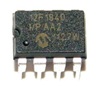
This project really has gone through a lot of iterations, for reasons of "I realized you can't do that", "I realized I can't do that", and most recently, "I realized they don't make those anymore." But I think I'm nearing a destination, even if it wasn't the one for which I originally planned.
I've been having a lot of fun with this lately. Besides a new and, I think, more elegant implementation of the ADB protocol, I now have a system that is actually working with parts that are still manufactured and are even in stock at DigiKey as of the time of this writing.
Here it is, with a useless but cute bit of HyperCard pixel art:
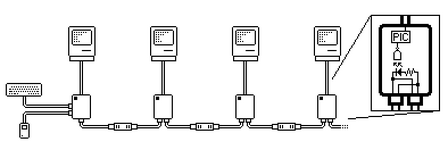
The main unit connects to an ADB Mac and a PS/2 keyboard and mouse. It also drives a current loop which can connect to a number (14, currently) of optoisolated downstream units powered by the Macs to which they connect. The main unit can switch between controlling any of the downstream units via a key combination. Because the downstream units are powered by their host Macs, I don't think powering them up remotely is possible.
Currently the downstream units only drive ADB Macs, but there's no reason one can't be made to drive a phone-cord-keyboard/quadrature-mouse Mac, or indeed a PC.
Unfortunately, I can't go through with my earlier idea of using the inner pair of a PhoneNet network - the signals aren't differential and they can't be reversed. I think instead I'll use RCA cables, I have a lot of those lying around and other people probably do too...
I've got this working on a breadboard; next stop, PCBs.
I've been having a lot of fun with this lately. Besides a new and, I think, more elegant implementation of the ADB protocol, I now have a system that is actually working with parts that are still manufactured and are even in stock at DigiKey as of the time of this writing.
Here it is, with a useless but cute bit of HyperCard pixel art:
The main unit connects to an ADB Mac and a PS/2 keyboard and mouse. It also drives a current loop which can connect to a number (14, currently) of optoisolated downstream units powered by the Macs to which they connect. The main unit can switch between controlling any of the downstream units via a key combination. Because the downstream units are powered by their host Macs, I don't think powering them up remotely is possible.
Currently the downstream units only drive ADB Macs, but there's no reason one can't be made to drive a phone-cord-keyboard/quadrature-mouse Mac, or indeed a PC.
Unfortunately, I can't go through with my earlier idea of using the inner pair of a PhoneNet network - the signals aren't differential and they can't be reversed. I think instead I'll use RCA cables, I have a lot of those lying around and other people probably do too...
I've got this working on a breadboard; next stop, PCBs.







