


Studio Session by Bogas Productions (1986)

Mu0n

6502
I uploaded a bunch of videos to increase awareness of this ancient, but capable piece of music software all the way from 1986: Studio Session Music System from Bogas Productions. Ed Bogas is the composer who made these quirky, charming music "vignettes" which showcased the software's ability to deal with many genres of music (jazz, rock, synth, classical, etc.), At 77, it's unclear whether he's still active, though he has a website: http://www.ebogas.com/who.html and a wikipedia page: https://en.wikipedia.org/wiki/Ed_Bogas

Studio Session made use of the free wave form capabilities of the Sound Driver, the piece of OS which predated the Sound Manager. What made it extra special was that it could play up to 6 instruments at once, beating the standard capability of the Macintosh, which could play only 4 wave forms. Perhaps the sounds were pre-mixed together in memory as they were being played back.
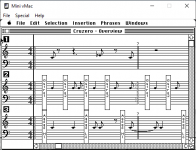
image.png

Studio Session is a sort of programming obsession of mine. It's a perfect gateway technology which can allow the writing of game intro tunes by leveraging this specialty software, without having to recreate a music playing engine from scratch. However, the challenge is to load a Studio Session music composition file, as well as the instrument files, which are played back at various speeds in order to imitate all the frequencies of the notes you want. I'll make a thread in the Hacking section soon about this as a sort of challenge beacon to this.

For now, enjoy these video captures I made on youtube of all the songs that came with them:


Last edited by a moderator:
Thanks for sharing this! What a beautiful user interface and the tunes are really captivating.

 
Thanks @Mu0n as you know I love this old program.  That Player GUI was something special in its day, as was the combination of multiple sampled tracks of digitized waveforms.  As a young kid upgrading from MusicWorks (four tracks of fixed waveforms using the Mac’s four-wave synthesizer) to Studio Session (six tracks of arbitrary digitized sounds with this gorgeous GUI) blew my mind.  A few years later Bogas released Super Studio Session which added two more tracks (total of 8).  Unfortunately they didn’t update the Player to show tracks 7 and 8, maybe because the UI was too perfect the way it was, or maybe because it wouldn’t fit on the disks anymore. :)  

 
I was too used to how the tunes sounded in Studio Session to appreciate their 8 track versions, revised instrument sound files at 22 kHz instead of the original 11 kHz. Don't get me wrong, Super Studio Session is also fantastic, but since it can't run at full power on a Mac Plus, it lacks the nostalgia factor of the original. If I can reverse engineer the original SS format, it seems like it could be trivial to also do SSS.

 
Hi Guys, I was a co-developer of on Studio Session with Steve Capps, Neil Cormia, Nick Borelli and our musical leader Ed Bogas. I am the one who took the sound driver guts and deployed it inside Tetris and F-16 both from Spectrum Holobyte. We also created Jam Session which was the interactive game versions that eventually went into toys made by World of Wonder.

Due to our affiliation with Capp, we has early access to the Macintosh and got ahold of the C compiler that made on Mac development possible (we couldn't afford a LISA). Studio Session was written on floppy drives (no hard drives for a year into the project) Ed Bogas was a successful composer (Peanuts, Fritz the Cat) and jingle writer and he fancied getting into the Mac software business and he funded the project. Capps left the Mac team when Jobs was fired and moved to Paris. So Studio Session was finished through collaboration on 1200 baud modems and floppy's sent by mail

Unfortunately, I don't have any of the documentation of the file formats as this was being done in 1983-1986 when I was in my early 20's. Steve Capps eventually took over the code base after I went off to work for Pixar and created Super Studio Session.

Excited to see people thinking about this great product which was kind of an 8 channel early sampler. This software was used by Herbie Hancock, Tod Rundgren, The Residents and other artists to create music. The Residents became long time friends and made many projects with me over the years.

Later I worked on creating music video digitizer for QuickTime, Later, I turned that into music album based CD-ROM's and eventually ended up working with David Bowie. Todd Rundgren, Primus and more. www.tyrobertsinnovation.com
 
Due to our affiliation with Capp, we had early access to the Macintosh and got ahold of the C compiler that made on Mac development possible (we couldn't afford a LISA). Studio Session was written on floppy drives (no hard drives for a year into the project) <snip>

Unfortunately, I don't have any of the documentation of the file formats as this was being done in 1983-1986<snip>
It's a real privilege to hear from you. You might regret the number of questions this prompts me to ask, but here goes: Firstly, are you saying that the 'C' compiler was Hippo 'C' or Consulair (or something else)? Secondly, why wouldn't it have been possible to develop with MDS or MacASM as they did run on a Mac? Thirdly, you said you only had Floppy drives, does that mean you had at least 2 floppy drives per Mac, or even just one? Finally, did you develop on Fat Mac 512Ks (my guess yes, given the 'C' compiler) or were you able to start with Mac 128s?

Thanks in advance if you read this and respond.
 
Consulair C was a superset of MDS, bundling those apps together with the C compiler. If Ty is saying that they got early access to the C compiler that made (high-level) Mac development possible, that very likely means Consulair C.
 
What's MDS?
MacASM is an assembler? Developing in a higher level language such as C or Pascal is probable preferable.
Yves Lempereur wrote MacASM, an integrated editor/macro assembler. It was the first self-hosted Mac Development environment and it's tiny, about 25kB. Its integrated environment is un-Mac, instead like editing BASIC on a Commodore 64, complete with line numbers, a BASIC style command line. OTOH it has full library access to . I used it to write the assembler version of a Morse Code app with it.


But yes, a HLL is going to be more productive. I'm always a bit surprised 'C' was first, given that Pascal was used for the Lisa & for much of the first Mac apps. But I guess it was the availability of PCC that gave 'C' an advantage.

Anyway, back to StudioSession! Given how much CPU is used to generate 4-voice samoled waveforms, writing any usable app on top of that is impressive, as our attempts with the Mod tracker showed.
 
Excited to see people thinking about this great product which was kind of an 8 channel early sampler. This software was used by Herbie Hancock, Tod Rundgren, The Residents and other artists to create music. The Residents became long time friends and made many projects with me over the years.
What did Rundgren do with it?
 
Back
Top

