



I've been troubleshooting my IIfx board erratically behaving in power on/power off...
I noticed that the leaking of acid solution from aluminum decoupling capacitors (C9 and C24 were the only in my board) leads to a "lower than ideal" resistance between +5 and ground (nearly 10 ohm in my strange behaving board).
The shunt of current towards ground mesh, especially when batteries are "tired", means lower voltage (the voltage spike we can read with the multimeter when we press Power button) between the "white cable" in the supply connector and ground (the ones we use for jumpstarting).
Therefore the power supply behaves not reacting or erratically reacting to power button (either power on either power off) and keyboard button.
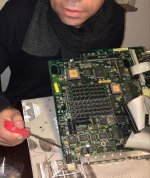
Comparing and measuring several Macintosh II family motherboards which i restored (replacing caps, restoring traces) it seems that 16 ohm value (between +5 and Ground) is the common endpoint for a flawless power on/off as long as there are fresh batteries and not broken/corroded traces.
View attachment VID_20190223_190321.mp4
I noticed that the leaking of acid solution from aluminum decoupling capacitors (C9 and C24 were the only in my board) leads to a "lower than ideal" resistance between +5 and ground (nearly 10 ohm in my strange behaving board).
The shunt of current towards ground mesh, especially when batteries are "tired", means lower voltage (the voltage spike we can read with the multimeter when we press Power button) between the "white cable" in the supply connector and ground (the ones we use for jumpstarting).
Therefore the power supply behaves not reacting or erratically reacting to power button (either power on either power off) and keyboard button.
Comparing and measuring several Macintosh II family motherboards which i restored (replacing caps, restoring traces) it seems that 16 ohm value (between +5 and Ground) is the common endpoint for a flawless power on/off as long as there are fresh batteries and not broken/corroded traces.
View attachment VID_20190223_190321.mp4


