Troubleshooting something like this is not easily done; it is why you are not getting a whole lot of suggestions on how to proceed.
First off, the ARTMIX card. Do you have anyway to test it? Have you tested for shorts across the capacitors on that card? It would be the easiest of the two cards to troubleshoot, and you shouldn't rule it out. It needs to be verified firstly.
Following that,
As you suggest, the most likely candidate is SIZ0, but we can't dismiss that other pins received wrong voltages and are suspect as well. If you look in the DCaDftMF under the IIci Cache slot descriptions, it also lists the load limits. Mostly in the µA - .x mA range. It also describes the function of the signals, including the CACHE signal. "CACHE, an active-high signal, disables the memory controller (MDU) so that it cannot start a memory cycle and allows the cache card to supply the data instead."
The main problem, most of these signals are processed by either the ASIC or the PALs-- or more likely, both. All are irreplaceable if damaged.
The programmable logic in the PALs are programmed at the time of manufacture, and unless you have the JEDEC fusemap, they are realistically impossible to recreate without a working card, a logic analyzer, a good knowledge of the function of the pin you are decoding, and a whole lot of time.
But a funny thing, I search up "VY14676-2" (the ASIC) into Google, and there are several "part suppliers" that show this part in stock, and even manufactured by Daystar. Of course, no way to tell the validity, or if these are Chinese scammers. But if the cost is only a few dollars (no, I did not price them), perhaps worth a try?
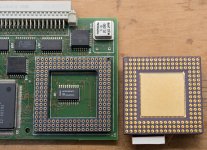
If this were my card, I'd have to limit my troubleshooting to something I could repair. In this case, a component tester on all the commodity parts (hot air removal) to check if they are good. Check the resistors and capacitors on the back. (boring, and a goose chase most likely, I know). Replace the CPU with a good one, and as a last resort, try one of those ASICs if cost allows.
I have a second card, so I could also check for burned internal traces. Choose a signal pin on the CPU socket (these are known by looking at the CPU pinout) and see where it goes and verify on the bad card. Do the same with the signals on the cache slot connector. Of course, with schematics, this process would be infinitely easier. If a burned internal trace is found, repair with a bodge wire.
I wish the best of luck, and so sorry this has happened!






 f:0
f:0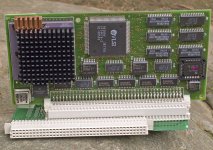




 (I don't know if none of you know the answer or if you simply failed to see my question.)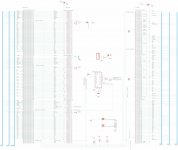
 i feel for you


