• Hello MLAers! We've re-enabled auto-approval for accounts. If you are still waiting on account approval, please check this thread for more information.

SE/30 Grayscale Project: 640x480 @4 bit or 8bit

Trash80toHP_Mini

NIGHT STALKER
68040
I think I've got VidCard development a hair less "out of control as usual" for my impossible dreams. Need to know if the analog end of things can be torqued to drive a crazy custom grayscale adapter?

Grayscale converter requirements:

Resolution:

640x480

Frequencies:

--35Hz Horizontal

--67Hz Vertical

Can it be done?

 
Would the limiting factor be the yoke, one of the connections to the A/B or both? Workarounds?

Mobo video would be disabled by removal of the Video ROM if that would be any help.

This would be a flat out replacement of onboard video.

No need for the overly complicated setup of the Micron Xceed card's external/internal tomfoolery.

 
Last edited by a moderator:
VidCard could be tweaked as well:

Rebuilding a Macintosh II "Toby" Display Card donor:

Why the Toby?

- it's as simple a frame buffer card as it gets

- 99% discrete or DIP components that are easily harvested if ©Apple/replaced with SMT versions of stock CMOSS/LS DIP ICs

- only remaining component is a socketed PGA ASIC!

- DeclROM on board

- drivers by Apple

- crystal cans and RAMDAC easily modified/replaced to better match GS converter input requirements

- multilayer PCBs and design tools now within reach of mere mortals

Procedures:

- schematic development of Toby to enable:

--- removal of NuBus MUX

--- replacement with 030 PDS buffer/line driver setup

--- replacement of space hogging low density DIP memory with an easily sourced, higher density SMT memory configuration

--- addition of SlotID header setup for SE/30's 030 PDS requirements

PCB would be enlarged DiiMO form factor with PDS passthru for horizontal NIC and joetheaombie's DayStar adapter GAL clone.

Possible implementation of a second passthru slot for remaining interrupt?

DIP components could be aligned vertically with layout "backwards" placing PGA ASIC's thruholes out of the way on the rear of the card enabling easier routing of passthru traces.

Dunno, what do you analog/CRT boffins think of this latest crazy notion? [:D] ]'>

 
Last edited by a moderator:
I vaguely remember some guy driving the CRT with a homemade video adapter connected to a Pi or some other ARM type computer via USB. Entering search mode...

 
Interesting research linkage there! Seems like most everything he hacked from the VESA Feature Connector can be implemented in the DAC section of my proposed "revision" of the Toby card. [}:)] ]'>

n00b here, waiting for tk and G to chime in with the roadblocks. :-/

 
Interesting timing. I did some experiments on SE/30 screen resolution a year or so back, but I'm just about to revisit the topic:

https://68kmla.org/forums/index.php?/topic/26313-compact-mac-retina-display/

The limiting factor is the horizontal scan rate, which is 22kHz on all the compacts and is very sensitive to even slight changes. As I found in those experiments, increase the scan rate by more than a few percent and all the flyback secondary voltages start to drop significantly. 

In principle the flyback circuitry could be changed to run at higher frequency, but what I found is that the internal parasitic capacitance of the flyback transformer itself means that the horizontal retrace period basically can't run any faster than it already does. In other words, with the flyback transformer that's on the SE/30 and earlier Macs, there's just no way to run the whole circuit fast enough to reach VGA resolution.

What I tried in the thread above was to build a second partial analog board circuit: one to run just the flyback with a dummy load in place of the yoke, another to drive the yoke without a flyback. It does work, after a fashion, but the video quality is limited by interference patterns between the two frequencies. That was about as far as I got at the time.

But this week I got my hands on a late 1991 Classic. The later Classics and the Classic II have a totally different analog board to all the previous compacts, including a different flyback model. I'm going to see if this one is any more flexible than the earlier model at running at higher frequencies. But first I need to do a full recap, because the power supply and logic boards are both in terrible shape!

As for the grayscale part, the circuit for the Xceed CRT board is out there somewhere, and could presumably work in this project too. It's the resolution that's the harder part.

 
yea, your stuck at using 512x342. 

You may be able to use the more common version 512x384 as the LC monitors did, and it MAY work. 

 
Just made a useful discovery! Here are some photos of one of those 9" (S)VGA monitors that I bought off eBay a while back:

https://68kmla.org/forums/index.php?/topic/26313-compact-mac-retina-display/page-2&do=findComment&comment=279984

Notice the marking on the flyback in that monitor: MTI-LTM-002, E58491

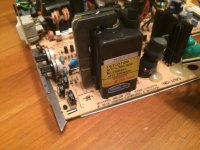
Now here's the flyback in the late-model Classic I just got:

IMG_5024.jpg

Same part! So (1) we can be sure that the flyback is capable of being driven at a higher horizontal frequency, and (2) there's now a working circuit to compare it to. I'd say the odds of success look considerably higher than before.

 
Very nice discovery. Forgot about your threads, great stuff! Waaaaay over my head, but fun to try to follow. :approve:

edit: just found the DataSheet for the Toby's Bt453 RAMDAC if it's of help to anyone.

 
Last edited by a moderator:
Not all classics have that particular flyback either. I had seen a couple that had the older style flyback. I guess it depends on the model year they were made? 

 
Interesting timing. I did some experiments on SE/30 screen resolution a year or so back, but I'm just about to revisit the topic:

https://68kmla.org/forums/index.php?/topic/26313-compact-mac-retina-display/

The limiting factor is the horizontal scan rate, which is 22kHz on all the compacts and is very sensitive to even slight changes. As I found in those experiments, increase the scan rate by more than a few percent and all the flyback secondary voltages start to drop significantly. 

In principle the flyback circuitry could be changed to run at higher frequency, but what I found is that the internal parasitic capacitance of the flyback transformer itself means that the horizontal retrace period basically can't run any faster than it already does. In other words, with the flyback transformer that's on the SE/30 and earlier Macs, there's just no way to run the whole circuit fast enough to reach VGA resolution.

What I tried in the thread above was to build a second partial analog board circuit: one to run just the flyback with a dummy load in place of the yoke, another to drive the yoke without a flyback. It does work, after a fashion, but the video quality is limited by interference patterns between the two frequencies. That was about as far as I got at the time.

But this week I got my hands on a late 1991 Classic. The later Classics and the Classic II have a totally different analog board to all the previous compacts, including a different flyback model. I'm going to see if this one is any more flexible than the earlier model at running at higher frequencies. But first I need to do a full recap, because the power supply and logic boards are both in terrible shape!

As for the grayscale part, the circuit for the Xceed CRT board is out there somewhere, and could presumably work in this project too. It's the resolution that's the harder part.
IMHO I think the flyback in the 128/512/plus/se/se30 is designed for NTSC 15Khz line frequency, and Apple is pushing it over as it is, thats probably why the 512x342 was a limit at the time. But again I am speculating. I have seen these flybacks used in older 9" CCTV monitors which is why I come up with this theory. 

 
Not all classics have that particular flyback either. I had seen a couple that had the older style flyback. I guess it depends on the model year they were made? 
Yeah, it appears the switch was sometime in 1991. There's a thread about it here somewhere. All the Classic IIs have the newer flyback (which also has a totally different analog board circuit), and some of the later Classics do. The older ones have essentially the same horizontal circuit as the earlier compacts.

I found this particular Classic on eBay with a 1991 week 45 serial number plus what looks to be a Classic II rear bucket with the audio in port covered, so it was a pretty good bet that there would be the newer analog board inside.

 
Yeah, it appears the switch was sometime in 1991. There's a thread about it here somewhere. All the Classic IIs have the newer flyback (which also has a totally different analog board circuit), and some of the later Classics do. The older ones have essentially the same horizontal circuit as the earlier compacts.

I found this particular Classic on eBay with a 1991 week 45 serial number plus what looks to be a Classic II rear bucket with the audio in port covered, so it was a pretty good bet that there would be the newer analog board inside.
Andrew I've got 4 Classics arriving into London today... so we can see if any of those contain what you need. I also remember that I disassembled a Classic II many years ago for a hack project, which I both regret and was quite fun at the time. I think I the flyback may still be inside it and not needed. There's chance it did get chucked out. It's also still in storage but when I get everything back out I can check :)

 
It appears I spoke too soon about the flybacks being the same. Having desoldered the flyback from the VGA monitor and tested the various winding resistances, there's no question that it is pinned out differently than the one on the Classic.

A bit more digging reveals that the marking "E58491" appears to relate to the RU (safety) certification, not the part number. Several different Meritron flybacks I found online have the same code, and conversely, here's a thread with another Meritron flyback model in a Classic II which has the same Apple part number (157-0129) but a different RU code, and a visibly different shape. The marking MTI-LTM-002 may refer to something more general about the flyback, maybe its pinout, rather than anything about the windings.

But of course, none of that means the frequency changing can't work, just that the circuit in the other monitor isn't necessarily a direct reference for how to do it.

 
Very nice discovery. Forgot about your threads, great stuff! Waaaaay over my head, but fun to try to follow. :approve:

edit: just found the DataSheet for the Toby's Bt453 RAMDAC if it's of help to anyone.
I think that the THS8135, THS8136 and THS8200 are good choices for a RAMDAC.  They are available from Digi-Key for $7 - $10 and the manufacturer is TI.   My only doubt on this score is that there's a tech note about building an analog reconstruction filter for television applications, suggesting that these are not complete RAMDACs (I would assume that a fully integrated RAMDAC would contain the required filters).

http://www.ti.com/general/docs/litabsmultiplefilelist.tsp?literatureNumber=slaa135

They may be a bit overcapable for these projects, but they have a lot of interesting features.  And most important, they are current, available parts.

 
Last edited by a moderator:
Using available parts for a brand new design would be very cool, but I can't wrap my head around driver development for such a project. That's why I'm looking at rebuilding the Toby, Apple did all the hard stuff 30 years ago and it's all sitting right there on the card's DeclROM.

Multiplexing its 640x480 output for reassembly on the neck board to scattershot the gun within the tolerances of the A/B has been simmering on the backburner and a couple of possible approaches to the GS adapter's MUX are nagging at imagination.

Does "adjusting" of the SE/30's image to a less than a properly adjusted 72 DPI resolution (filling more of the CRT's active area) stress the A/B?

 
Back
Top