
-
 Hello Guest! We're hosting a challenge to welcome vintage Intel macs to the MLA during the month of July! See this thread for more information.
 -
We've made some quality of life improvements to the Trading Post. More info here.
You are using an out of date browser. It may not display this or other websites correctly.
You should upgrade or use an alternative browser.
You should upgrade or use an alternative browser.
Reverse Engineering the Macintosh SE PCB & Custom Chips for 1:1 reproduction
- Thread starter Kai Robinson
- Start date

Porchy has worked some magic and behold - a .JED for the GLU!! A Proper fuse map! 
Is anyone in a position to test this aside from me?
View attachment apple1.jed
Is anyone in a position to test this aside from me?
View attachment apple1.jed


Porchy has worked some magic and behold - a .JED for the GLU!! A Proper fuse map!
That was an impressively quick turnaround!
I know! I'm unreasonably excited for this nowThat was an impressively quick turnaround!


Nope, Guide to the Macintosh Family Hardware Second Edition is the book @quorten was referencing and it's available on vintageapple.org already. Got that one new off the shelf in the day, it's the 1990 update to the three part series. Technical Introduction to the Macintosh Family is the first book on the map and may suffice
Macintosh Family Hardware Reference has (more or different?) info for the SE and Mac II, that's assumed to be understood in GttMFH2e. So MFHR is the one to search for in .PDF out in the wilds. Unfortunately abebooks is sold out, but you might find a hard copy at a reasonable price somewhere else.
- ISBN-10 : 0201192551
- ISBN-13 : 978-0201192551
- Publisher : Addison-Wesley Pub. Co; 2nd edition (January 1, 1988)
edit: found one: used copy for $28.32

Last edited by a moderator:
Only $254...
LOL! Gotta love the listed prices for new books And that only gets you the paperback version! Click on the 7 used from $25 link to get over the sticker shock. [ ]
]
I'm wondering if the selling of "new" books on Amazon angle is a faster, safer path to laundered money than the usual eBay schtick?
] I'm wondering if the selling of "new" books on Amazon angle is a faster, safer path to laundered money than the usual eBay schtick?



Definitely +1 for AbeBooks, looked there first yesterday and search reported the title was sold out. Didn't know Amazon owned them or I'd have been more hesitant to use them in the past. Finally got past my hatred of Amazon, now it's just skin-crawly when I buy from there.
This time a couple of Amazon prices are lower:
https://www.amazon.com/gp/offer-listing/0201192551/ref=tmm_pap_used_olp_0?ie=UTF8&condition=used
This time a couple of Amazon prices are lower:
https://www.amazon.com/gp/offer-listing/0201192551/ref=tmm_pap_used_olp_0?ie=UTF8&condition=used
Okay, it's done...
See pics for details!
No boot, but a checkerboard again at least...
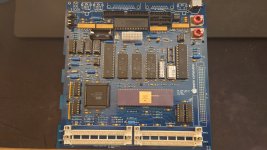
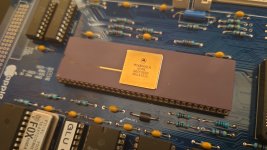
See pics for details!
No boot, but a checkerboard again at least...
Last edited by a moderator:
Well done! I'm lagging significantly behind you, I fear... but most of mine is done too, so I will hopefully join you in checkerboard land shortly

Nice!
that looks like uninitialized RAM, so the CPU isnt starting up for some reason.
Wonder if theres another address/data line that was missed or unconnected.
that looks like uninitialized RAM, so the CPU isnt starting up for some reason.
Wonder if theres another address/data line that was missed or unconnected.
I just checked the test points for voltages - instead of reading +5v, it's reading +7.5v!!!
I think my analog board has potentially killed some chips...
I think my analog board has potentially killed some chips...

I'm thinking my analogue board is potentially in need of repair as well - seeing as the video is very off centre as well as being wonky...voltages are something i'll have to measure....if only i had an extension cable to be able to test this flat on a bench! Anyone make one at all?
Similar threads

- Replies
- 44
- Views
- 3K


