Fill them with deoxitBut installing another set of known-working 4x4MB SIMMs in

Another thing I do is wiggle the RAM a load before pushing it the last little bit to latch it, to try and clean the points on the contacts.


Fill them with deoxitBut installing another set of known-working 4x4MB SIMMs in

I'd check the power switch contacts and deox if required.The power button is a latching design. Try rotating it.
Although... Hum. You say it behaves after that? I'd expect it to repower up anytime you shut down if that was the issue. Weird.
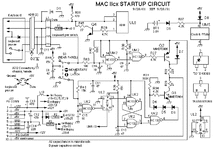
Perhaps an issue in the soft power circuit then.
Shouldn't be, I've built the same one as BMOW is using and it doesn't do that. All it does is invert the polarity of the soft power signal.And does the cold-start power-on happen with a Mac PSU? It may be a quirk of your ATX PSU plus adapter.

Cleaning and lubricating generally gets them quiet again.Has anyone ever tried replacing the fan in a stock IIcx/IIci PSU? Mine is pretty loud.
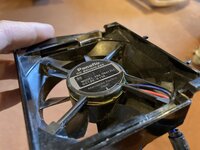
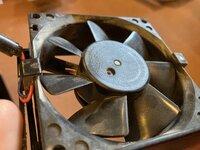
You peel back that sticker and its underneath there that you want to put a few drops of oil in.how does one get access to the fan bearing to lubricate it?
There is often access under the sticker. Try not to get oil on the sticker or it won't stick.This may be a dumb question, but how does one get access to the fan bearing to lubricate it? Do you drip oil into the gap surrounding the hub, or is there a way to disassemble the fan and remove the blades?
Has the cap lost capacity. Or has the resistor lost resistance? Did you check for shorts as well as breaks?But my IIcx turns on within about 0.5 seconds of plugging it in or flipping the switch on the ATX supply. That should be impossible. So this points to a problem with C9, R30, or the connections between them and the NAND gate. But I've checked all those and they're OK.
First thing is to desolder, clean and resolder it. The cap juice can create high resistance or dry joints on chips.My guess here is that UM2 is bad.

Interesting... thanks! How do you use them? Do you apply your soldering iron to the needle, or to the rim of the pad?I find a bit of twisting motion on them while you push and heat with the iron works wonders.

It’s a little tricky to pull off but I’ve found for me that using the iron on one side of the board and the little pusher on the other side pushing through to the iron works best. Worth a try if you just can’t get that battery holder cleared.Interesting... thanks! How do you use them? Do you apply your soldering iron to the needle, or to the rim of the pad?
An alternative I've used dozens of times is a dental probe. A fine and rigid stainless steel tip chases solder out of through holes easily. Heat should be applied to both hole and probe.Highly recommend picking some of these up for those pesky through hole pins that seem to be able to suck up stupid amounts of heat and still not clear. Game changer for me with them… very cheap too. I find a bit of twisting motion on them while you push and heat with the iron works wonders. HiLetgo 3 Lot Mixed Stainless Steel Non-stick Tin Hollow Core Needle Kits for Soldering Assist Accessories https://a.co/d/8ZqOLc3
When I was recapping my Mac II I got super frustrated until I found those.