• Hello MLAers! We've re-enabled auto-approval for accounts. If you are still waiting on account approval, please check this thread for more information.

ProtoCache1 - IIsi/SE/30 PowerCache Adapter Prototype Development

Dunno what voltages are on the four pin ATX mobo connector extension offhand, but if one is 5V, that female or a PCB connector for FDD or SATA(?) ought to be easily sourced for the PowerCache Adapter.
There's +12 and +5.  I love tinkering with hardware, but I'm definitely not an electrical engineer.  Putting a supplemental power input on the ProtoCache is an excellent idea (i'm already experiencing low voltage just by using my logic board extension cable to keep the SE30 board powered out on the bench), but I'm curious how we would do it.  There is +5V power mux available with the TI TPS2115 which can handle 2A.  (the PDS30 power budget is 1.5A). That's easy enough if we had just 1 +5V line.  But the CACHE has 9 individual +5V pins, and the PDS30 has 7 pins.  I understand they are all tied together, but I don't know how to integrate the mux and connect to all those lines to it.  Would you use just a really thick trace to connect them all to the IN1 PIN, then a large trace to connect the supplemental to IN2 PIN, then a thick trace from OUT which branches to the 9 CACHE pins and 7 THRU pins?

 
.  .  the CACHE has 9 individual +5V pins, and the PDS30 has 7 pins.  I understand they are all tied together, but I don't know how to integrate the mux and connect to all those lines to it.  Would you use just a really thick trace to connect them all to the IN1 PIN, then a large trace to connect the supplemental to IN2 PIN, then a thick trace from OUT which branches to the 9 CACHE pins and 7 THRU pins?
As I understand it, all 5v pins make their connections to the sub-surface power plane. So distribution shouldn't be a problem.

Leave the SE/30's PDS pins unconnected to the power plane and you're good to go for aux power from the adapter's connector to the power plane.

Dunno how steady the 5V supply would be on that Molex cable splitter, might need to add a capacitor/whatever to even out the feed. As I understand it, power's distributed through the PDS slots to make it handy at several points on the expansion card's PCB? Haven't traced them all, but a good number of connections appear to feed caps for further distribution to ICs across the card. My WAG would be that they all do something like that, whatever that is..

What's the power budget for the HDD? If it's not high enough on its own, it should be easy enough to just split the power plane. Run the PowerCache connector on the 1.5A available on the PDS30 pins and power only the passthru slots from the splitter cable.

Is your cable length a problem? Dunno, I thought length didn't matter. If you're runnin' on empty, I would think that pretty much confirms my WAG that nobody provided a second PDS passthru on their adapter due to power budget provisions for PDS expansion.

Is there a resistor/whatever that physically limits the PDS to 1.5A, no clue here about how this stuff actually works.

I'm not even half awake yet, so corrections/suggestions from the Power & Ground boffins would be greatly appreciated here! :approve:

 
Last edited by a moderator:
Small update, hopefully some results this Labor Day weekend. Finally some time to play!

I have two fuse maps to try out. 1st, mine based on the equations i found in dcadftmf3e. i have two versions as the wording is a bit strange concerning RESET. And 2nd, Porchy, one of the PLD experts over at jammarcade.net has graciously sent over his own analysis of my dump. I think we’ll have a working clone of the PAL soon. Now, to design the card...

 
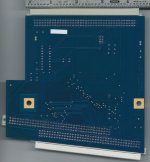
DiiMO-Artmix-form-factor.JPG

I'm beginning to think about board form factors and PCB layout again. I've got the rough form factor of the DiiMO/Artmix now to work from, but it'll need to be changed quite a bit if we're to make provision for a second passthru slot.

Comments on design choices would be most welcome:

1) Cubic requirements for the proposed second PDS card:

_____ removal of the HDD cage

__________ if installing a second PDS card, a SCSI2SD or low profile server drive is assumed

_____ historical correctness available per vertical HDD installation at rear of bucket

__________  OEM's spinning rust in 512K-Plus internal HDD upgrade precedent

__________ there are several versions available for reference design
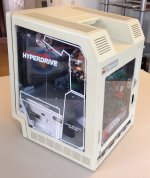
HyperDrive.JPG

3) Position of second PDS passthru connector/card

_____ I'm thinking the PowerCache would be moved as high as practical

_____ second PDS connector would be located underneath within top portion of HDD cubic

__________ SCSI2SD mounted atop FDD cage in lower portion of HDD cubic

Does anyone have any problems with these scenarios?

3) Power/cooling budget considerations:

_____ there isn't enough of either, there's barely enough to run accelerator and a single PDS card

__________ ATX conversion within PSU can assumed

_____ historical correctness available per SCSI adapter/HDD install as documented in another thread

__________aux. PSU occupied cubic between FDD cage and A/B

__________don't have the link handy, help there would be appreciated in posting poic

4) IIsi version requirement

_____ as is, the DiiMO/Artmix form factor is an angled/extended version of the IIsi TwinSlot Adapter

__________PCB layout should follow that precedent

_______________ possible complication would height of top PDS passthru

By leaving the second (bottom) PDS passthru connector unimplemented, the HDD cage cubic remains untouched, however the top (vertically oriented) PDS would be higher than in reference designs. I don't think that should be a problem, please let me know if it is.

_____ NIC/GS vidcard stack doesn't fit anyway

_____ are there any card combinations that might be problematic?

If/when zomb's got the PAL clone in hand, we'll need an expert PCB designer for the multilayer board to step in. Volunteers?

edit: forgot to ask if there would be any electrical interference complications involved in moving the PowerCache a bit closer to the CRT?


 
Dear Trash,

I believe your creation of the vertical "SideCard" was brilliant, particularly the one set off at 90 degrees to PDS slot. If positioned correctly it would fit into the chassis air vent slot and permit full length boards. I originally thought you were doing that for NuBus cards. Whatever. It is not just a Rube Goldberg idea and don't give up its development.

I'm not a Thermodynamic engineer but I believe all heat sinks should face the open volume of the bucket with the hottest components the highest, with a small fan below pushing upward or above sucking upward or both if needed.

Yeah, the atx psu is unavoidable, new boards, fans, SSD RAIDs, probably electrical cooling and PSI slots next year. :)

Keep up the good work and don't get discouraged. You are doing what a lot of can't do.

Peace

TPope

 
Thanks for your kind note, your encouragement here is much appreciated.

The vertical adapter card work I did was merely a riff on badgoldeagle's project, so credit for that goes to him. At any rate, toledogeek's Cheap, Quick and Dirty flexable SE/30 PDS extender pretty much solves that particular problem when no PowerCache is involved.

There's probably no solution for fitting a full length NuBus card within the SE/30 bucket, but you just inspired me to take a look at the case extension I have in the works for the neck of my 10" CRT hack. It looks like a full length NuBus card might just fit! Anyway, that's neither here nor there, memory addressing complications for your NuBus in SE/30 proposal appear to put the kaibosh on using the IIsi adapter approach. There is some hope remaining for putting my pair of NuBus cards in the SE/30, but it will involve building a customized NuBus adapter. Development of that will likely my next attempt to get a cooperative open source project off the ground. I need folks like zomb with the chops to step in and do the dirty work. I certainly don't have the kinds of expertise to do such things and am in no danger of developing them in this lifetime. Perseverance in keeping crazy notions alive would be my stock in trade. [:D] ]'>

That said, if/when the NuBus feature might be grafted onto this thread's adaptation, I won't need a full length card. The shorter JackHammer will suffice for my SSD RAID configured 50MHz PowerCache infused SE/30. [;)] ]'>

 
Last edited by a moderator:
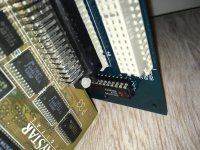
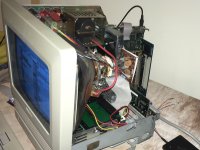
It's hard to see what's going on here, but the original MMI PAL16L8 has been replaced with a Lattice GAL16V8 containing a best-guess copy of the equations.

IMG_1407.jpg

IMG_1409.jpg

SUCCESS!

Initial benchmarks show the exact same speed tests in Speedometer.  I will need to run many more tests before I make the fusemap public.  I also need to try it in the IIsi.

 
So if this PAL clone works and you can burn copies, then you could (theoretically) make cost effective SE/30 & IIsi adapters?  Or at the very least offer an alternative to the Statros and official adapters?

 
That's exactly the point of the exercise. ;D It's a collaborative open source development project to be released under some non-commercial license or other. Details to be worked out.

Next iteration of the project will be a thread dedicated to noodling out form factors for several SE/30 implementation scenarios. We'll need someone who knows power line conditioning for the multiple passthru slot configurations during that phase.

IIsi is easier, the reference design's in zomb's hands right now. His incredible discovery of a readable PAL IC on that DayStar IIsi adapter appears to have put us on a very fast track toward completion. The si/30 twins are well in hand. The rest of the PowerCache adapter tree remains a challenge, but one we're working on.

After the form factor designs are tuned for production, we'll need a PCB design topic for developing a layout that's adaptable to those configurations. We'll definitely need an expert PCB designer to step up to the plate for that challenge.

Nowhere near done, incremental progress under way  .  .  .  the zombie just bit off one Big@$$ increment! :approve:

 
Last edited by a moderator:
Not sure about the licensing bit.. you still want to ensure it is worthwhile making them for sale - or none will get made.

Offering a PCB design on OSHpark would be a good start anyway.

There is a project for the amiga/atari st called the terriblefire 530 that has the right approach to all this (note: worth testing in a mac)

 
Looking into the licensing setup dougg3 released his ROM project under seems prudent. Not necessarily looking to get any money out of the project, though recovering costs of development would be nice. Joe and I have spent a not insignificant amout of money on this impossible dream after all.

A revocable licensing deal for production ought to be a feasible approach. Keeping the GAL's black magic closely held might be a good idea for enforcing that. Burned/security fuse blown GALs could also be made available to individuals and groups interested in making their own batches.or customized derivative designs.

As I said, the details need to be worked out, but there's plenty of time for that  .  .  .  if and when.

There's a company on eBay selling copies of the fruits of the labors of love developed by others for their own profit. That REALLY makes me angry, even if their products are derivative clones rather than direct copies. Can not let that happen to this project!!!! [}:)] ]'>

 
Last edited by a moderator:
Back
Top