Hi!
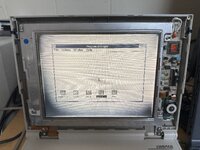
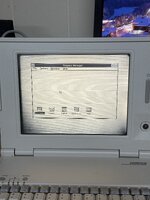
I'm currently struggling with the display of my Macintosh Portable M5120 (non-backlit model). Unfortunately, it has developed severe tunnel vision over time.
Here's what I've done and what I've observed:
I baked the display twice in an oven while precisely controlling the temperature. The first attempt was at 90–95C for 8 hours, and the second was at 98–104C. As a result, the screen became less dark and the blackening became more uniform, but unfortunately the main problem remained: after about 20 minutes, the display becomes so dark that almost nothing can be seen.
I then investigated whether this could be an electrical problem.
The Hosiden HLR1010-10-1101 is an active-matrix TFT LCD, so this display has several common bias voltages similar to those found in modern LCDs. Here's what I've discovered:
- The positive pixel voltage is always 5.1 V (the power rail supplied by the Macintosh).
- The "neutral" point shifts as the contrast is adjusted. This voltage is available at test point T7.
- The positive and negative pixel voltages are symmetrical with respect to the "neutral" point.
- VR1 and VR2 adjust the contrast (the neutral point) for the minimum and maximum contrast settings, respectively.
- VR3 adjusts VCOM (the voltage on VC BAR). Someone appears to have adjusted it previously, as the factory silicone seal was partially damaged. When returned to its factory position, VCOM is always 1.6 V below the "neutral" point. This offset is adjusted by VR3.
- VGH is approximately +12.1 V.
- VGL is approximately -9.5 V.
- For black pixels, the pixel voltage alternates between the positive and negative voltages on every column. For white pixels, the voltage remains at the "neutral" level. VCOM itself is not inverted and remains constant.
My first approach was to adjust VCOM to minimize flicker using a vertical striped test pattern. This worked initially, but the panel's operating point gradually drifted during use. The further I increased VCOM (moving it farther away from the "neutral" point), the faster this drift occurred.
At the maximum practical VCOM setting, the display produced a clean, crisp image with virtually no ghosting or burn-in. However, after switching the display off, the screen became unevenly black and only slowly returned to its normal state. Once fully relaxed, powering the display back on with that VCOM setting caused the screen to appear almost completely black. So this is clearly not the correct adjustment.
I then tried setting VCOM as close as possible to the neutral point. When the panel is not yet showing signs of tunnel vision, this setting appears to slow down the buildup of the effect as much as possible. After many experiments, I've come to the tentative conclusion that the factory adjustment (VCOM = T7 − 1.6 V) is probably the optimal setting.
My current theory is that either the TFT transistors have developed excessive leakage, or some form of charge accumulation is occurring within the liquid crystal material itself. When the display was new, polarization occurred much more slowly, within 24 houts as listed in Portable CDEV warning.
What I currently suspect is that if VCOM were inverted on every frame (similar to how the pixel voltages are inverted), this polarization might not occur. I'm planning to draw the VCOM supply schematic and investigate whether implementing frame-by-frame VCOM inversion would be feasible.
If anyone has any thoughts or experience with this issue, I'd really appreciate hearing your opinions.