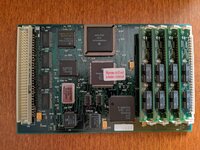
The board Phipli posted is the CPU dauterboard out of a PowerBook (170 I think). He was just showing the picture to illustrate that they eventually made MC versions of the 68030. It isn't the accelerator being discussed.Interesting board, strange connectors. What machine is it for, a PowerBook?
- has anyone identified a crystal on that board, I didn't see one right off?
- if no crystal's on board, then it's running on a system bus multiplier, which could be problematic.
Long term quest has been running the 68030/16Mhz Performer from my Drexel Plus at 32MHz. But such appears not to be feasible.
@Bolle has cloned it and tried hooking the 8MHz bus clock-doubling GAL to the 16MHz clock on the board. I'd hoped for success there for a very long time™, but timings appear to be too tight for it to work.
Markings appear to indicate 25MHz is a possibility, wondering about timing complications this case?
Oh ya...found an MC 030 on my LCII's accelerator:I might get the terminology wrong, but basically, from Motorola, engineering samples start with PC, then full production parts start with XC, until all the bugs are ironed out and when they are, the part is 'qualified' and they switch to MC. I think they are sort of saying there won't be any more functional changes.
PR68040RC25, XC68040RC25 and MC68040RC25, for example.
It lagged so much that Apple moved on before the 040s were ever qualified, so no mac came with an MC68040.

Heh.
At least they were apparently warrantying the overclockHeh.
Only reason that warranty void sticker is there is to hide that they overclocked some or all of their processors.
Oh ya...found an MC 030 on my LCII's accelerator:
That's what I thought as well from looking at the picture.I'm now thinking a more likely candidate is the flip-flop IC on the right of the crystal.
You mean on that LCII accelerator? Don't want to derail this thread about the MultiSpeed, but I never noticed the soldering on those resistors. I've never taken a soldering iron to it myself. I've also never definitively identified that accelerator. There aren't any identifying markings on it. It's the accelerator that was in the MicroMac Power Workstation I got from my dad, which was advertised to include a ThunderCache accelerator, which looks kind of similar, but not identical from the few pictures I've found. Given the vaporware-ish nature of the Power Workstation, maybe that accelerator is also some kind of prototype or something that explains the hand soldering? I dunno. I don't know the whole history of that machine. My dad can't remember if he already had the accelerator before adding the Power Workstation expansion or not.@KennyPowers How come there is so much hand soldering on your board? Did you take it apart? Did you remove all the resistors for some reason?Kenn
Strange. Yeah, the soldering doesn't look like it was done by someone used to doing surface mount soldering.You mean on that LCII accelerator? Don't want to derail this thread about the MultiSpeed, but I never noticed the soldering on those resistors. I've never taken a soldering iron to it myself. I've also never definitively identified that accelerator. There aren't any identifying markings on it. It's the accelerator that was in the MicroMac Power Workstation I got from my dad, which was advertised to include a ThunderCache accelerator, which looks kind of similar, but not identical from the few pictures I've found. Given the vaporware-ish nature of the Power Workstation, maybe that accelerator is also some kind of prototype or something that explains the hand soldering? I dunno. I don't know the whole history of that machine. My dad can't remember if he already had the accelerator before adding the Power Workstation expansion or not.
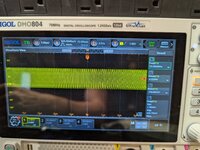
You are correct. I had my SE with MultiSpeed apart today and I took a look at it. My MultiSpeed has a 50Mhz oscillator. The output pin of that flip-flop is connected directly to the clock pins on the CPU and FPU. As you can see, the flip-flop is halving the oscillator's frequency:I'm now thinking a more likely candidate is the flip-flop IC on the right of the crystal. I think the only way to know for sure is to get a high-res photo of a 33Mhz board (per @avadondragon suggestion), and specifically the area around the oscillator. If anybody has one and is willing to post a pic, that would be awesome!