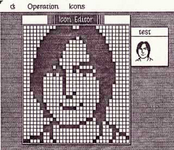
https://axio.ms//projects/2024/06/16/MicroMac.html
Just discovered this, am kind of surprised that no one (including it's creator) has mentioned it here.
Cute, but ultimately kind of a dead end. The Pi Pico 2 that's out now probably has enough extra oomph to just run Mini vMac.
Neither of them would be fast enough to emulate a Mac using Mini VMac. The author of that Micro Mac uses a 68000 emulator written in 'C', which is probably as fast as them, perhaps faster and he had to overclock the RP2040 PICO to about 250MHz.
From the blogpost:
One problem though: it totally sucked. It was suuuuper slow. I added a 1Hz dump of instruction count, and it was doing about 300 KIPS... I didn’t say I wasn’t gonna cheat: let’s run that Pico at 250MHz instead of 125MHz. Okay better, but not 2x better. From memory, only about 30% better. Damn, no free lunch today.
He had to apply a whole bunch of other tricks, including running parts of the emulator in RAM and eventually got up to 1.4MIPS.
But I am working on a Cortex M0+ (as on the RP2040) based 68000 emulator, in assembler which I already
know will achieve at least the same performance of an original Mac, at 125MHz. And the basic reason is that it will fit entirely in the RP2040's 16kB XIP Flash cache. The worst instructions, which are
move.w rs,rd instructions will be a bit faster (a few %), but more complex instructions will be increasingly faster, as the decoding overhead goes down. So, ALU, JMP, JSR instructions are faster and instructions that read memory addresses are increasingly faster.
And I already have the RP2040's successor, a PICO 2, running at 150MHz. It has 524kB of RAM (520kB, but you can use the USB endpoint RAM too). This means it can emulate a proper 512kB Fat Mac from 1985!
There's a thread here, discussing the emulator above:
(Apologies if there is already another thread on this topic. A quick search didn't reveal any...) Apple's Macintosh 128K on a Pi Pico gets thumbs-up from Upton Just because you could definitely means you should Richard Speed Tue 18 Jun 2024 // 09:30 UTC...
68kmla.org
There's a thread here, discussing the RP2350:
Hi folks, With an RP2350 PICO-2 at 150MHz + 520kB of RAM and 4MB of Flash, we can emulate a full Fat Mac at well over full-speed! Read the data sheet here: https://www.raspberrypi.com/products/rp2350/ Oh, and it has a single-precision FPU (maybe dual single-precision FPU!!)
68kmla.org
I've managed to get Blinky to run, so I'm 99% of the way there already ;-) !
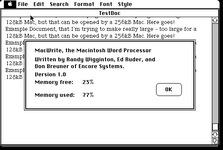
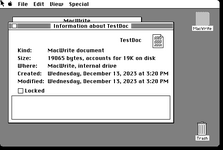
My emulator will work, as is, on the RP2040, but would enable the mythical 256kB Mac to be emulated. The MicroMac article actually references my 68KMLA article from the end of December 2023 on the subject:
This MacGUI blog post covers the boot process for the early System Software on a Mac 512K (or Mac 128K). In part of it, he talks about the Mythical 256KB Mac: At the beginning of the boot blocks are several stored parameters. The version number is two bytes. Another two bytes hold flags for...
68kmla.org
Finally, oddly enough, the MicroMac blog post claims that MacPaint won't run in 128kB, but this isn't correct - proof below.
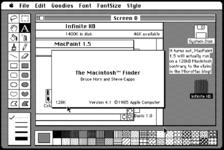
Try it yourself, by running the Infinite Mac 128kB Mac emulator (which is a JS conversion of mini VMac); double-clicking on the Infinite HD; navigating to MacPaint 1.5 and opening it:
A classic Mac loaded with everything you'd want.

infinitemac.org
Although it says Version 4.1 of the Finder, that's a quirk of the version numbering system Apple were using. It's really System 2.0 as per the link.