Macintosh Portable SLIM cards

Digging around in the ROM and source code, Apple originally planned to include removable disk cards on the Macintosh Portable. This would have predated PCMCIA cards.

In the source file, EDiskDriver.a, Gary Davidian ("GGD") appears to have begun work on EDisks around June of 1988. He first refers to SLIM EDisks around September of that year.

; <1.2> 2/21/89 GGD Added support for immediate calls, and KillIO. Made the Apple
; look better in SLIM Icon. Added support for new SLIM interface
; adapter.
; <1.5> 11/2/88 GGD Added code to post events to drive some sort of user interface
; for the lack of an eject/locking mechanism (currently, and
; hopefully permanently, disabled). Added support for internal ROM
; Disks (untested). Removed drivers need to staticly know its
; driver refnum, no code needs to change if refnum needs to
; change. Storage is now only allocated for drives that exist.
; EDiskHeader format and signature changed. Probably lots of other
; improvements too.
; <1.3> 9/1/88 GGD Added official drive icons. Added partial support for ROM disks.
; Added DriveInfo support. Changed drive queue order and numbering
; to interface better with the Startup Device CDEV. Optimized a
; few routines. Deleted code associated with normandy work around.
; Deleted support for Non-Battery-Backed-Up SLIM EDisks. Added
; special RAM Disk format code to erase and delete from drive
; queue.
; <1.1> 6/21/88 GGD Changed Internal EDisk size computation and space allocation to
; be in 64KB blocks ending at MemTop. Changed FormatVerify to
; check checksums if present, otherwise NoErr. Changed Format to
; call TestManager to test RAM.

It was anticipated that there would be two SLIM drives.

; EDisks are installed in the following order, Slim1 (lower),
; Slim0 (upper), ROM Disk, RAM Disk. This is the order that
; the start code will attempt to boot from them, unless this
; has been overriden with the Startup Device CDEV. This order
; was chosen as follows, removable devices first, fixed devices
; last. For Slims, the lower Slim is checked first to be consistent
; with the two drive Mac SE / Harpo Floppy drive search order,
; which checks the lower drive first. For ROM/RAM disks, the RAM
; disk is searched first, and then the ROM disks are searched. The
; user can still override this order, by picking one with the CDEV.
; Also, gaps may be left in the drive numbering for drive which
; aren't found, when installing them in the drive queue, because
; the startup device drive number is saved in parameter ram,
; and we don't want it moving around across boots.

SLIMs could be battery-backed RAM, or they could be ROM based (or write protected). His code checks for both possibilities. They can be up to 2 MB in 512KB increments.

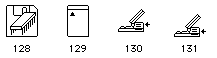
Unfortunately, the leaked source code is far enough after the release of the Portable that parts of the code to support the Portable had already been removed. And specifically of interest to this topic, Gary's SLIM icons had been removed from the source. However, by peeking into the actual Portable ROM at offset 2A53A, we find the following four icons.
1768170091433.png

It appears the Apple logo had been removed from Gary's icon by the time the Portable ROM was built. Nevertheless, this is what a SLIM card was supposed to look like. It also appears that these were intended to be located in the upper bay, where the hard drive or second floppy drive currently resides.

Although untested, the ROM code and memory mapping is set up to support SLIM cards. It might be possible to hack them in. The PowerBook 100 also has this code in its ROM.

Apple would have been ahead of the market and the Portable would have been slightly lighter if these had come into fruition back in 1989.

Does anyone else know anything about them?

- David
 
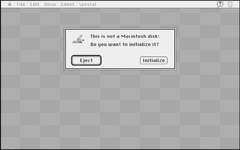
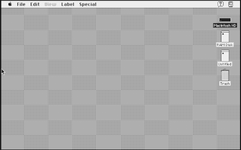
Well I don't know much about the cards, but as for the icons, non-HD equipped models were able to be equipped with two internal 1.4 drives, and that is what the Icons 130 and 131 are used to represent in the system.
 
They do work just fine since the entire driver is in ROM:

Screenshot 2026-01-11 at 2.47.28 PM.png
Screenshot 2026-01-11 at 2.47.08 PM.png

Getting it in the Powerbook 100 would be tricky, since you need both access to the bus as well as the signals from the CPU GLU, at least to implement it the way Apple intended.


As I understand the SLIM cards got delayed because they couldn't get the right hardware for auto-eject, and there wasn't really much sense in releasing them later as technology advanced. There was another Mac system that was planned to revolve around them as well that never came out.
 
Very cool. How were you able to trigger it and generate that screenshot?
This is just in the Snow emulator at the moment.

You could likely fake it on real hardware if you have between 5.5-9MB of RAM, but you would need to fake some of the hardware. You would need to pull high bit 3 of 0xFC0200 and bit 3 of 0xF00000 and/or 0xF00030, and likely make sure other bits aren't floating.

There is a bit more to the actual implementation, as it has a whole RAM mapping system for assigning the cards to specific CS lines.
 
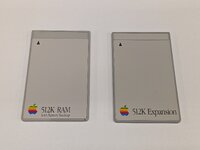
Thanks for posting this information. I recently came into possession of two SlimCard prototypes and have found next to nothing on the internet about them. This seems as good a place as any to try to document what I've found.

The design docs for the Macintosh Portable were famously leaked in 1988 by Chuck Farnham who claims to have pulled the document out of an Apple dumpster. I haven't found a copy of the document itself, but contemporary reports about Project Laguna, as the Portable was then called, make reference to the SlimCard.
https://archive.org/details/mac-week-v-2-n-36/page/n61/mode/2up?q=slimcard

A leaked Apple design doc from 1991 mentions an upcoming machine code named "Mr. Ed" which featured a SlimCard for adding additional software. This was to be a very unusual device of which little information exists. It appears to be loosely based on the Mac LC, but with no hard drive, a CD-ROM drive, ethernet connectivity, a trackpad, and the ability to connect to a TV. Perhaps an early attempt at a "Web TV" style device, or a predecessor of the STB/Pippin?
https://bitsavers.trailing-edge.com...ologies/Macintosh_Hardware_Overview_Feb91.pdf

There was a post on Applefritter in 2004 which showed a ROM SlimCard with MacDraw on it as well as what appears to be the matching 2-slot reader for the Portable.
https://www.applefritter.com/node/4826
https://www.applefritter.com/node/4824

The person who posted these pictures also offered it for sale.
https://www.applefritter.com/node/4825

A summary of the SlimCard plans for the Portable was posted on MacintoshPortable.info
https://macintoshportable.info/SlimCards/

And that seems to have been it until this very thread was started.

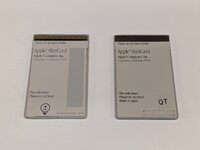
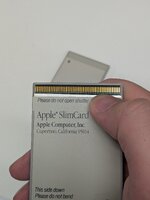
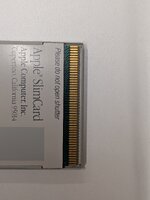
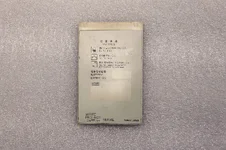
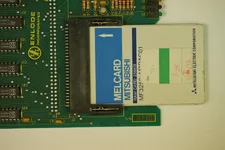
So what is a SlimCard? It is a small, metal-and-plastic-bodied memory card the same size and shape as type-1 PCMCIA, but unlike PCMCIA, SlimCard uses a 50-pin edge connector underneath a sliding metal flap. The contacts face down when the card is inserted instead of being mounted along the forward-edge of a PCMCIA card. Despite similarities, it is not the same connector as Hudson Soft's Bee Card, HuCard, or the related Atari Portfolio memory card. It is also different from the Astron SoftCard and the various cards used by Roland synthesizers. If I had to guess, I would say this is likely a proprietary device built just for Apple by one of the major Japanese memory companies.

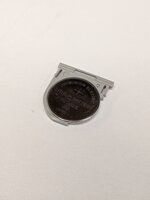
One of the cards I have identifies itself as a 512k RAM card and specifies that it is battery backed. Sure enough, a removable plastic tab along the back edge reveals a CR2016 battery, much like on PCMCIA SRAM cards.

The other card also says 512k RAM, but this one has no place for a battery. I initially wondered if this contained an early form of flash memory. After all, Toshiba had invented flash in 1987, and all of these cards say Made in Japan on them. Now I suspect the batteryless card is just SRAM, and that it functioned as some sort of RAM disk which only retained its contents as long as it remained inserted in the Portable. I wonder if it could also be used as system RAM? Regardless, this is probably the device mentioned in this update:
Deleted support for Non-Battery-Backed-Up SLIM EDisks.

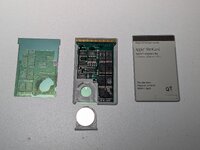
One of my cards is slightly damaged. I may try to carefully pop the metal cover off of it to obtain a photo of the insides. That will have to wait until I'm back at work next week though.

Now what about the reader? I feel that the picture on Applefritter raises more questions than it answers. It appears to show both card slots connecting directly to the Portable's PDS slot through a ribbon cable. It's hard to be sure, but the ribbon cable doesn't appear to be connected to the top 15 pins or the bottom 21. That would exclude 5v and ground, among other important connections. Was that just a mockup? Did an interface card sit between the motherboard and the reader? Or are there more connections we can't see in the photo? I would love to know the eventual fate of the unit in the photos.

And speaking of photos, I will snap a few next week to update the thread with.
 
I lied, I went into my shop on my day off to grab some photos:


PXL_20260524_235914311.jpg


PXL_20260524_235856031.jpg

PXL_20260525_000013709.jpg
PXL_20260524_235424839.jpg
PXL_20260524_235644350.jpg
PXL_20260524_235541333.jpg

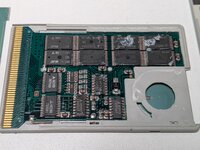
Turns out I misremembered, it uses a BR2325 battery. I also note that the traces leading away from the edge connector differ between the one with and without a battery. I had initially suspected the battery-less one may just have the same PCB in a case without the battery slot, but perhaps not.
 
A leaked Apple design doc from 1991 mentions an upcoming machine code named "Mr. Ed" which featured a SlimCard for adding additional software. This was to be a very unusual device of which little information exists. It appears to be loosely based on the Mac LC, but with no hard drive, a CD-ROM drive, ethernet connectivity, a trackpad, and the ability to connect to a TV. Perhaps an early attempt at a "Web TV" style device, or a predecessor of the STB/Pippin?

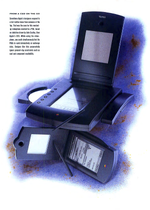
The specs on that design seemed shockingly low (512KB of RAM?) so my theory was that it was possibly this prototype design shown in a 1995 issue of MacWorld:
MacWorld_9505_May_1995.png

Now what about the reader? I feel that the picture on Applefritter raises more questions than it answers. It appears to show both card slots connecting directly to the Portable's PDS slot through a ribbon cable. It's hard to be sure, but the ribbon cable doesn't appear to be connected to the top 15 pins or the bottom 21. That would exclude 5v and ground, among other important connections. Was that just a mockup? Did an interface card sit between the motherboard and the reader? Or are there more connections we can't see in the photo? I would love to know the eventual fate of the unit in the photos.
It does make sense looking at what signals are available on the connector. My guess is it cuts off before A19/A20/A21, possibly including the +5V lines on row 25. There's a good chance those adaptors are entirely passive since all the required signals are provided on those pins. Though it should still have something to identify that the adaptor is present at the right memory address, so it's hard to say.

There's one internal Apple document that says they were delayed due to the lack of software eject (on the adaptor side) and would have to be redesigned.
Curiously that document also says the slim cards were unlikely to be bootable due to this, though this is not the case. The slim cards are perfectly bootable, unlike regular ROM disks which don't work properly on the Portable due to a bug in the Portable's ROM.
 
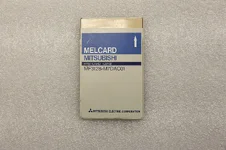
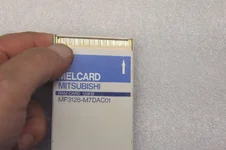
I believe I have identified the origin of the SlimCard. It appears to be derived from the Mitsubishi Melcard. Importantly there are two generations of Melcard, with the later one having a PCMCIA-style connector, but the early one uses the same 50 pin edge connector and shutter design as the SlimCard.

I was searching eBay for various obscure memory cards when this one caught my eye:
s-l1600.webp

s-l1600 (1).webp

s-l1600 (2).webp

Source: https://www.ebay.ca/itm/327179745630

Apart from the write-protect tab and the two keying slots, this looks like the same card to my eyes. Note the rounded corners and the metal covers atop a plastic frame. Note too that the top cover flares outward just before the edge connector. These are all a match for our SlimCard. Could Mitsubishi be the mystery supplier? It looked like the only way to know for sure would be a destructive one. I looked at my damaged SlimCard... and the intrusive thoughts won.

PXL_20260527_042128197.jpg

PXL_20260527_042149192.jpg

Here we see inside the battery-backed 512k RAM card. Sure enough, every chip inside is from Mitsubishi. I think it's safe to say we've found the supplier. That said, I have no idea whether this card is directly compatible with production Melcards.

So now we know where it came from, what's next? I would like to see whether it's possible to fire one of these things up. After all, I doubt one has been used in 30 years.

Option one would be to track down a device that uses standard Melcards to see whether the Apple branded one can be used, although I'd be nervous to blindly shove it in, especially since there is a keying difference.

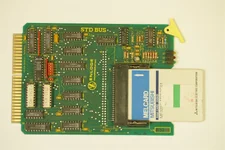
Option two would be to try to source or build the adapter to plug one into the Macintosh Portable. Given that only one has ever been photographed, and that it was last mentioned 22 years ago, I have a hunch this may require some reverse engineering. I will note that there is a device on eBay with a Melcard and the matching slot on it right now:s-l1600 (3).webp

s-l1600 (4).webp


Regardless of the path forward, I think a good first step would be to beep out this card while I have it apart and make a schematic. I'll hopefully get to that in the next couple days and post it here when it's done. That should give us some insight into whether these cards look like they could be plugged straight into a PDS slot or not.
 
Oh, I just noticed that the first part of the model number on this card corresponds to the format mentioned in the Mitsubishi manual. This is a type 3 (SRAM) card of size 513, which is 512k arranged in a 16-bit format.

I should also mention that the datecodes on the ICs inside the SlimCard are all mid to late 1987.
 
Option two would be to try to source or build the adapter to plug one into the Macintosh Portable. Given that only one has ever been photographed, and that it was last mentioned 22 years ago, I have a hunch this may require some reverse engineering. I will note that there is a device on eBay with a Melcard and the matching slot on it right now:

...

Regardless of the path forward, I think a good first step would be to beep out this card while I have it apart and make a schematic. I'll hopefully get to that in the next couple days and post it here when it's done. That should give us some insight into whether these cards look like they could be plugged straight into a PDS slot or not.

I'm thinking that adaptor was probably pre ROM freeze, as the design probably changed. There's supposed to be registers for eject, write protect, read only, and card inserted that's not possible when just connecting the cards directly. Aside from those, all the other signals needed for the cards are available in that middle portion of the PDS slot.
 
I managed to contact the person who posted the MacDraw SlimCard and reader pictures to Applefritter back in 2004. She unfortunately sold them off in a lot not long after her last post and doesn't remember who they went to.

Perhaps there is another reader somewhere out there, but I suspect the only option for getting these running now would be a total hack.
 
It wouldn't be that hard to make them work (most of the effort would just be putting the physical part together).
The trickier part is if you want to make them just like the original ones, since it's not clear if Apple ever even truly figured out what that would look like.

Since we already have working examples in emulation we know they work, and we know how they work, it's just the matter of turning that into something physical.
 
My concern is that the Apple reader may have had additional circuitry in it which we wouldn't know about. The picture makes them look big enough that they could even have a motorized eject, for all I know. But I'll start with that schematic so we can see how the cards are put together.
 
Back
Top