Macintosh IIfx tries to start but won't catch

plat

6502
I'm guessing this is a common problem as they age but I have had trouble describing the issue and finding information. Basically when you hit the power switch there is at least a click and sometimes it begins to power up to the point of starting the chime and then quits. It was working perfectly when last run probably 10 years ago. I have already replaced the pram batteries and re-seated everything including the memory chips and power supply connection to no effect.

I suspect bad capacitors at this point? If so, more likely on the motherboard or in the power supply? I just want to be cautious with it and not take the risk in doing anything unnecessary if I can avoid it.

I appreciate any thoughts on this.
 
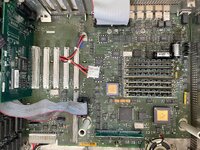
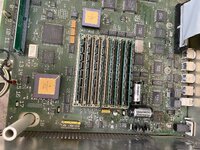
There are a couple of different versions with different quantities of electrolytic capacitors of the motherboard. Can you take pictures of the motherboard? (Particularly the right side --that's where the power on/off logic is located)
 
Thanks for looking at it. I noticed there are a couple of spots that look like some kind of residue on the surface of the motherboard on the right side, wondering if that's from the nearby capacitor to each one leaking? I'm not aware of any foreign substance getting in.
 

Attachments

  • 788634455.467762public.jpeg
    788634455.467762public.jpeg
    3.2 MB · Views: 14
  • 788634455.284426public.jpeg
    788634455.284426public.jpeg
    3.1 MB · Views: 11
A common problem because of the couple of electrolytic capacitors fitted to some IIfx boards (some were tantalums only as David is alluding to).

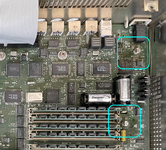
The only capacitors you need to be concerned about are C9 and C24 as they have leaked, notice the extra dirt around those. Replace these. Clean the area thorougly with isopropyl alcohol. On these boards Apple provided two sets of pads, one for tantalums and one for SMD electrolytics, you can use either depending on what size package the new capacitors are.

If this doesn't solve the problem, further diagnosis of the startup circuit will be required, explained extremely well here: https://www.downtowndougbrown.com/2015/03/explanation-of-the-macintosh-iiiix-power-onoff-circuit/

1766942313956.png
 
Thanks, this is great information and I will see to it. And to confirm, I can replace with any type of capacitor of equivalent value and suitable voltage rating?
 
stick to reputable brands, replace with the same mounting type. i also advise using aluminum polymer SMD capacitors instead of electrolytic/tantalum
 
Yes, Polymer and Tantalums are the popular choices - for the capacitors indicated, replace them with a capacitance of 47uF and a voltage of 16V or higher. On the board there are pads for both tantalums and the SMD caps.
Cleaning up after removing the old capacitors is key - the cap goo can be under nearby components, so clean up the board thoroughly. There are plenty of threads on the forum with specifics on the various methods of cap removal, cleanup and replacement.
 
Last edited:
I just wanted to update that replacing the two capacitors in question fixed the issue and the Mac is running normally again. Appreciate all the quick responses and am very impressed with the forum and helpful people here.
 
Great to hear, and I'm glad this is still usually enough to get these going again.
Usually? Have you seen some of the eBay sales lately? Most of them are far beyond saving via a simple recap.

Edit: I didn’t realize you were not in the US. Long story short, it’s been a while I’ve seen a IIfx listing that wasn’t just a pile of rust. Good condition machines are becoming very rare.
 
Usually? Have you seen some of the eBay sales lately? Most of them are far beyond saving via a simple recap.

Edit: I didn’t realize you were not in the US. Long story short, it’s been a while I’ve seen a IIfx listing that wasn’t just a pile of rust. Good condition machines are becoming very rare.
No, I don’t tend to look religiously at eBay for IIfx listings.

I wasn’t talking about battery bombed ones but ones that are actually worth saving, like the one in this thread.

And yeah most of the world are not in the US so best to not assume they are in the US.

In general as time goes on, non battery bombed examples of all models are going to even harder to find.
 
non battery bombed examples of all models are going to even harder to find.

That is an interesting premise. I've seen capacitors go two ways: juicy or dried out. I assume this has to do with the climate they are stored in.

I wonder if all alkaline batteries eventually burst catastrophically, or whether a subset of the batteries pass a certain point (outgassing?) where they become functionally inert.
 
Pretty much every IIsi I see is battery bombed. For some reason certain models
seem more affected than others. And certain battery brands seem to explode more than others, and the Maxell ones seem to cause the most damage. No idea why just seems to be something different about them. I wouldn’t consider any machine with its original battery, regardless of age, to be safe.

As for capacitors, again for some reason certain models and components seem to suffer worse than others. Classic and Classic II tend to be very damaged by leaky caps, others just seem to dry out and not really cause any damage. SONY PSU units used for IIsi machines always seem to have really wet leaky caps that destroy the PCB. Same for TSK PSUs in LCs.

But really at this point a general rule to stick to is anything that hasn’t had a battery/recap refresh by now is at risk and they all need attention by now. People, some, not many, were recapping 80s machines with SMD caps by the mid-late 90s.

And it’s not country specific, I don’t know why the other post mentioned only about US listings, universally it’s only going to get harder to find old machines that aren’t damaged in some way.
 
But really, at this point, a general rule to stick to is anything that hasn’t had a battery/recap refresh by now is at risk, and they all need attention by now.
Agree, too. Don't forget the Sony Caddy cdrom while you're doing the motherboard.. I haven't found one without bad caps. Most are saveable, but some take a lot more work than others.
 
Agree, too. Don't forget the Sony Caddy cdrom while you're doing the motherboard.. I haven't found one without bad caps. Most are saveable, but some take a lot more work than others.
yeah those are bad too. anything with electrolytic SMD caps in them especially. they're in a lot more things than most people realise.
 
Back
Top