Editorial: Apple isn't forcing anything on you. You're free to buy another kind of computer to avoid having to work with Apple's connection standards.
It was this attitude that dominated at Apple from about 1989 through the mid-90s. Go ask Gassee, Sculley, Spindler, and Amelio how that worked out for them. Spoiler alert: many people did buy another kind of computer in that time frame, either a PC or a clone, because they were tired of paying a premium for Apple's you'll-pay-for-what-we-want-to-give-you-and-like-it stance even as market share crashed and profits plummeted, culminating in a $1.6B deficit in 1996. By then, the only loyal customer bases buying its aging OS and confusing array of mediocre hardware were education and others who were heavily invested in Mac-centric software/hardware suites, and since a lot of those programs were in the process of being or already ported to Windows, that support was likely to continue to wane and potentially evaporate entirely without the post-Steve Jobs return turn-around. Steve Jobs' Apple wasn't perfect but they often offered compelling products that were reasonably priced, especially when compared to their previous products; most were pretty competitive and a good value for what they offered. Modern models have lost their way a little and they may have some ridiculous offerings in the Apple Store now (I'm not paying $1000 for a monitor stand or buying $700 wheels for a Mac Pro) but it's still not quite as aimless as the early '90s were.
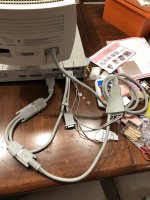
Back on topic, HDI45 could have been cool if only they had a. offered an adapter that could utilize the ADB and audio signals and whatever else rather than just the video portion; b. signed on third parties and/or had a variety of products available to use it rather than just the three PMs (whose A/V cards couldn't even use it, which was stupid) and the one AV14 monitor; c. built in an internal pass-through or something for upgraded video to internally connect to the HDI45 port without lots of external adapters. But they didn't do any of these things, so it was a total flop. No big loss, since onboard video on those early PMs was 640k worth of RBV-based trash, but it was still a huge waste of time and effort.
ADC was cool in theory but I like the the external adapter-based variant better: you still had only the one cable going to the display to minimize desktop clutter, but power was provided by a dedicated external power supply and the computer used a normal video card, eliminating the hacked-up mess that they ultimately produced and enabling the computers to use standard video cards (and AGP 8x in the later G4, something that wasn't possible due to ADC's reassigning of previously unused AGP pins that were (surprise!) later necessary to enable 8X mode).
There really wouldn't have been much of a point to Apple switching to DSub15 VGA at the earliest opportunity (about 1990 or so when it became popular) because you'd still need adapters anyway: an old DB15 Mac plugging in to a new VGA-based Apple monitor would need an adapter just the same as a new VGA-equipped Mac would have needed one when going to an existing DB15 Apple monitor or other accessory. So it wasn't the biggest deal in the world that they kept DB15, especially since the little VGA adapter enabled modern Macs drive both Apple monitors and most multi-sync VGA displays with no problems. As ridiculous as some of Apple's moves were, for a time they did offer very good upgrade programs/extended support for their products (DB15 was used from 1987 to roughly 1998; NuBus from 1987 to 1994; ADB from 1986 to 1999; LCPDS from 1990 to 1995; Mac Plus had support from 1986 to 1995; etc).