• Hello MLAers! We've re-enabled auto-approval for accounts. If you are still waiting on account approval, please check this thread for more information.

Intel iMac from work...

He'll be waiting a bit though, especially if he wants anything that matters! I build the kernel on my Pentium D and it took 30 minutes, with barely any modules. I can't see that on 300 Mhz. Personally, I'd suggest OpenBSD - it's small, fast, and secure - well suited if he wants to learn servering.

You can do the same in tmux: Ctrl+B (instead of A) and d, and then tmux attach.

 
As it was said above, in some places it basically rains better computers. I'll mirror what gorgonops said and mention that I have myself (and I routinely see people do even today) given away much more powerful computers than the one you've listed. I gave a friend a 2.8GHz P4 Northwood with at least a gig or two of ram and a new hard disk, as well as a monitor/keyboard/mouse...
I have two P4 systems of about that caliber that are sitting in the garage waiting either for a garage sale or to be carted down to Weirdstuff just to get them out of my life, and a third that I'll probably hold onto for a little longer because it's a really nice machine (A small form-factor Optiplex GX280 with a 915 chipset and a nice quiet cooling system) and I sort of hate to just toss it. (But see below for the "test" as to why I'm not actually using it; it failed to meet that criteria when the thing expected of it was to play flash games on pbskids.org. Just a wee bit too slow.)

The thing that really needs to be understood by the OP here is that from a corporate accounting standpoint it's pretty typical for a computer to be "worthless", IE, it's on the books with an asset value of "Zero", after only three or four years. That's how people end up with these things for free, or nearly so. And:

If you looked, you'd be able to find better hardware, and really, if even gorgonops is telling you that you need better hardware, then it's advice that you should probably not take lightly.
Heh. As much as I defend the right of someone to use an oddball or ancient computer because it's their hobby, (and occasionally express some ire with a certain company which has this tendency to be a bit aggressive when it comes to "forced obsolescence"), I also acknowledge that if you want/need a computer to just do its job without forcing the user to jump through hoops then you have to draw some realistic lines in the sand as to what caliber of a machine will suffice. Where exactly that line lies is certainly subjective, but assuming using the web is a priority at all and we're talking about x86 hardware running "mainstream" applications (IE, a heavyweight HTML5 browser like Firefox/Chrome/IE/Safari with the option of Flash support and capable of video playback with today's common codecs) the bottom end of acceptable is squarely in the fastest Pentium 4/Pentium M - early Core Duo ballpark; IE, a mainstream (not bottom-end) 2005 to 2008-ish machine. That's just the way it is. You can get by with less, but my criteria is based on this idea:

You're putting together a computer for someone to browse the web with. You don't know exactly what that person will be doing, but you can guess that they'll be doing the usual FaceFriend/YabberTube/FarmVole-type-web-and-Flash-games rigmarole. (And that they probably *won't* be playing 3D games or production-grade Photoshopping.) And, here's the critical part, you don't want them to be constantly calling you and asking you why their computer fell over when they just clicked on something.

Pick a computer that fits that description for your production non-hobby machine. Life it too short not to, and it's not like it's hard to achieve it. Doing a quick search of "sold listings" on ebay.co.uk shows it's pretty trivial to get a Core Duo 2 Dell Optiplex. a good corporate-grade computer that will probably continue to pass the "minimum acceptable" bar for a couple more years, for 40-50 pounds. (Probably *from* someone that got it for free, or nearly so, from a big corporation.)

Feh. I guess the OP's "Oh, pity me, I'll never be able to afford a new floppy drive for my Mac, let alone a computer" act is getting a little old. If he's genuinely destitute I'm sorry, but it sort of reads more to me like there's a prioritization problem at work here.

Bleah.

 
300 Mhz? In 2002? The Mhz race was on by then, you would have had a P3/P4 with 1 Ghz+. (The P4 would have had it for inflated numbers, but it'd be fastish.) That's P2 level Mhz.

Wubi? No, no, no. Get rid of that and install a MODERN (8.04 left LTS) Linux distro.
Processor: AMD Athlon XP.Speed: The new one from 2004 just makes it to the 1 GHz mark.

Wubi: Because I wanted to keep Windows without repartitioning.

 
300 Mhz? In 2002?
Processor: AMD Athlon XP.

Speed: The new one from 2004 just makes it to the 1 GHz mark.
Try again. The first desktop Athlons marketed as "Athlon XP" debuted in late 2001 with a 1.33Ghz clocked version, the "1500+", as the slowest model. The last Windows gaming PC I ever built I put together sometime around May 2001 with the 1.33Ghz version of the XP's "Thunderbird" predecessor... and thus I know exactly how fast a machine like that is, and if that's what you have I don't actually pity you that much. You could use more RAM but a 1.33Ghz Athlon is still way faster than a 2008 NetBook and should navigate the web semi-competently. Seriously, where did this "300mhz" come from? If your machine is from 2004 and using an Athlon XP it would be pretty likely to have a "3000+" model number, which would be clocked over 2Ghz. (And would compare pretty well with a late Pentium M/Core Solo-equipped computer.)

If you really did have an AMD machine with a 300Mhz CPU it'd have to be a K6 or K6-2 from late 1998-1999.

 
Repartitioning is not hard - it takes a minute to do.

Also, regular Ubuntu will NOT run too terribly well on that machine anyways. Either install Ubuntu from the mini.iso/Server or get Debian and install a small desktop like Xfce/install without a desktop and built from the bottom up

 
Athlon XP it would be pretty likely to have a "3000+" model number, which would be clocked over 2Ghz.
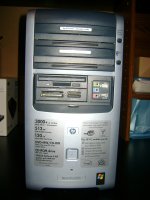
I second that. My mom had an HP Pavilion tower that came equipped with an AMD Athlon processor (labelled 3000+ on the front label). Here's a picture of the tower with the specs up front:

DSC06732.jpg

 
Just to add, if you really do have an AMD machine from almost 2005, it shouldn't be too hard to add like a gig of ram to that thing and put in a not-dying hard disk(1) and have regular, modern Ubuntu or Xubuntu perform pretty well on there. I don't know if I'd put so much money into a machine like that as to get a SATA card if you don't already have one, but that's just because you can get late Pentium4s and Ds and early-mid generation Core2 desktops for not much more and those will be faster in every single way by probably a factor of two or so.

I absolutely second the suggestion that you look for an old OptiPlex 520/620 or 745 or greater. The 280 was a nice machine but the 520/620 and netburst-based 745s have better cooling. The 745 in particular can also run a Core2Quad q6600/6700 and up to eight gigs of ram. You can also put current PCI Express graphics cards in them. That particular config is a reasonably good base for the next few years if you're really into the "computing on the absolute lowest budget possible" thing.

(1) Just statistically, after eight years there's a pretty good chance the disk is dead or that even if it's not dead, replacing it with a new one will improve performance a whole heck of a lot.

 
Back
Top