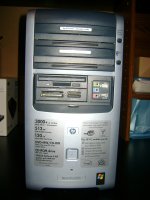
As it was said above, in some places it basically rains better computers. I'll mirror what gorgonops said and mention that I have myself (and I routinely see people do even today) given away much more powerful computers than the one you've listed. I gave a friend a 2.8GHz P4 Northwood with at least a gig or two of ram and a new hard disk, as well as a monitor/keyboard/mouse...
I have two P4 systems of about that caliber that are sitting in the garage waiting either for a garage sale or to be carted down to Weirdstuff just to get them out of my life, and a third that I'll probably hold onto for a little longer because it's a really nice machine (A small form-factor Optiplex GX280 with a 915 chipset and a nice quiet cooling system) and I sort of hate to just toss it. (But see below for the "test" as to why I'm not actually using it; it failed to meet that criteria when the thing expected of it was to play flash games on pbskids.org. Just a wee bit too slow.)
The thing that really needs to be understood by the OP here is that from a corporate accounting standpoint it's pretty typical for a computer to be "worthless", IE, it's on the books with an asset value of "Zero", after only three or four years. That's how people end up with these things for free, or nearly so. And:
If you looked, you'd be able to find better hardware, and really, if even gorgonops is telling you that you need better hardware, then it's advice that you should probably not take lightly.
Heh. As much as I defend the right of someone to use an oddball or ancient computer because it's their hobby, (and occasionally express some ire with a certain company which has this tendency to be a bit aggressive when it comes to "forced obsolescence"), I also acknowledge that if you want/need a computer to just do its job
without forcing the user to jump through hoops then you have to draw some realistic lines in the sand as to what caliber of a machine will suffice. Where
exactly that line lies is certainly subjective, but assuming using the web is a priority at all and we're talking about x86 hardware running "mainstream" applications (IE, a heavyweight HTML5 browser like Firefox/Chrome/IE/Safari with the option of Flash support and capable of video playback with today's common codecs) the bottom end of acceptable is squarely in the fastest Pentium 4/Pentium M - early Core Duo ballpark; IE, a mainstream (not bottom-end) 2005 to 2008-ish machine. That's just the way it is. You can get by with less, but my criteria is based on this idea:
You're putting together a computer for someone to browse the web with. You don't know
exactly what that person will be doing, but you can guess that they'll be doing the usual FaceFriend/YabberTube/FarmVole-type-web-and-Flash-games rigmarole. (And that they probably *won't* be playing 3D games or production-grade Photoshopping.) And, here's the critical part, you don't want them to be constantly calling you and asking you why their computer fell over when they just clicked on something.
Pick a computer that fits that description for your production non-hobby machine. Life it too short not to, and it's not like it's hard to achieve it. Doing a quick search of "sold listings" on ebay.co.uk shows it's pretty trivial to get a Core Duo 2 Dell Optiplex. a good corporate-grade computer that will probably continue to pass the "minimum acceptable" bar for a couple more years, for 40-50 pounds. (Probably *from* someone that got it for free, or nearly so, from a big corporation.)
Feh. I guess the OP's "Oh, pity me, I'll never be able to afford a new floppy drive for my Mac, let alone a computer" act is getting a little old. If he's genuinely destitute I'm sorry, but it sort of reads more to me like there's a prioritization problem at work here.
Bleah.