• Hello MLAers! We've re-enabled auto-approval for accounts. If you are still waiting on account approval, please check this thread for more information.

Farallon ETHERMAC LC NSC w/NuBus drivers in the SE/30 PDS?

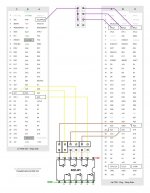
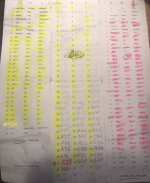
I wish I'd started error checking the wrap map before I put in the wash. I was working from a copy of it that I made at work this afternoon when I picked up some paperwork. Found a notation I couldn't read and bolted to the washing machine to peel the dead sea scroll out of the pocket of my jeans. Prized it apart like the sodden disintegrating manuscript it was and it's drying now. Thankfully I had posted the pic of most of it above. Thought I'd posted a pic of the whole thing, OOPSIE!

Copy is all marked up and everything looks like it's good to go. Now to the AI input stage and one last proofread.

 
Last edited by a moderator:
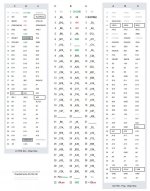
View attachment LC-030-Worksheet-02-002.PDF

edit: Bolle, if you get a chance let me know which pins I should connect the LC PDS clocks to on the 030 PDS side. There are nice little blanks on the wrap map worksheet for me to fill in. I think I've got it from your schematic, but  .  .  .

I'm second guessing myself on this and everything else this weekend. Do I have the lines in and out of each of my three select blocks for the inverters reversed? :mellow:

 
Last edited by a moderator:
 @Bolle You'll love this. Couldn't find Loctite 444 on their website earlier so I just searched it directly. At $29 for a 20g Bottle I'm sticking with their Gel. Very carefully sticking bits together with teensy dots from one of the two 2g tubes I got for under $3. Works out to something like half the price of the real deal, but sounds a lot worse. I don't think I ever used more than a few grams out of a 20g bottle before it went bad. ::)

 
Thanks so much. Mine came up straight board yellow, so I've entered the test into the map PDF above. Haven't had a chance to compare printed paper to paper scratch, but screen to paper came off well. Just waiting on word about need to flip the inputs to the inverter or not and I can get moving.

 
Nah, just fold the new printout up by column and check it column by column against the scribbling. I'll be doing the same. We both came up roses on the real proofreading and I'll be triple checking as I wrap. Noodling out a set of jumpers so I can send either set of address lines to the inverters. I'll set the jumpers for it straight through and test the kluge in Slot $E in the SE/30 with the Video ROM pulled after I figure out where to tap that interrupt, a Pivot Card and external display per the original plan. The tidbits bit of VRAM might still be a problem in the SE/30. The board may just too stupid to forgo loading the registers for video output when the Video ROM (DeclROM) is pulled.

The IIsi will be next up  if the SE/30's more rudimentary video setup remains in conflict. When no sense lines from a monitor are detected, buffering of first Meg of memory doesn't happen for the Vampire setup. So the IIsi has a much clearer line of demarcation for the video subsystem and prospects for conflict would seem to be lessened if not totally eliminated. Dunno, that a guess, but not a WAG.

Dunno, gonna build the crate, kick the tires, light the fires and see if/how she taxis around on the tarmac for now. I can also test the initial take on inverter ploy with the signals coming from either direction. That should keep me busy until Bolle gets back into the same room as his logic analyzer.

 
Seems like some bad news about testing in the SE/30 in Slot $E with the Video ROM pulled and the Pivot Card/external display:

uniserver's post of five years past:

2 - pulling the SE/30 onboard video rom does not give you any worth-while results… the computer still boots using the internal CRT anyways, even if the rom is not installed.
so the internal video would have to be disabled in other ways.
 
Last edited by a moderator:
@techknight had posted this earlier in the thread, gotta find his GS Card development thread for more info.

The SE/30 is hampered by that darned video hardware, as its clocked off the main system bus and it doesn't use its own clock.

Once you get it off the dependence of that on-board video, than anythings possible. The Simasimac we are all known and accustomed to is generated from the video RAM at its initial power-up state, before the VRAM is ever initialized by the mac itself.

I did notice the simasimac is different between the 2 different RAMs used.


This tidbit appears to affect two concurrent projects, this one for my proposed testing methodology. Looks like I need to risk killing one of my IIsi boards in my first shot at a recap. :mellow: Again, when the IIsi boots without detecting sense line encoding, buffering of the first Megabyte of system memory as blood sucked VRAM does not take place. I imagine the IIsi might be run headless? At any rate, a PDS card can then become the startup screen in a clean break from Slot $E operations as opposed the the bastardized setup of the SE/30 hybrid? Dunno, food for thought and yet another hurdle on the road to straight up testing of the WireWrap1 prototype adapter.

Morning confuzzlement of the day: One of my old threads has resurfaced and reminded me that adapting the 68000 PDS to 020 PDS for Video is a done dea andl and I have an adapter in hand for taking a whack at adapting an LC PDS NIC to Plus/SE/Classic:

View attachment 25945

@Bolle has already explained probable function of the GAL on the adapter to make this possible.


< Tangent >

So the SE/30 appears to be hitting on internal video to display the  :huh: icon at startup before INITs load and even before the Video ROM is polled? That makes sense regarding its odd designation. From my read, it's not a Declaration ROM per se in terms of the Slot Manager, being either a subset (superset?) of DeclROM function? This makes sense as the SE/30 sits at the fork in the road of Compact Mac development:

The SE/30 can be seen as a Color QuickDraw/NuBus architecture PDS hybrid from IIcs Sire and SE QuickdDaw PDS dam. The Classic, which is assumed to be the replacement the SE/30 in hardware comparisons, can then be seen as its purebred sibling, being a direct developed of the Compact Mac line that lived on for a bit in the Classic II The Color Classic in its bloated Compact form factor would be the SE/30's badly malformed offspring.

< Tangent >

 
Last edited by a moderator:
Seems like some bad news about testing in the SE/30 in Slot $E with the Video ROM pulled and the Pivot Card/external display:
Another thing to think about here: regardless of whether or not pulling that little fake declaration ROM off the board in an SE/30 would make it "not see" the display hardware you have to remember that the actual display hardware would be there regardless. IE, there would still be address decoders sitting on the bus enabling the SE/30's VRAM and whatever control ports it presents inside the SE/30's slot area *unless* there is some sort of mux/buffer that has to be explicitly enabled to allow that hardware to work, and the control port for *that* would also likely reside somewhere inside the slot $E area. That stuff is *electrically* going to conflict with any other PDS device you try to put there.

The fact that the SE/30 displays "simasimac" instead of a blank screen when it's broken in such a way to prevent it from starting is a clear indication that the hardware in there is completely "hard-coded" and doesn't require any software initialization to come on and start pushing pixels out the door. (Video cards that require programming something like a CRTC chip *don't* display anything if the CPU isn't starting unless the chip's registers are set to come on in a working base config; this is the case with the display chips in some old home computers, but not so much anything more modern.) That is also a really big strike against any idea that it's possible to "soft-disable" it.

 
@Trash80toHP_Mini the map looked good to me.  Are you saying you tested the wire wrap board and it gave the Simasimac?   That little adapter board looked really interesting. Was that something like SE>LC?

 
Thanks for checking, I haven't had a chance to more than glance at it. So I haven't starting wrapping again. Doing research for two projects and thinking about another at the same time. Apparently they're all intertwined.

1)  Farallon LC NIC adapter for the SE/30 in this thread

2)  The notion of expanding that to an SE adapter for the NIC that we've been toying with just got a big boost.

     I was reminded of an SE 68000 PDS adapter/Video Card I have in hand. Video is output only?

     Might be an important link to using an LC PDS NIC in the SE, need to see if it's capable of doing I/O?

3)  Baby creep project toward Internal GS VidCard development for the SE/30 was what turned me on to those complications.

     I've been gleaning tidbits from five year old threads. Need information on Compact Mac Video in general. Gotta set up my first rev(?) Spectrum/24 for 512x342 @ 60Hz.

     Goal is driving a MultiSync Monster from signals for that Compact Video Res.  Signals that might possibly be fed to an A/B and a GS Neck Board way down the road. TPD first up.

WireWrap1 adapter is currently slated for baseline testing in the IIsi, due to what appear to be serious complications imposed be very low level video subsystem activity in the startup sequence of the SE/30. Schniznit!  :p

 
That Big Picture adapter is not meant to be used in the LC.

The video card you got there is meant to be used together with an accelerator that has the correct 64pin connector.

If you want to use it without an accelerator you can do so by using the adapter you have.

If you plug this thing into an LC all it will do is release some smoke.

 
No doubt of that. I was mucsing about using it in the SE to interface with the LC NIC. Premise was based the accelerator being 68020 or 68030, the monitor interface might be seen as a significant subset of the LC 020 PDS? Wondering if the logic in the PAL could be much of what's needed for that SE PDS to LC NIC translation.

 
I started looking into testing the adapter in the IIsi and found something interesting about the Asante MacCon3 IIsi in the manual:

View attachment 28216

I was wondering about how to go about setting the NIC up to be in Slot$E, maybe it's not such a big deal after all? I thought I'd need to hijack the $E interrupt at the logic board level, but the Asante NIC appears to be able to do it via jumper configuration? But the 030 PDS only has three interrupt lines?

How might this work?

 
Hopefully I can figure that jumper config out. With a bit of luck it's not a logical intervention synthesizing $E in the GALs. Can't figure out why they'd have bothered with implementing a Slot ID that conflicts with onboard video in its target machine. WAG would be that the "Address Set" of the NIC does not conflict with Vampire Video memory mapped to that Slot and by extension, precludes stepping on the SE/30 video mapped within the same space?

Couldn't relocate the technical discussion thread for this project. :/

 
Could be jumper is used with (2 years newer) IIsi and ignored on SE/30, since reasonable assumption circa 1991-92 would have been nobody installs a second PDS card on SE/30 due to physical constraints. There weren’t other PDS cards on the market at the time that had vertical slots or the MacCon to hop on top of, SE/30s were really just single PDS card machines.

 
Missed your comment, nick. Dunno, when did DiiMO cards with passthru connectors hit the SE/30 market? I'm wondering if it's mapped to memory for Slot E that conflicts with neither SE/30 rudimentary video nor IIsi Vampire Video frame buffers? May or may not matter for the LC NIC adaptation. I'm suddenly thinking about the PseudoSlot location of LC Internal Video, if it is also implemented in Slot $E, LC NICs are also mapped outside that location in memory?

The DuoDock+ board is one huge multifunction Slot E expansion card with Video and AAUI NIC on board. HRMMM? :huh:

 
Last edited by a moderator:
Back
Top