
-
 Hello Guest! The forum software will be upgraded weekend of 06/26. See this announcement thread for more information.
You are using an out of date browser. It may not display this or other websites correctly.
You should upgrade or use an alternative browser.
You should upgrade or use an alternative browser.
Cooling for Better 040 Speed
- Thread starter LC_575
- Start date




I run System 7.1 on my SE, and there are no significant "speed-related" issues with it (although I must agree, System 6, especially version 6.0.8, runs very well with the 68000 processor).A 68000 is ok with OS 6.x and the old software designed for it. I assume a faster 68040 would be to speed up software designed for an 040.

Lest it have not shown well enough my comment about 68000 Macs was tongue-in-cheek. Of course they run software of the appropriate scale and vintage well enough... although I suppose to be honest the Macintosh was rarely described as being a "fast" machine even at the time. (Contemporary software reviews often describe the 8Mhz Macs as being about as fast as 4.77Mhz IBM PCs for doing a given task... which means of course the hardware is faster because in addition to doing the task itself it's running a GUI. But it did mean a similarly clocked 80286 PC AT could run rings around a Mac in a task like recalculating a spreadsheet.) I was only underlining my point was that if you're expecting an old machine to live up to a new one you're going to be disappointed.
Computer years are far shorter than dog years, so adding just a few years can mean a several-fold decrease in capability. And, sad to say, you'll see this even if you run period software. Take normal everyday tasks like a loading 200k document or manipulating a color image file which uncompressed occupies a megabyte or two of RAM. A modern mass storage device and CPU can handle tasks like that essentially instantaneously, while loading or saving a few hundred K or performing some sort of transform on a moderately-sized framebuffer will take a perceptible amount of time on an old system, no matter how efficient the software is. Undoubtedly any given old computer felt "fast" when it was born because those perceptible delays were that much more perceptible on the last computer its user owned... or if it was the person's first computer having it at all seemed like a quantum leap compared to breaking out the typewriter and slide rule. Unfortunately for the perception of these old machines time moves forward rather than backwards.
Remember when it "mattered" how fast a given web browser would render a page? People used to go crazy obsessing over side-by-side speed tests, because it did matter how efficient the rendering engine was when we were still running double-digit-Mhz-speed CPUs. Some still do, I guess, but... come on, on a new-ish computer *any* web browser can render a simple web page faster than your network connection can give it to you unless you're sitting behind an OC-48. Now the thing that matters is whether that computer is fast enough to handle the latest Flash video standard or amazingly inefficient HTML5 animation. Nobody even *thinks* about how long it should take to load a 200k Word document simply because it doesn't take any time anymore.
When you fire up your LC 575 you're activating up a time machine. Enjoy it! Or don't.
Computer years are far shorter than dog years, so adding just a few years can mean a several-fold decrease in capability. And, sad to say, you'll see this even if you run period software. Take normal everyday tasks like a loading 200k document or manipulating a color image file which uncompressed occupies a megabyte or two of RAM. A modern mass storage device and CPU can handle tasks like that essentially instantaneously, while loading or saving a few hundred K or performing some sort of transform on a moderately-sized framebuffer will take a perceptible amount of time on an old system, no matter how efficient the software is. Undoubtedly any given old computer felt "fast" when it was born because those perceptible delays were that much more perceptible on the last computer its user owned... or if it was the person's first computer having it at all seemed like a quantum leap compared to breaking out the typewriter and slide rule. Unfortunately for the perception of these old machines time moves forward rather than backwards.
Remember when it "mattered" how fast a given web browser would render a page? People used to go crazy obsessing over side-by-side speed tests, because it did matter how efficient the rendering engine was when we were still running double-digit-Mhz-speed CPUs. Some still do, I guess, but... come on, on a new-ish computer *any* web browser can render a simple web page faster than your network connection can give it to you unless you're sitting behind an OC-48. Now the thing that matters is whether that computer is fast enough to handle the latest Flash video standard or amazingly inefficient HTML5 animation. Nobody even *thinks* about how long it should take to load a 200k Word document simply because it doesn't take any time anymore.
When you fire up your LC 575 you're activating up a time machine. Enjoy it! Or don't.


First off, I didn't buy this machine: I found it in the garbage. My uses of it are a combination of nostalgia and actual productivity, mainly with MORE 3.1.
I forgot to mention that it seems my speed was faster when the 575 had it's original Apple-Approved IBM hard drive. My new HP SureStore disk feels considerably slower. Yet I believe it has a faster transfer speed. Odd...
I forgot to mention that it seems my speed was faster when the 575 had it's original Apple-Approved IBM hard drive. My new HP SureStore disk feels considerably slower. Yet I believe it has a faster transfer speed. Odd...

The only thing I can think of is that maybe that the newer drive uses a newer, faster SCSI standard, and when connected to the 575, it goes into a compatibility mode that is slower than the original drive. That's nothing more than a guess though.
Regardless of what your uses are (in my case, it's to read old files & play old games), and how you got it, you can only squeeze so much out of a tube before that tube ruptures, and your computer is reduced to shit.First off, I didn't buy this machine: I found it in the garbage. My uses of it are a combination of nostalgia and actual productivity, mainly with MORE 3.1.
In my opinion, the LC-series stank, but there was a market for it, and that kept Apple's factories humming (for the most part, anyway). The bottom line is we have to accept the limitations of these units, and appreciate them for what they are.
I'm assuming that the IBM drive has a faster RPM rating than the HP drive. If it's the other way around, perhaps there are defects with your HP drive (or the 575' board cannot handle it).My new HP SureStore disk feels considerably slower. Yet I believe it has a faster transfer speed. Odd..

hook u an external scsi HD (format if necessary), copy your system to the external, copy Speed disk to the externalLC_575 wrote :I have tried using Norton Speed Disk, but the program requires a special startup disk to work.
> control panel > chose startup disk of the external HD, restart
run Speed disk for the internal HD of the LC
not compatible with quadra AV'sThe common PPC PDS cards are for Quadra machines.
They *did* sell them for LCs. There was even an Apple-branded one. Here's a link. And here's another link. Apparently Apple's fit in the 68040 socket, not the expansion slot. Finding one nowadays might be a problem, of course.LC PPC PDS cards are either rare on non existant. The common PPC PDS cards are for Quadra machines.
So, I suppose I do have to ask this question... you apparently have a powerful Windows machine at your disposal. If you're using the LC for productive work (you mentioned "MORE 3.1", which I guess is an outliner?) might you be better served just running BasiliskII or Sheepshaver on your Windows machine? My four-year-old Core Duo desktop scores something like 20 times faster than a Quadra 605 in Speedometer 4.0 under BasiliskII, and even faster in Sheepshaver. If you simply want to run old Mac software rather than specifically play with an old Mac it's probably the best option there is. Even a wimpy little Netbook will be far faster than any 68k Mac.

These are my results, in the first one I have my current HP notebook as well as my old netbook.(acer aspire one, the 1GB RAM, 120GB HDD model)http://www.poopr.org/images/84i45pzj51oyitwyu09.pngMy four-year-old Core Duo desktop scores something like 20 times faster than a Quadra 605 in Speedometer 4.0 under BasiliskII, and even faster in Sheepshaver. If you simply want to run old Mac software rather than specifically play with an old Mac it's probably the best option there is. Even a wimpy little Netbook will be far faster than any 68k Mac.
Then I have my current desktop.

http://www.poopr.org/images/j55hvjwfk01n03rsp1fs.png
Speedometer 4.02 results from Basilisk and Sheepshaver for that old desktop I mentioned. (It's a 2 Ghz quad-core Mac Pro... the very first model Mac Pro, and it's running Linux. For a single-core task like this being a Mac Pro is no advantage... my 2.33Ghz MacBook Pro actually runs these tests almost 25% faster.) Both results are obtained from booting the same 1GB disk image with MacOS 7.5.5.
Anyway. If you're running 68K code BasiliskII is the better choice, but if you've got a fat binary it's SheepShaver all the way. Either completely trounces an LC 575, PPC or no PPC upgrade.
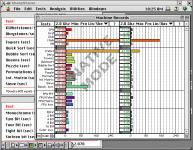
Anyway. If you're running 68K code BasiliskII is the better choice, but if you've got a fat binary it's SheepShaver all the way. Either completely trounces an LC 575, PPC or no PPC upgrade.
Virtual ][ and Lisa Emulator are installed on my G5 quad
- most of the old mac apps runs in classic mode -
i tested the emulators, but i never use them anymore
nothing better than the real thing
- most of the old mac apps runs in classic mode -
i tested the emulators, but i never use them anymore
nothing better than the real thing


Good point. It improves stability often too. To learn what you can and can't disable, get a hold of a database called InformINIT. And to see and disable more things than Apple's Extensions Manager will show you, try Symbionts or Conflict Catcher.
Also, you haven't mentioned what OS you're running, or how much RAM is in there, or if you're using virtual memory, or how full your internal drive is.
Because it hasn't been explicitly spelled out here, dropping in a 40MHz 040 from another machine won't help either; it'll still run at 33MHz unless you overclock it. The existing 33MHz CPU can usually be clocked to somewhere around 40MHz, especially with added cooling, but there are issues. There's also an extremely rare CPU-socket upgrade called the Quad Doubler which will run a 50MHz 040. But long before you get excited about that kind of thing, do the other stuff.
Also, you haven't mentioned what OS you're running, or how much RAM is in there, or if you're using virtual memory, or how full your internal drive is.
Well, maybe, but the 575/475/605s were the last, best and fastest of the LC series.In my opinion, the LC-series stank
Because it hasn't been explicitly spelled out here, dropping in a 40MHz 040 from another machine won't help either; it'll still run at 33MHz unless you overclock it. The existing 33MHz CPU can usually be clocked to somewhere around 40MHz, especially with added cooling, but there are issues. There's also an extremely rare CPU-socket upgrade called the Quad Doubler which will run a 50MHz 040. But long before you get excited about that kind of thing, do the other stuff.
Similar threads


- Replies
- 2
- Views
- 362
- Replies
- 10
- Views
- 887

- Replies
- 3
- Views
- 407

- Replies
- 107
- Views
- 15K