• Hello MLAers! We've re-enabled auto-approval for accounts. If you are still waiting on account approval, please check this thread for more information.

Colour Classic Analog board issue

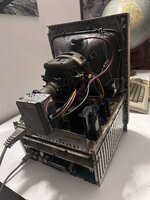
Hi. I've been trying to get Colour Classic back on its feet for some time now... The symptom indicates a damaged switching power supply, but I'm wondering about other possibilities. To be sure, I put a 100% working logic board in it. When I hold the Power button on the keyboard, the computer cyclically clicks, flashes a diode and you can hear a cyclic high voltage start noise. However, this only happens when I hold the power button on the keyboard. I checked each electrolytic capacitor with a capacitance meter and they are dry and maintain their parameters. I also checked all the diodes and transistors (they are ok), I unsoldered the TDA’s which are controlling the converter and they don't look like they're shorted or damaged in any other obvious way (I don't know how I could check them without replacing them with new ones). I replaced the optocouplers with new ones. I also tried disconnecting the kinescope from the analog board, both the neck PCB, the coils and the high voltage... it didn't help (I thought maybe the kinescope had a short circuit). There are no shorts on the 5 and 12V lines either. What else could it be? Maybe the starting system, or the HV transformer?

Thanks for your suggestions!IMG_8597.jpeg
 
you say you have checked all the caps and they are dry - did you replace them ? with all the effort you are making you might as well just get a recap kit for analog board and replace them all - I spent months trying to get my Lisa working and it ended up being 1 small radial cap on the cpu board that was stopping the machine from booting , and it was only slightly off spec - im not sure but testing a capacitors value versus its constant running specs is something i dont really trust - recap it
 
you say you have checked all the caps and they are dry - did you replace them ? with all the effort you are making you might as well just get a recap kit for analog board and replace them all - I spent months trying to get my Lisa working and it ended up being 1 small radial cap on the cpu board that was stopping the machine from booting , and it was only slightly off spec - im not sure but testing a capacitors value versus its constant running specs is something i dont really trust - recap it
I would like to find the cause of the problem. Replacing all the parts blindly at random is an inelegant form of repair... Of course, I will eventually replace the capacitors, but since I have checked each one and they look OK, I do not want to waste money on the entire set when it turns out that the flyback is broken and the board will be useless anyway.
 
I see - and sorry for the typo. I meant to write "out" not "not" :-). The Colour Classic I worked on underwent a full recap. I can highly recommend doing it for yours too. It'll have to happen anyway so why not do it now?
 
From memory I think the low voltage power side requires low ESR caps, but I don't have any more specific info than that.

If you want your Colour Classic to work properly, replace all electrolytic caps on the analog board AND logicboard before doing any more troubleshooting.
 
From memory I think the low voltage power side requires low ESR caps, but I don't have any more specific info than that.

If you want your Colour Classic to work properly, replace all electrolytic caps on the analog board AND logicboard before doing any more troubleshooting.
As I wrote in the post. The motherboard is functional, taken out from my other functional CC (it is also after recap). From what I see, the original capacitors that were installed in the analog board are not LOW ESR type. You don't have to tell me to recap the analog board. My question was what else could be the cause BESIDES this. Someone wrote that I'll eventually replace them anyway. I'll answer that (maybe yes, maybe no) If it turns out that the flyback transformer is damaged, I'll probably look for another analog board. Otherwise, I'll have a dead board with good capacitors (no point)
 
My question was what else could be the cause BESIDES this.
Yes, and my advice was to replace the capacitors before attempting further troubleshooting. You are correct - you may still have a non functioning board afterwards, but then at least you know the 30+ year old caps are not the cause of the issue. This is a fairly standard way of dealing with these boards.

I've worked on about five of these boards, managed to revive four of them I think. Replacing caps was necessary on all of them.

Failed flyback transformer is not a common cause of failure on these, from what I've read about/experienced myself.
You don't have to tell me to recap the analog board.
I'm just trying to help. I have fixed these boards before, always started with a recap before going further with other troubleshooting steps.

I'll probably look for another analog board.
You could, but you'll be getting another 30+ year old board that may not work, unless you can find a known working one.

Have you inspected the solder joints on the analog board? It is quite common on these to have dry joints, another good place to start.
 
Recap first, then troubleshoot further. As caps dry out you may find capacitance measures more or less OK but that means nothing if the ESR has become so high due to age that they are unable to deliver current. It is not worth troubleshooting when you already have a known issue.

You are worried about throwing good money after bad, which I respect, but you've already done so by spending so much effort on checking transistors, diodes, optocouplers, etc. Between time and effort, you've already invested more than the cost of the replacement caps.
 
Recap first, then troubleshoot further. As caps dry out you may find capacitance measures more or less OK but that means nothing if the ESR has become so high due to age that they are unable to deliver current. It is not worth troubleshooting when you already have a known issue.

You are worried about throwing good money after bad, which I respect, but you've already done so by spending so much effort on checking transistors, diodes, optocouplers, etc. Between time and effort, you've already invested more than the cost of the replacement caps.
tried to tell him - wont listen - ah sure , what can u do !
 
Those symptoms sound more like the PSU failing to start up than anything to do with the video circuitry. Have you tried firing up the PSU under controlled load to see if it regulates?
 
Good luck finding another good CC AB. Just recap the AB and take it from there. As someone who’s been through this twice, it’s your best bet.
 
Good luck finding another good CC AB. Just recap the AB and take it from there. As someone who’s been through this twice, it’s your best bet.
Yup, cc analog boards hard to find. I was lucky and found one locally a few years back. I was sad that they are hard to find. The guy recapped part of analog so I finally finished that a few weeks back.
 
Yup, cc analog boards hard to find. I was lucky and found one locally a few years back. I was sad that they are hard to find. The guy recapped part of analog so I finally finished that a few weeks back.
About a year ago I had three CC's, stripped a few parts off one and sold the rest (including good AB) at VCF swap (stupid decision). A few months later after a lot of wasted hours and heartache, I sold another on ebay with a flaky AB that survived shipping. A few months lafter that, I managed to score a forgotten vacation house CC in northern NJ for $150 that ran great, so using my prior experience, I just left it alone. I knew enough that sometimes once you start fussing with these things, it can quickly go from bad to worse. One day the video started going nuts and powered off. I recapped the entire AB, replaced some those hot resistors and adjoining zener diodes only for it to still barely work. After some additional testing/fussing, it completely s--t the bed with a big pop! I just laughed!
 
Back
Top