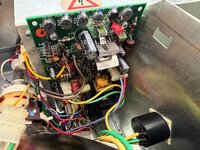
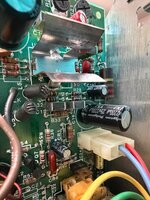
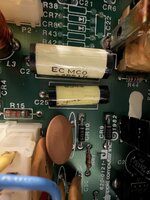
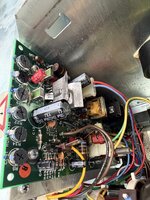
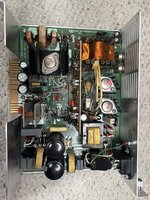
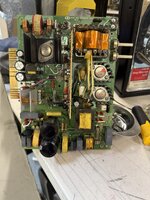
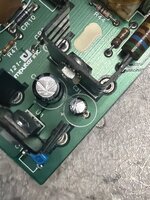
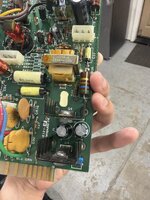
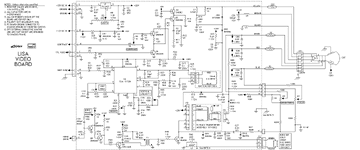
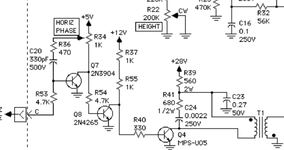
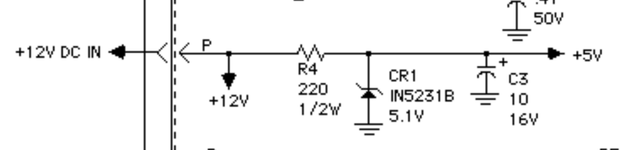
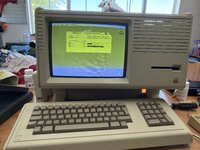
Decided to recap my Lisa recently after a couple of people told me that the 1.8A PSU + video board can suffer from bad caps. I ordered these parts, which I later found out I forgot to order a 100uf cap for the analog board (replaced it with a 100uf cap in the order and skipped one of the 100uf caps on the PSU).
When I turned the Lisa on for the first time after recapping the boards, I instantly got a massive plume of smoke from the front left (PSU power connector/speaker area), but also the usual click when the Lisa turns on. Obviously I panicked and unplugged the Lisa, but when I went to check for a blown component, I couldn’t find anything. The caps I put on both look fine, and there’s nothing obviously burned (outside of what was burned from the original RIFAs blowing up).
Furthermore, I’m still getting some horizontal ripple on the screen, but it seems to “improve” (lack of a better word) as the Lisa stays on, which points to a cap potentially?
Any guesses on what could have gone up in smoke, and also cause horizontal ripple in the video? Sorry for the bad photos, will take better ones ASAP!
When I turned the Lisa on for the first time after recapping the boards, I instantly got a massive plume of smoke from the front left (PSU power connector/speaker area), but also the usual click when the Lisa turns on. Obviously I panicked and unplugged the Lisa, but when I went to check for a blown component, I couldn’t find anything. The caps I put on both look fine, and there’s nothing obviously burned (outside of what was burned from the original RIFAs blowing up).
Furthermore, I’m still getting some horizontal ripple on the screen, but it seems to “improve” (lack of a better word) as the Lisa stays on, which points to a cap potentially?
Any guesses on what could have gone up in smoke, and also cause horizontal ripple in the video? Sorry for the bad photos, will take better ones ASAP!