A 512k with a surprise inside

Hello. The thing that happens to everybody but me actually happened to me and not everyone else for once, haha

On Facebook Marketplace, I saw a 512k w/keyboard, mouse, Apple tote bag, and a midnight blue Abcom dust cover for the Mac and the keyboard, listed for $350. Pictures of the front of the unit powered off; listing said it was functional. All I wanted was the dust cover, as I have the white version and am obsessed with it. The midnight blue, which I had no clue even existed, looked awesome.

But I have a 512k already that I was happy with. I stuck a ROMinator in it and it's great. Don't really need another.

Anyway, it's now like a month later and the listing is still up. I figured, screw it, and offered the seller $200, which he accepted immediately. Drove 45 minutes today for pickup. Kid selling it said he got it for free from an estate cleanout. They told him to chuck it or just take it for himself. He decided to save it, God love him. $200 straight profit for him; I get a dust cover and a 512k I can trade someone for something else, maybe.

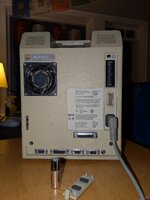
Anyway, I got home and got it out of the bag to take a look at it:
PXL_20260320_220437811.jpg

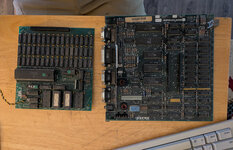
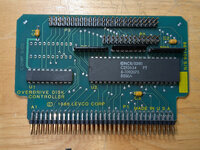
That ain't normal, haha. So I cracked it open and found a the following card hooked up to this hand-mounted SCSI board:
scsiboard.jpg

I don't remember there being an expansion slot on my other 512k, probably because there isn't. So I buttoned the machine back up quick to see if it would boot. It did, and as you'll see below, this thing has 2MB of RAM somehow:

ram.jpg

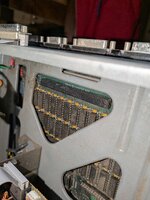
Now I'm excited to see what exactly what expansion board is installed. I'm guessing a Levco MonsterMac or something similar, but I cannot remove the board from the unit. There is absolutely zero clearance between the SCSI slot there and the metal shelf above it. Does anyone have an suggestions on how I can get this thing out for cleaning and identification? It is enticingly stuck in there:
PXL_20260321_000940140.jpg

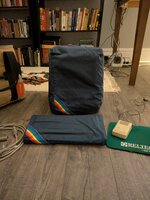
Also, this would have been worth it regardless, because this dust cover is sick:

PXL_20260320_215949236.MP.jpg
 
Looks good. You’ll probably need to tape up and end of a flathead screwdriver and unclip the motherboard from the metal sliding frame from one side to get it out.

Don’t mind these early upgrades as they make a shelf queen useful with more RAM or SCSI and often socketed chips for easy repair if components become faulty.
 
It makes sense for it to have 2MB, given that the Mac 128/512 logic board can't cope with different types of RAM chips. So, initially I thought, yes it's going to be 128K (16x 64kBit), 512K (16x 256kBit) or 2MB (16x 1MBit). But the images appear to show 3 rows of at least 12 chips. My guess then is that it uses its original 512K and then another 1.5MB of 256kBit chips (32 in total). No wonder it needs a fan, it's poor little power supply must be exhausted!
 
it's poor little power supply must be exhausted
Sometimes this sort of thing came with an auxiliary power supply to help out :) the CPU upgrades certainly often did.
I imagine it is quite a usable machine.

Whoever aligned that fan really loved this computer.
I was wondering if they used a jig and a router with a trim bit, but then I saw the hole for the SCSI port and I think they were just fairly careful and the fan guard is covering their sins 😆
 
Looks good. You’ll probably need to tape up and end of a flathead screwdriver and unclip the motherboard from the metal sliding frame from one side to get it out.

Don’t mind these early upgrades as they make a shelf queen useful with more RAM or SCSI and often socketed chips for easy repair if components become faulty.

I ended up jaws-of-lifeing it out from both sides like a Chesapeake blue crab, and dropping it out the bottom. It was scary! And it is indeed a Monster Mac, rev C, serial #206

free.jpg

If you look close, they have a bunch of chips that are named after the Marx brothers:

mm.jpg

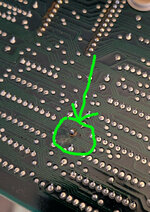
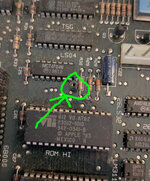
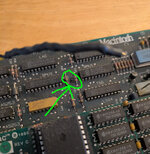
I did manage to break something, though. This ground(?) connector to the 512k logic board meant for the yellow-black wire, which is a single pin that seems to be yet another custom job for this thing to work:

brokenconnector.jpg
brokenconnector2.jpg

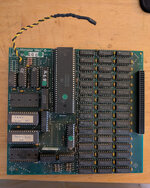
There's also this connector on the 512k logic board for a lone pin on the underside of the MM board. I assume this is also custom {I'm too lazy to teardown my other 512k, at present):

connector.jpg


Whoever aligned that fan really loved this computer.

I was wondering if they used a jig and a router with a trim bit, but then I saw the hole for the SCSI port and I think they were just fairly careful and the fan guard is covering their sins 😆

Haha, yeah. I have not removed the fan to see the hole, but it sure does look like the SCSI cut was yolo'd
 
I like the later mods that snake the SCSI port out the battery compartment for a very clean upgrade. That fan upgrade, however, is extremely clean.
 
Sometimes this sort of thing came with an auxiliary power supply to help out :) the CPU upgrades certainly often did.
Believable.
I imagine it is quite a usable machine.
When we were first put in front of the Mac 512s at UEA in 1986, they seemed very capable too. In fact, I've just remembered that in one of the introductory lectures in the first year, they were very excited to let us know that the Mac Lab Macs had been upgraded to 512k.

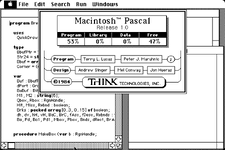
That's cool because when running Macintosh Pascal, which occupied 117kB on the disk, a 7kB program (Breakout) took up 53% of the available RAM on a Mac 128kB. They wouldn't have been able to push MacPascal very far before autumn 1986.

1774305521258.png

Later, in one of the early programming labs, I did Get Info... on MacWrite and saw that it occupied 65kB. I started thinking about the sheer amount of effort it would take to write a 65kB program based on the fact that it took me weeks to about a month to write BASIC programs that took up 16kB (excluding data). I mean, if I was trying to write it well. So, I was thinking yes, it'd take at least 4 months or more to write MacWrite and that seemed like a long time. Similarly, writing applications that would fill all of a Mac 512's memory would take years.

It's quite a challenge to think back to the mid-1980s and properly remember what I actually thought about computers and their capabilities at the time. It wasn't really the case that one couldn't imagine computers would have more than 640kB, because we could see that over time they were getting more powerful: faster CPUs, better graphics, more RAM, more storage. Also, the 1st year's Microvax had been hacked to support 16MB, so clearly we already had access to computers with far more storage (shared between dozens of users).

It was really a case of trying to imagine how we would use a personal computer with 512kB or 1MB or more (the Mac Plus was already out). As per: how would anyone spend years writing a program? What kind of data would use up all that extra RAM and storage?

A decade later though, it would be obvious: 16MB of RAM and 1GB would feel limiting, though 160MHz CPUs felt pretty decent.
 
Later, in one of the early programming labs, I did Get Info... on MacWrite and saw that it occupied 65kB. I started thinking about the sheer amount of effort it would take to write a 65kB program based on the fact that it took me weeks to about a month to write BASIC programs that took up 16kB (excluding data). I mean, if I was trying to write it well. So, I was thinking yes, it'd take at least 4 months or more to write MacWrite and that seemed like a long time. Similarly, writing applications that would fill all of a Mac 512's memory would take years.
MCUs keep me in this frame of mind - it takes quite a lot of code to fill the flash on an ATMega328, and when I do it is usually because I've done something like store sampled audio in flash or something. I can't comprehend how many lines of code must be in a 20MB program. I realise modern software is full of images and video etc, but they're so huge!
 
MCUs keep me in this frame of mind - it takes quite a lot of code to fill the flash on an ATMega328,
On average I find that 1 line of code ≈ 10 bytes. So, 32kB ≈ 3200 lines, and at 50 lines per day(?) that's about 2 months solid coding.

and when I do it is usually because I've done something like store sampled audio in flash or something. I can't comprehend how many lines of code must be in a 20MB program. I realise modern software is full of images and video etc, but they're so huge!
Yes. That's most of the difference, all the assets that form part of a modern application aren't actual lines of code written by a programmer. And there's three other reasons why even the resultant app is so large. Firstly, apps aren't built up by a single programmer, but by multiple programmers. Secondly, we use lots of libraries, so only a fraction of an app is actually written as such by the app's programmers. Thirdly, the libraries, and the apps themselves have involved years of coding.

So, two of my assumptions in the mid-1980s just turned out to be wrong and I didn't even consider the contribution libraries and assets would make to applications.
 
Back
Top