• Hello MLAers! We've re-enabled auto-approval for accounts. If you are still waiting on account approval, please check this thread for more information.

30Video: New video board for SE/30 / IIsi / more?

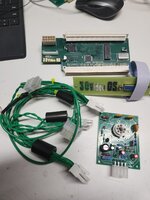
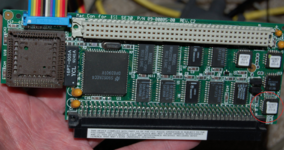
Getting closer.... the card itself functionally works 100% including grayscale <> VGA switching, but it's somewhat sensitive to noise on the system clock lines while in grayscale mode. The SE/30's clock signal tends to be noisy at the best of times and it gets worse the more cards in a system ... I need to tinker to see if I can improve the tolerance. Hopefully I can have some test cards available soon.

In the longer term I need to design a neckboard, I'm using Bolle's with permission but it's not pleasant to build. The harnesses are actually rather enjoyable as I made some tool to help me reliably construct and test them.

1719965110362.jpeg
 
Looks great! any thoughts on aproximate cost for those interested?

I haven't quite worked exact numbers out yet, but to set expectations, I expect the whole kit and caboodle will not be cheap. Though, nowhere near as expensive as a vintage Xceed setup. It takes an excessive amount of time to build & test the video board, harness, grayscale board altogether. I'm quite dreading that part, honestly.

I don't know that there will be all that much I can do to reduce costs in the long run, though I do plan on making a VGA-only version intended for IIsi (or SE/30, upon request - different PDS passthru connector) at some point. That version can be cheaper since less to test, less to assemble, and grayscale capability does nothing in an IIsi.
 
Great progress! You may need a zero delay clock buffer on the clock or at least some termination to compensate long channel and extra loading on the clock signal without alter the timing.
 
but it's not pleasant to build
What‘s making it not pleasant to build? (Apart from being made of boring through-hole components)? Could a SMD version improve that?
It takes an excessive amount of time to build & test the video board, harness, grayscale board altogether. I'm quite dreading that part, honestly.
What about offering a PCB+components DIY kit? I‘d be quite happy with that! I love soldering 😃
 
Great progress! You may need a zero delay clock buffer on the clock or at least some termination to compensate long channel and extra loading on the clock signal without alter the timing.

I actually have both! I do buffer the ZDB itself though which I am going to try removing as I think it is counterproductive here. I borrowed the PLL section I use on my Booster clones, but it's a mix of old design and new that I added, so maybe that wasn't the best idea.

Unfortunately, termination is a sensitive situation given that the signal itself is very anemic by this point. Even a 1K resistor pull up/down is enough to tilt it towards working or not. The clock is series terminated on the LB, but the PAL also has poor drive strength. A GAL or ATF seems to clean it up a little, but I can't exactly insist everyone who wants to use a card swaps that out. For the moment I have a series resistor as I've seen done on some accelerators, however benefits are quesitonable.

What‘s making it not pleasant to build? (Apart from being made of boring through-hole components)? Could a SMD version improve that?

What about offering a PCB+components DIY kit? I‘d be quite happy with that! I love soldering 😃

I don't mind the through hole as much, though it takes a while to build. It's about half components and half some design issues. Essentially all annular rings are undersized, and most of the holes are also. Makes it more complicated than necessary both to insert components and to solder thoroughly.

I definitely want to offer full setups, but I could see selling just video cards with a neckboard PCB included. By the time all the parts are together for a kit, it ends up being about as much effort to assemble it myself. I'd provide bare PCB and folks can DIY the harness / assembly if so inclined. Also, important correction to all who are treating the BOM data from Gamba's site as authoritative: R6 is 20K (not 200) ohms, and R5 is 560 (not 56) ohms. Won't work without changing those!

wrt turning it to SMD: Of the ~30 components on the neckboard, only around 10 would be immediate candidates for a relatively direct SMD replacement. Mostly some resistors, 3 diodes, and a cap. Problem is much of the card is designed for power handling, so would be large and/or exotic parts as far as SMD is concerned. It also involves analog voodoo I'm not conversant with.... a full redesign (new schematic) might be able to move more parts to SMD, but at the moment I'm not able to undertake that.

You could use a (battery bombed) compact mac as external monitor 🤓

Haha, if only. I don't provide a full set of control signals though, and rely on the logic board for syncs and pixel clock. Micron does something similar, though they shift HSYNC slightly which seems to be responsible to the buzzing my Micron setup generates.

It turns out the HSYNC from the LB isn't so much hsync as it is the horizontal drive, and it is very different from a typical hsync signal. It would require custom logic to generate as it needs to be asserted well into the period when pixels are output also. Given it directly drives the power transistor, I was strongly advised to avoid any disruption to the hsync signal as it could have potentially catastrophic consequences.
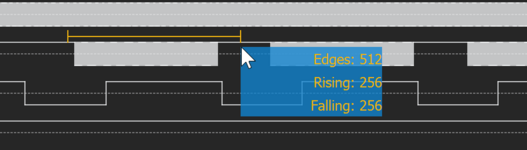

1720012913713.png
 
Last edited:
Also, important correction to all who are treating the BOM data from Gamba's site as authoritative: R6 is 20K (not 200) ohms, and R5 is 560 (not 56) ohms. Won't work without changing those!
Wow... great catch. I just confirmed by looking at an original photo and decoding the color bands. I have parts to build a neckboard of my own but haven't started yet. Guess it's time for another DigiKey order!
 
I'm not sure I'd want to alter my SE/30 this much and maybe a crazy idea but what about replacing the CRT with a modern 10? inch LCD and driving it with the 30Video VGA output? I guess that would be no different from the 30Video's prospective then driving an external VGA monitor? i.e. the internal video could be ignored (or would it be a fantom, non-visible video output you would need to deal with?)

...it could be nice to have a sharp 640x480 8-bit color monitor in the SE/30 form factor. When I've seen other mods ("M1 Mac mini and LCD in a Macintosh Classic case!") I generally feel like its a step to close to a Mac Aquarium, but maybe running it in grayscale would feel less blasphemous?
 
I don't find it terribly blasphemous, to be honest. The CRT and analog board (particularly the flyback) feel like inevitable failure points, and it's not like they're making any more. Someone's got to figure out the mod process for the rest of us.
 
I'm not sure I'd want to alter my SE/30 this much and maybe a crazy idea but what about replacing the CRT with a modern 10? inch LCD and driving it with the 30Video VGA output? I guess that would be no different from the 30Video's prospective then driving an external VGA monitor? i.e. the internal video could be ignored (or would it be a fantom, non-visible video output you would need to deal with?)

...it could be nice to have a sharp 640x480 8-bit color monitor in the SE/30 form factor. When I've seen other mods ("M1 Mac mini and LCD in a Macintosh Classic case!") I generally feel like its a step to close to a Mac Aquarium, but maybe running it in grayscale would feel less blasphemous?

There would need to be some special logic to disable the onboard video (or just pull the Video ROM, probably easier) as otherwise yes Mac OS would always think the screen is there. When in Grayscale mode, the ROM takes a few steps to convince Mac OS to do nothing further with the onboard video.

Using a LCD internally is very much doable and perhaps even simpler than needing to jump to VGA: the chip supports a native LCD interface. Now... this is a chip from the late 90s, so it's not going to be interfacing to an ipad display or laptop display, it supports either 9/12/16 bit TFT or 4/8/16 bit passive LCD. It may be a bit of a search, but it's a definite possibility. Technically, it would even be possible to do screen mirroring of the internal LCD to the external VGA (so long as resolutions are compatible).

Also not impossible to convert that parallel LCD interface to DVI/HDMI, but the chip doesn't really have the range to push much beyond SVGA, so the value in having HDMI is IMO limited as compared to something like NuBusFPGA. I'd kinda hoped a widescreen resolution was doable, but it'd be something strange that I'm not sure most monitors would be able to make sense of.
 
Ha! That was me! I'm glad someone found it useful!
I'm glad you did - I was about to start tracing out my Micron neckboard to verify myself!

In unrelated news, Asante MacCons are apparently the destroyer of clocks. I'm not quite sure what is wrong (?) with the U14 GAL on them, but both examples I have drag the system clock down from a "healthy" 3.1v or so down to a sickly 2.3v.

Apparently, the MacCon jumpers select between CPUCLK and C16M. Both feed into GAL U14 and logic decides which signal leaves the GAL. Only in the case where JP2 is present and JP1 is not present (Slot E) does it use C16M, under all other cases it uses CPUCLK. I'm assuming that is for use in an IIfx??

Using my PDS booster V1.1 card, which buffers CPUCLK, I notice only a .4v drop as C16M is still unbuffered and C16M=CPUCLK on SE/30. So, the two GAL inputs on the merged CPUCLK/C16M lines correctly add up to 0.8v of drop. I may experiment with putting an ATF on the MacCon instead of a GAL to see if that reduces this nonsense.

Why this matters:
68030 + Maccon + 30Video GS = stable (I think. More testing will be required to confirm).
Socketed booster + Maccon + 30Video GS = no go.

In fact, pretty much any accelerator + Maccon seems to be pushing it: My Socket Diimo + Maccon + Xceed setup has always needed a pull up on the clock to be stable. Pretty disappointing, really - I've always preferred Maccons as they were vintage and the "gold standard", but even my Fallaron and Shiva cards which implement the same controller in a functionally identical manner don't maim the clock lines the Maccons do. I notice those both use PALs where both my Maccons use GAL16V8Bs.

It looks like the takeaway here is that for *any* PDS cards with a passthrough, use caution when stacking with MacCons. Swapping card order can help stability also. Bolle's products AFAIK use either ATFs or PALs, as well as offering special treatment of the clock signals in general (buffering), so this is really /just/ for MacCon users (sigh). I may make some tweaks on future revisions to improve resistance to MacCons.

I would be curious if anyone reading this uses a MacCon in their SE/30.
 
Last edited:
I would be curious if anyone reading this uses a MacCon in their SE/30.
I do, and didn't know about these problems. However, my main SE/30 uses an onboard socketed accelerator (Daystar PowerCache 030) rather than a PDS one, but not sure if that makes any difference as to the problem you're highlighting here?
 
I also use a MacCon with one of your socketed boosters. Haven't noticed anything out of the ordinary but happy to poke around if it'll be helpful.
 
I do, and didn't know about these problems. However, my main SE/30 uses an onboard socketed accelerator (Daystar PowerCache 030) rather than a PDS one, but not sure if that makes any difference as to the problem you're highlighting here?

Not in this case, since they all tie into the same clock line, including socketed Diimo and Carrera clones also. Though socketed does at least remove the load of the idle 68030.

I also use a MacCon with one of your socketed boosters. Haven't noticed anything out of the ordinary but happy to poke around if it'll be helpful.

I would be curious if U14 is a GAL or PAL on your card. I don't have a PAL-based card to test with, but I suspect they load the clock lines less.

1720099938608.png
 
Back
Top