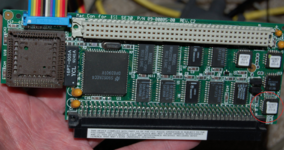
Great progress! You may need a zero delay clock buffer on the clock or at least some termination to compensate long channel and extra loading on the clock signal without alter the timing.
I actually have both! I do buffer the ZDB itself though which I am going to try removing as I think it is counterproductive here. I borrowed the PLL section I use on my Booster clones, but it's a mix of old design and new that I added, so maybe that wasn't the best idea.
Unfortunately, termination is a sensitive situation given that the signal itself is very anemic by this point. Even a 1K resistor pull up/down is enough to tilt it towards working or not. The clock is series terminated on the LB, but the PAL also has poor drive strength. A GAL or ATF seems to clean it up a little, but I can't exactly insist everyone who wants to use a card swaps that out. For the moment I have a series resistor as I've seen done on some accelerators, however benefits are quesitonable.
What‘s making it not pleasant to build? (Apart from being made of boring through-hole components)? Could a SMD version improve that?
What about offering a PCB+components DIY kit? I‘d be quite happy with that! I love soldering

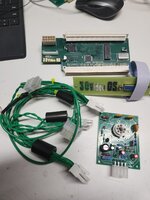
I don't mind the through hole as much, though it takes a while to build. It's about half components and half some design issues. Essentially all annular rings are undersized, and most of the holes are also. Makes it more complicated than necessary both to insert components and to solder thoroughly.
I definitely want to offer full setups, but I could see selling just video cards with a neckboard PCB included. By the time all the parts are together for a kit, it ends up being about as much effort to assemble it myself. I'd provide bare PCB and folks can DIY the harness / assembly if so inclined.
Also, important correction to all who are treating the BOM data from Gamba's site as authoritative: R6 is 20K (not 200) ohms, and R5 is 560 (not 56) ohms. Won't work without changing those!
wrt turning it to SMD: Of the ~30 components on the neckboard, only around 10 would be immediate candidates for a relatively direct SMD replacement. Mostly some resistors, 3 diodes, and a cap. Problem is much of the card is designed for power handling, so would be large and/or exotic parts as far as SMD is concerned. It also involves analog voodoo I'm not conversant with.... a full redesign (new schematic) might be able to move more parts to SMD, but at the moment I'm not able to undertake that.
You could use a (battery bombed) compact mac as external monitor

Haha, if only. I don't provide a full set of control signals though, and rely on the logic board for syncs and pixel clock. Micron does something similar, though they shift HSYNC slightly which seems to be responsible to the buzzing my Micron setup generates.
It turns out the HSYNC from the LB isn't so much hsync as it is the horizontal drive, and it is very different from a typical hsync signal. It would require custom logic to generate as it needs to be asserted well into the period when pixels are output also. Given it directly drives the power transistor, I was strongly advised to avoid any disruption to the hsync signal as it could have potentially catastrophic consequences.