
This video is Part II of the interview excerpts with Ray Arachelian, focusing on the Apple Lisa's historical significance as an inflection point in computing and the development of his LisaEm emulator.

You are using an out of date browser. It may not display this or other websites correctly.
You should upgrade or use an alternative browser.
You should upgrade or use an alternative browser.
Ray Arachelian, Part II, focusing on the Apple Lisa's historical significance as an inflection point
- Thread starter ClassicComputing.com
- Start date


Cool, I've watched this now! I think most of what I knew about the Lisa came from the extensive benchtest in Personal Computer World (UK) in July 1983; the book "Insanely Great"; possibly bits from the biography "Jobs" and reading Folklore.org. It's good to describe the Lisa as an inflection point, as it united a number of technologies at the cusp of a new era; whereas the Mac actually broke through.This video is Part II of the interview excerpts with Ray Arachelian, focusing on the Apple Lisa's historical significance as an inflection point in computing and the development of his LisaEm emulator.
I think the only time I've seen a Lisa in action was at the 68KMLA/UK meetup a few years back, but their primary goal was to run (or demo) GEM on it (I understand that GEM was bootstrapped via the Lisa).
The extensive, 12 page PCW review of the Lisa was my first introduction to WIMP concepts (they weren't called a GUI then):
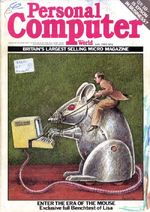
Hmm. My copy of this magazine is in better condition than theirs.
At the time I read this, at the age of 15.5, I was already on my third computer, a ZX Spectrum 48k following my 16kB ZX81 (Jan 1982-June 1982) and 1kB ZX80 (October 1980-October 1981). I found the concepts inspiring enough to want to create my 'O' level Computer Studies project around icons (which I implemented as 16x16 pixel images at the bottom of the display).
I'm currently playing with SunOS emulators. I must say that Sunview (1989) and Solaris 3 (1991) are woeful as GUIs in comparison with even an early Mac. Ugly, crude, unintuitive, Unix bolt-ons; though intriguing in their own right.
I didn't actually have a GUI-based computer until 1993 when I bought an LCII (which is finally dying due to cap leakage, which I need to fix by recapping). Between 1986 and then I had a Sinclair QL. The rush to release the QL ahead of the Mac and before most of its ROM bugs were fixed led to terrible reviews and its ultimate failure (though it sold 150K units, far more than the Lisa, mostly because it cost £400).

I'm currently playing with SunOS emulators. I must say that Sunview (1989) and Solaris 3 (1991) are woeful as GUIs in comparison with even an early Mac. Ugly, crude, unintuitive, Unix bolt-ons; though intriguing in their own right.
I love messing around with early graphical environments. I have a couple UK-centric ones in my "lab", in fact: the window management system in PERQ PNX, and Oriel as developed on machines made by Whitechapel Computer Works, both circa 1984 or so.
These are similarly uninspiring from a UX standpoint, but I think that this is not an objective that motivated their creators. My hypothesis is that there were two major varieties of reaction when computer professionals saw graphical windowing systems and graphical workstations as demonstrated by Xerox and others:
One camp said "at last, this gives us the capability to make a computer interface that harnesses familiar idioms from the physical world". These are the people who built the kinds of graphical interfaces that the Lisa and the Mac introduced to the world. (Yes, yes, Xerox Star, VisiOn, whatever, Santos-Dumont invented the aeroplane first, fine. Not important right now.)
The other camp said "at last, a way for me to take all the VT-102s in the computer lab plus that dusty Tektronix 4012 and pack them all into one big computer monitor --- my big computer monitor". These are the people who brought us the Unix windowing systems. Ease-of-use was not the goal: it was power. (PNX and Oriel barely have the concept of a button!)
Good theory. I've never used a PERQ, though I think I saw one when I was visiting Unis during my 'A' levels (it was switched off). I also saw a Sun Workstation in 1986 with its massive monitor when I snuck off from the guided tour for about 15 seconds into a small office (I saw the computer as we were going past, so I popped into the office just to gawk at it, before they noticed I wasn't following).I love messing around with early graphical environments. I have a couple UK-centric ones <snip> PERQ PNX, and Oriel <snip> circa 1984 or so.
<snip> My hypothesis <snip> One camp said <snip> familiar idioms <snip> Lisa and the Mac. <snip> The other camp <snip> Ease-of-use was not the goal: it was power.
The 3M concept is certainly of the power ilk. In this sense, using the already familiar point and click idioms to serve their power objectives makes sense. I also had a go at helping to port the ETH lilith emulator to Mac OS X: I worked on an m-code emulator in'C' rather than a microcode emulator; and got most of the way. It was about 10x faster than the µcode one. I didn't have enough m-code level debugging to figure out where and why my emulator improperly diverged from the microcode version, but since mine had different timings it was bound to anyway.
Right now, I've been having a bit of 'fun' with the MAME SparcStation 1 emulator. Yes, I know it's classified as "Not Working" and primarily I'm just trying to get a feel for what a SparcStataion 1 was like, with its amazing 12.9MIPs of CPU! I have SunOS 4.1.2 installed on an emulated 1.3GB drive, with a few glitches (sometimes the keyboard doesn't work in the GUI). But I haven't figured out how to do data transfer to and from the host. I've tried using a pcfs floppy disk image made with MAME's imgtool but the SS1 just hangs when I try to use it (maybe a bug with the emulator). I haven't gotten my head properly around how to use MAME's serial port emulation over sockets to transfer data yet (do I use 127.0.0.1 or my actual IP or some other protocol, UDP/TCP?). I don't know if MAME's SS1 ethernet works either (if it did I can use the same method as for the QEMU SS-5 approach). I'm interested in MAME, because, unlike QEMU it aims to run at actual speeds and supports Sparc V7 (when they only had Multiply step instructions).
Any ideas?
Sounds like a PERQ all right, especially if it was summertime and a space heater was not required.it was switched off
Unfortunately I've never troubled MAME for very much (the in-browser emulator for software on archive.org is about it), so I'm afraid I can't offer any help! Hopefully someone else knows...
Yes it could have been summer. The PERQ already seemed like an old design even in the mid-80s.Sounds like a PERQ all right, especially if it was summertime and a space heater was not required.
Something tells me that SparcStation emulation on the 68KMLA on a thread about the Lisa might not be 100% on topicUnfortunately I've never troubled MAME for very much (the in-browser emulator for software on archive.org is about it), so I'm afraid I can't offer any help! Hopefully someone else knows...
 ! But thanks for replying!
Aaah, anyway I've figured out part of the problem. I can get data onto the SS1 by creating a folder with the data I want, then creating an .iso image from macOS using:Sounds like a PERQ all right, especially if it was summertime and a space heater was not required.
Unfortunately I've never troubled MAME for very much (the in-browser emulator for software on archive.org is about it), so I'm afraid I can't offer any help! Hopefully someone else knows...
hdiutil makehybrid -iso -joliet -o image.iso /path/to/sourceThen I can boot into the SS1; log in as me; then su ;
mount -rt hsfs /dev/sr0 /mnt/cd (I had created a directory /mnt/cd). Then I can ls /mnt/cd to get my files. Can't yet get data off it though!One of the things I wanted to test first was the Dhrystone benchmark. I nicked the version from Retro68 on GitHub; however, it has all the prints and timing disabled, so I had to re-enable it. SunOS provides a default K&R C compiler, which will compile dhry.c happily (as it's K&R) . Compiling with:

Gave a result of:

when given 1000000 runs (so it took about 44 seconds to run). This is pretty close to the official result for a SparcStation 1+ (at 25MHz),
Sun SPARCstation 1+ SunOS 4.1.2 SPARC 25.0 11.8 12.1
So, I think that means it's a good enough experience for now. I'm getting used to SunView at this point. 3rd button click menus are pretty conventional (all the menus are pop-up contextual menus, like traditional Alto or Archimedes ones). There's no scientific calculator I can see, but I have just found the fileviewer, so that's helpful! Anyway, I'll try and bow out for now!
Last edited:

There's CD authoring software for SunOS 4.1.2 isn't there? I vaguely remember it back in the day, with a 1X CD-RW drive.
That said, SunOS comes with an easy way to get stuff on/off: NFS. Set up an NFS share on the guest system, and if you've got networking configured, you should be able to NFS in directly from the Finder on the host, or from Terminal. You can probably do it the other way too, set up an NFS share on the host, and connect to it with the guest system. Of course, then you still have to figure out which interface to connect over, and I'm not sure how MAME is handling that. Alternatively, a Linux VM on your host should be able to read the partition info from your MAME image.
That said, SunOS comes with an easy way to get stuff on/off: NFS. Set up an NFS share on the guest system, and if you've got networking configured, you should be able to NFS in directly from the Finder on the host, or from Terminal. You can probably do it the other way too, set up an NFS share on the host, and connect to it with the guest system. Of course, then you still have to figure out which interface to connect over, and I'm not sure how MAME is handling that. Alternatively, a Linux VM on your host should be able to read the partition info from your MAME image.
Indeed, the technique with QEMU's SS-5 emulator is to use NFS. However, when I boot up the SS-1 under MAME, its MAC address in the emulated PROM is just FF:FF:FF:FF:FF:FF. And it doesn't boot automatically into disk3 (where the OS is), I have to type b disk3 each time at the OpenFirmware (OpenBoot?) prompt. So perhaps ethernet isn't working or the PROM isn't. It's something I'll look into.There's CD authoring software for SunOS 4.1.2 isn't there? I vaguely remember it back in the day, with a 1X CD-RW drive.
That said, SunOS comes with an easy way to get stuff on/off: NFS <snip> not sure how MAME is handling that<snip>
Similar threads
- Replies
- 0
- Views
- 327

- Replies
- 4
- Views
- 2K


- Replies
- 0
- Views
- 1K
