1024=0x400
Not that, I don't think. The pixels would be numbered 0-1023.
It could be a limitation of RAM.
I'm inclined to believe this. The color lookup table takes 256*something bytes.
Could it actually be a bug that no one caught? (I doubt)


1024=0x400
It could be a limitation of RAM.
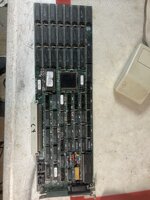
Great writeup, you went above and beyond with the old articles from magazines.I bought this old SuperMac graphics card on eBay. I knew it was going to be an early card, given that it nearly contains only through-hole parts.
View attachment 83304
The ROM label is interesting, in that it says "SPECTRUM" but not "/8" or "III" or any additional modifier. I assume 'D6' is the ROM version. Looking at the raw ROM file reveals the version to be 1.0b6. So, a prerelease ROM? Given the mid-1987 date codes on some of the other chips, I think this is a production release.
View attachment 83305
With the card installed, I was in for a bit of a treat. 1024x768 resolution in 8-bit color circa the launch of the Macintosh II. Wow! I was sure it would be only 640x480.
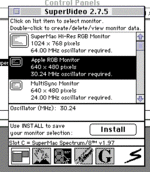
Although no driver is required, the SuperVideo software did not work with such an old ROM.
View attachment 83306
Back to eBay. Quickly!
Someone was selling an identical board with a v1.97 ROM. (The seller said this card had weak color, but it seems to be an issue with choosing the correct sync settings. The color is beautiful with @bigmessowires Mac Sync-inator. There is some waviness which the first card doesn't have. I assume something has aged poorly in the second card.)
View attachment 83307
Not sure what that copyright date is. I think 1990. I copied a '0' from the part number and made it partially transparent. Seems to fit.
View attachment 83308
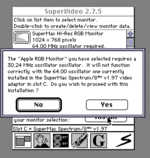
With the newer ROM, the SuperMac software works. There are seven resolutions / frequencies which can be enabled if the correct crystals are installed.
View attachment 83309 View attachment 83310 View attachment 83311
Does anyone know where I could get a 30.24 MHz oscillator in a full can? Not available on Digi-Key, Mouser, or eBay. Maybe a surface mount with adapter board? But, it would need to be a 5V part. It doesn't even look like programmable oscillators are available.
The ROM is a M2764A-2FI. Ha! That's only 8KB. In fact, the earlier firmware just filled up about 5KB.
View attachment 83312
The Texas Instruments chip is blacked out on both boards. Any idea what would remove permanent marker but not the chip markings? I understand the TMS34010 was popular at the time, but that number doesn't quite fit the markings.
View attachment 83313
The board does have a design flaw. They put the connector too high on the slot. It barely fits a monitor connector on a Macintosh II (IIx, IIfx) model.
View attachment 83314
But the monitor cable connector does not have enough space on the compact Mac II series, such as a IIci. Seriously, I tried. It doesn't fit.
View attachment 83315
Did Apple change the slot length specifications? That seems like such a weird thing to alter.
What's in a name?
What is the official name of this video board? The initial ROM is simply "SuperMac Spectrum". The later ROM is "SuperMac Spectrum/8".
Looking through old issues of MacWorld, the first mention of this card by name is July 1987. By the way, I didn't see an 800x600 setting in the SuperVideo software, so maybe they didn't ship that configuration.
View attachment 83318
But, later in the issue the card is called "Spectrum 1000/1" and "Spectrum 1000/8".
View attachment 83320
In that same issue, here is a comparison of the competing cards around the time of the Macintosh II launch. The card and monitor would set you back $4500.
View attachment 83319
A year later, RasterOps caught up with color cards, including millions of colors.
View attachment 83321
But, SuperMac also released a 24-bit color card. Hence, the Spectrum/8 name stuck to differentiate it from the Spectrum/24.
View attachment 83322
As of the August 1988 MacWorld issue, Apple did not support 32-bit QuickDraw. According to technical note QD01, 32-bit QuickDraw shipped in May 1989, was built into the IIci ROM, and shipped with System 6.0.5 in 1990.
View attachment 83323
Anyway, it is cool to own such an initially powerful color card, even if it pales in comparison to later generations.
ROMs attached.
- David
They might have a row bytes register that is not numbered like that.Not that, I don't think. The pixels would be numbered 0-1023.
Probably 3 bytes if they had 8 bit DACs (not necessarily true for cards limited to 256 colors).The color lookup table takes 256*something bytes.
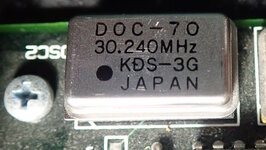
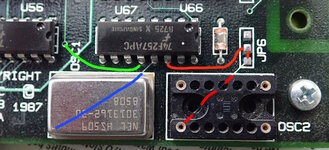
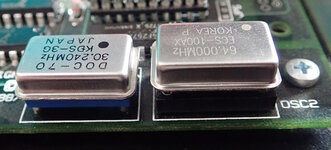
From your previous picture, it looks like the clock signal from OSC2 goes through a disconnected jumper (jp6)? I assume you closed that? Not sure how jp6 is wired but curious if in this first generation card, a jumper was required to select between the two oscillators?
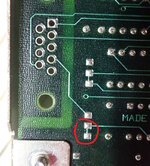
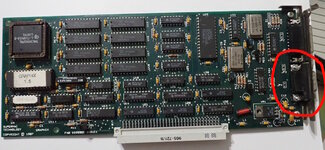

Thanks for the potential lead. That was originally my thought as well. However, the jumper connector was hard jumped for production. Check it out:


I count 24 NEC D41264C 4bit x 64k dual ported VRam chips - 768kb VRam. I guess that‘s not enough for 24bit even at 640x480, you need 921kb or simply 1mb.How much VRAM(?) is on the card? Enough to support 214bit color? @Bolle, I'd go in the other direction. LEM is more likely to be wrong on the specs for this card than for it to have been 24bit capable in that era.

Agreed; 768kb is what I needed to get 16bit at 640x480.I count 24 NEC D41264C 4bit x 64k dual ported VRam chips - 768kb VRam. I guess that‘s not enough for 24bit even at 640x480, you need 921kb or simply 1mb.
 Another good question. Might be in the manual.
The original versions of SuperVideo had a "slurper" tool (eye dropper with a fun slurping) tool that would let you chromakey whatever background color you selected.