• Hello MLAers! We've re-enabled auto-approval for accounts. If you are still waiting on account approval, please check this thread for more information.

Interware Booster 30-SE50F Info Dump

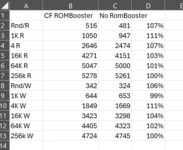
The ROM-booster function does seem to help disk access too. Another extreme case as this is using my compactflash card though.

There's a bit of jitter in the write results (CF card, rather than the accelerator) but there is an evident trend the calls that are overhead-heavy (more time spent running code than reading data) noticeably improve from it. I suppose it makes sense the filesystem/disk intermediate layers between user application and my disk driver would also remain in ROM.

1739892027975.png
 
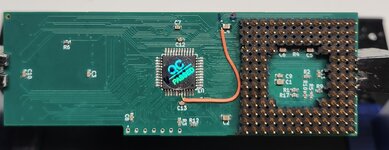
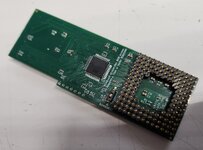
I bought a Booster 50-SE30F v1.2 (goes in PDS slot) from ZigZagJoe last August for my SE/30 and it works great except for audio. I loaded up Sid Meier's Civilization last night and the opening music is distorted. For the last few months, I've been working on getting my BlueSCSI up and working and thanks to the help I got from the people here, my drive images now work great on my SE/30. Anyway, out of curiosity, I pulled the Booster out and restarted Civilization and the audio is fine. I also found out that in the 2.0 version, this issue is fixed.

So what are my options here? There are no controls to adjust the speed of the accelerator so can I upgrade the firmware to fix this issue?

Thank you for your time,
Gerry

(continued from feedback thread.) It sounds like you're using System 7.5 and/or Sound Manager 3.0. This is the 'the garbled sound on 7.5' I mentioned that affects the V1.X boosters (and the original Interware boards too). The 2.0 cards I completely redesigned with a new programmable logic device to enable the new features, so there's no way to backport this feature to the earlier cards.

I would recommend running 7.1 if possible as that's the only workaround here.
 
(continued from feedback thread.) It sounds like you're using System 7.5 and/or Sound Manager 3.0. This is the 'the garbled sound on 7.5' I mentioned that affects the V1.X boosters (and the original Interware boards too). The 2.0 cards I completely redesigned with a new programmable logic device to enable the new features, so there's no way to backport this feature to the earlier cards.

I would recommend running 7.1 if possible as that's the only workaround here.

I much prefer System 7.1 on an SE/30 to 7.5 (and up), it just feels more responsive. You can disable a lot of the extensions and control panels in 7.5 that I think lead to some of this but at that point why not just run System 7.1? I do add BeHierarchic and SuperClock! as having a hierarchical Apple Menu and menu bar clock are two features I like most from 7.5.
 
I much prefer System 7.1 on an SE/30 to 7.5 (and up), it just feels more responsive. You can disable a lot of the extensions and control panels in 7.5 that I think lead to some of this but at that point why not just run System 7.1? I do add BeHierarchic and SuperClock! as having a hierarchical Apple Menu and menu bar clock are two features I like most from 7.5.
Same here. The boosters at least make 7.5 tolerable, but even if the newer Boosters correct audio on 7.5, I think 7.1 is still the better choice. With a couple of add-ons I find it functionally close enough to 7.5 as well as much faster. Especially to boot. No need to bother with resediting the system file when using a different ROM image.

By the by, did you ever have any luck with those cache modules? Fully understand if you don't want to pull that pin out though.

---------

Unrelated to both topics, the ROM booster/acceleration functionality seems stable and being field tested now. It appears to provide a minor but still relevant performance gain. All existing booster 2.0 cards can support this functionality, if you're interested in having the upgrade applied just send me a PM. Due to the lack of an easy way to configure it, the best option I've got is to add a bodge wire that would need to be desoldered in order to switch the enabled state.

1741798218306.jpeg
 
Last edited:
Life has gotten in the way of me getting back to that. Hopefully soon!
No worries! Just idly curious, as I'd like to some day come up with a faster booster design that maintains the simplicity that's nice about the current ones.

I still flirt with the idea of sticking 16MB of fast SRAM on one of these (at least in a SE/30 version), as that would provide some extremely interesting potential. It'd be extremely expensive and more complex than is sane, unfortunately, but it's fun to think about.
 
the ROM booster/acceleration functionality seems stable and being field tested now. It appears to provide a minor but still relevant performance gain. All existing booster 2.0 cards can support this functionality, if you're interested in having the upgrade applied just send me a PM. Due to the lack of an easy way to configure it, the best option I've got is to add a bodge wire that would need to be desoldered in order to switch the enabled state.

I do not recommend Rominator and other unbuffered SIMMs using TSOP flash as they cannot support high speed operation due to insufficient drive strength. It's fine for stock, but use either GG Labs or a design with discrete buffers if you want to use the ROM Boost.
From: https://68kmla.org/bb/index.php?threads/different-rom-se-30.50996/post-574603


In anticipation of receiving a socketed Booster v2 from you (thanks!) I'm trying to make sure I understand how best to make use of the ROM booster feature.

Hardware wise there is a jumper for enabling ROM booster functionality on the latest Booster v2 cards? As stated in the quote above owners of the original Booster v2 cards can reach out to you for equivalent enabling bodge instructions (and re-flashing?). This does not apply to IIsi Boosters as the ROM booster function relies on chipset features of the SE/30 (and Iix I'm guessing?).

You need a fast ROM to be able to use this feature, not all modern ROM SIMMs support high speed operation. The GG Labs ROM is one that should work.

To be of the most benefit you need a ROM image and OS combination where the OS is not patching over the contents of the ROM.

Good - Original SE/30 image and System 6.0.x
No Good - Original SE/30 image and System 7.1
Good - IIsi ROM image and System 7.1

Am I close? :)
 
Last edited:
Any recent production PDS cards now have a DIP switch on the rear of the card. Socketed ones have it on the bottom next to the PGA pins. So enabling and disabling ROM Boost is easy now.

1000021238.jpg

ROM boost relies on exploiting a quirk (bug?) of how the early GLU based Mac II machines do address decode for the ROM which is why the IIsi with its better designed chipset doesn't have the option for ROM Boost. There's a theory of operation here.

Realistically, any OS is fine as the main benefit is have found is for improved quickdraw performance and to a lesser degree disk access. I don't think any substantial patches are made to these on the IIsi/IIci universal ROMs. SE30 ROMs dont see the quickdraw benefits as color quickdraw is patched for 32 bit compatibility in all but earlier versions of System 6. Raw throughput of the ROM is increased by about 2.4x over stock. This would also apply to ROM disks...

ROM Boost compatibility known good.
  • GG Labs and similar with 4 PLCC chips
  • SE30 reloaded onboard PLCC chips
  • Pgreenland ROM simm (prototypes only)
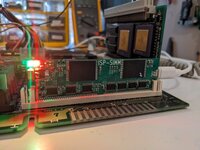
  • My ISP-SIMM (discontinued)
  • Garrets workshop gw4402b
  • Caymac prototype simms (derivative of gw4402b)
  • In general any ROM with 7 small buffer chips beneath the flash should work. See below for an example.
1000004729.jpg

Known problematic
  • ROMinator ii (any)
  • Older Caymac simms without buffers
  • OEM apple simms

To clarify on problematic: these simms may still work and it helps if an expansion card is not present and or RAM is not fully populated. The worst that will happen is the machine won't boot, so if you have one of these SIMMs you may as well try turning ROM boost on and just turn it back off if it does not boot.

There are no obvious tells to when it's enabled such as icons or otherwise. You can verify it's working by running a graphical benchmark of any type, you will observe a performance increase though to what degree depends on the particular benchmark.
 
Last edited:
Thanks. I bought a custom ROM SIMM years ago or my IIsi which I had forgotten the particulars of, it is is a GG Labs SIMM! Its really not doing much in my IIsi other than making is possible to boot from ROM for fun (or if the HD dies, needs troubleshooting...) so I think I will move it over to my "new" SE/30 for use with your Booster.
 
Back
Top