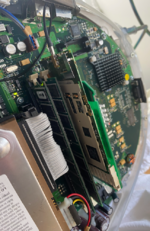
The point is to use machines which have internal AirPort cards, running classic MacOS, for which there are no 802.11g card drivers.
I think you're confusing WiFi generation and encryption standard here. The problem isn't so much there aren't any 11g drivers as that the OS 9 WiFi stack does not support WPA(2) even over 11b.
Also, who is doing anything worth spying on with a thirty-year-old computer? That is a fake problem

Not true. Let's think about what the risk actually is in this situation. Risk is the result of both the likelihood of occurrence and the impact of any occurrence. So we can take these separately.
Likelihood of occurrence: there are millions of domestic networks out there, many of them rather poorly secured. People do try to break into domestic networks, for various reasons. But because there are millions of them and any malicious activity is probably not aimed at the owner of the network personally (except under rather unfortunate circumstances), for most of us we can get away with just not being the softest target in a given area. Our putative attacker will find easier prey quite easily, generally.
If we've got WEP then getting access to that wireless network is trivial, and you are no longer 'not the softest target' - in fact, the only softer targets are those without any encryption and access control at all. So by sheer statistics, even assuming that the attacker is not going after you personally, the likelihood of occurrence is noticeably higher. If the attacker is going after you personally, welp, good luck.
Impact of occurrence: depends on how your network is set up, but most of the simple ways are a liability. Let's look at two things an attacker could attempt to do.
First, the "spying"/stealing data use case. It is not the case that having a WEP AP just attached to your network is only putting at risk traffic between the old computers on the WEP network. Remember that if you can inject arbitrary L2 frames into a broadcast domain - especially ARP - you can basically pretend to be any computer on that broadcast domain and redirect traffic away from, say, a wired station to a wireless station. This can be mitigated by encrypting everything at application layer - which is what the modern web largely does - and so is not as much of a problem as it used to be. It can also be mitigated on the network layer by having your WEP network as a separate broadcast domain and route between that and the rest of your network, if you must. But how many people do that, other than network nerds?
Second, the "I want bandwidth that can't be traced back to me" use case. This is far more common, and can actually potentially get you into far more trouble than the first. There's all kinds of dirty work that one might prefer to do on someone else's network from a car outside, say - and by the time they get the nasty letter from their ISP or the police, one is long gone. To mitigate this, your WEP network would need not to have a route to the outside world at all. Again, how many people do that other than network nerds?
Most people who want WEP just plug an old AP into their existing network. That exposes them to these risks.
Now, are these risks enormous? Not... hugely. One is far more likely to get got by malware on the Internet than by a drive-past attacker. But they're also basically trivial to remedy. And even if the likelihood of occurrence isn't huge, not exposing yourself to risk you don't have to is a prudent and sensible thing to do, especially when it's dead easy.
So telling other people this is a 'fake problem' is irresponsible. It's not a fake problem at all. If you have decided that in your risk calculus this is OK, then that's fine. But each person has to make their own decision here; to tell them it's a fake problem prevents them from making their own decision about risk in a situation where the nature of that risk can be very non-obvious. And that's not a good thing to do.