Bought a couple of parts iisi units. Both have good egrets, and other components that are compatible with classic ii from searching google. Is it possible to do a cheap upgrade from the 16mhz to 20 68030 from iisi as well?? why not if its possible 



When you overclock beyond the 50MHz oscillator (CPU speed would be 25MHz at this point) the NuBus runs into a lot of weird issues.Curious about possible wonkiness of NuBus Adapter/Card function in an overclocked IIsi board?
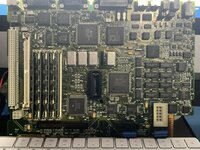
The crystal can is unmarked on the Apple IIsi NuBus adapters I have on hand. Methinks it's for the FPU which would be consistent with Accelerators I've seen.
The Radius NuBus Adapter for the IIsi halves the baseline 20MHz CPUCLK of the IIsi to derive the 10MHz NuBus Clock requirement. It "just works" in the SE/30, but at 8MHz based on the 16MHz SE/30 clock and NuBus cards tested appear to work at that rate.
So wondering if NuBus would be running at a multiple of 10MHz in an overclocked IIsi based on the chipped clock rate?


Yep, that'd be the result I expected.
If using a NuBus Card, keep the IIsi system clock stock at 40MHz. I'm a bit surprised you don't get wonkiness with the 50MHz crystal can?
PDS cards may or may not work correctly. I'd not much expect an SE/30 form factor PDS Card to work correctly in a hot rodded IIsi. In DCaD Apple notes that some legacy 16MHz cards for the SE/30 may not be compatible the 20MHz Clock of the IIsi.
Is the IIsi's onboard Vampire Video kluge wonky at all given that 25MHz CPUCLK rate? Timings could be off for syncing with brain dead Apple fixed, silly resolution displays?
edit: this pretty much puts the last nail in the coffin of the "Apple had intended it as a 25 MHz computer, but chose to scale back the speed to avoid cutting into IIci sales" (urban) LEM legend. Given the tightly knit, flexible NuBus/PDS expansion spec. for its development, the IIsi was obviously designed from the very start to be a 20MHz system. It just happened to use available parts from the eleven months earlier IIci design that were rated for that faster 25MHz CPUCLK.
Clock chipping the IIsi: Just don't do it, find an accelerator.
I have one of these 25MHz boards, be neat to test on my end and see.Apple may have considered making the IIsi a 25mhz machine, and certainly the PCB design would make no difference if it ran at 20 or 25mhz. As you have found, NUBUS compatibility with the SE/30 likely caused Apple to just proceed with a 20mhz model.
Is the PDS slot in the IIsi the same as the cache/PDS slot of the IIci?
I’m thinking it was likely easier for Apple to make the IIsi a “middle ground” at 20Mhz than to try to make it somehow compatible with SE/30 PDS and also run at 25mhz.
If the legend has any truth at all, it likely was a very early decision in the design process, not a late change like is alluded to by LEM editorials.
I have one of these 25MHz boards, be neat to test on my end and see.
I have one that shipped with a 25MHz and a weird serial number.You have a 25mhz IIsi that shipped as 25mhz, or that you made run at 25mhz with an oscillator swap?
Not likely at all, I'd say, given overall history of development:Apple may have considered making the IIsi a 25mhz machine, and certainly the PCB design would make no difference if it ran at 20 or 25mhz
Per above, NuBus was entirely out of the scope of the SE/30's development. That the Radius NuBus Adapter works on its PDS at all is a minor miracle, but totally out of spec. with NuBus running at 8MHzAs you have found, NUBUS compatibility with the SE/30 likely caused Apple to just proceed with a 20mhz model.
Not at all, it's exactly the same as the 030 PDS of the SE/30, but running at the higher 20MHz CPUCLK with 10MHz NuBus derived from that.Is the PDS slot in the IIsi the same as the cache/PDS slot of the IIci?
IIsi was targeted from the start to be the mid/low marketing entry to the 030 Macinosh II line. IIvi and IIvx were already on the horizon as stopgap measures during the Quadra line's development.I’m thinking it was likely easier for Apple to make the IIsi a “middle ground” at 20Mhz than to try to make it somehow compatible with SE/30 PDS and also run at 25mhz.
I'd bet a shiny nickel that that thought never crossed the minds of Apple marketing and so never entered into design process at all.If the legend has any truth at all, it likely was a very early decision in the design process, not a late change like is alluded to by LEM editorials.
Very interesting, are you positive it shipped with that 50MHz crystal?I have one of these 25MHz boards, be neat to test on my end and see.
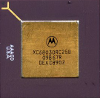
It’s a 25MHz CPU.Very interesting, are you positive it shipped with that 50MHz crystal?
Is the crystal can soldered or socketed?
What does the silk screen layer of the board say at that position?
Check to see if there's any crystal present capable of supporting 10MHz for the NuBus adapter, none present on stock IIsi other than the 40.0000MHz system crystal closest to SIMM Slots. The other three are for various purposes. Appearance of such (a fifth?) crystal on your board might prove it to be a prototype. Otherwise it would likely be special production run as indicated by the odd serial number?
If a special edition of the stock board, that would make it a PDS ONLY build, NuBus incompatiblilty would have been specified. I'd think the silk screen legend would say 40.0000MHz?
I agree but it’s the serial number that really gets me as being very odd, hence why I cannot fully agree.Perhaps when Apple was doing initial production, to save time they just used 25mhz CPUs they had on hand for the IIci in building the first few IIsi machines. Maybe there was a delay with Motorola for 20mhz marked chips.
Because this machine has non-prototype ROMs, and it has silkscreen for 40mhz clock oscillator, leads me to believe it was always a 20mhz board.
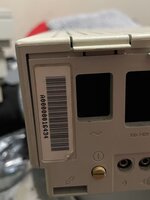
What is the logic board serial number ? That is more important as the case sticker could have been changed by anyone. I might not even be an apple sticker it could be an inventory control sticker for asset documentation.I agree but it’s the serial number that really gets me as being very odd, hence why I cannot fully agree.