• Hello MLAers! We've re-enabled auto-approval for accounts. If you are still waiting on account approval, please check this thread for more information.

Reverse Engineering the Macintosh LC III Logicboard

max1zzz

68000
Time for another board!
I was initially intending to work on the LC II board next, however about a week ago I picked up a LC III board and started having a closer look at it, I initially expected this to be a 6 layer board and require redrawing form the schematic however the closer I looked the more it looked like a 4 layer board

So I reached for the desoldeirng gun and hot air station and spent a couple of days stripping the board, then scanned it and loaded it into sprint. I then started picking traces at random and following them, None disappeared into the board and comparing them to the schematic showed they connected to everywhere they should. My conclusion therefore was that the III is most likely only a 4 layer board.

Since I now know the III is a 4 layer board, and because I have already stripped and scanned it I'll put the II on hold for now and work on the III

So this evening I sat down and started on it, top side components have mostly been placed, I'll probably start on the tracks tomorrow
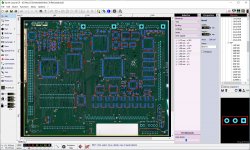
25-08-21.jpg

This one might take a little while, mainly because I should probably finish off the testing on the reproduction LC 1 boards before spending too much time on this one! :)
 
Dose anyone know what the value of the system clock crystal is on the LC III? It's marked 0107T3B, in guessing the "0107" in that signifys the frequency but I can't seem to equate that to any sensible value and it's not stated in the bomarc schematics.....
 
If you don't have a second one to measure I suppose I can have a look at mine with an oscilloscope this week-end.
Mine says:
S0107
92-52 (likely manufacturing date)
 
Since I had it already open and the osc was 1m away with a brand new probe to test, I had a look… at first I thought I would get anything since it's a 20MHz antique, but it seems to have a magic EXP.10 button that shows a nice sine wave.
I counted almost 15.5 alternances for the whole 10 divisions, with 0.5µs/div but with the EXP.10 I suppose it's 10 times less…
That'd make 1000000*(10/10)*15.5/0.5 = 31MHz.
32MHz would seem more logical though.
A bit odd since the LC-III supposedly uses 25MHz for the CPU, but maybe there's some scaling in the glue.
 
Since I had it already open and the osc was 1m away with a brand new probe to test, I had a look… at first I thought I would get anything since it's a 20MHz antique, but it seems to have a magic EXP.10 button that shows a nice sine wave.
I counted almost 15.5 alternances for the whole 10 divisions, with 0.5µs/div but with the EXP.10 I suppose it's 10 times less…
That'd make 1000000*(10/10)*15.5/0.5 = 31MHz.
32MHz would seem more logical though.
A bit odd since the LC-III supposedly uses 25MHz for the CPU, but maybe there's some scaling in the glue.
Figures. Maybe it skips the scaling if you put the 0 ohm resistor on the position that gives 33MHz to the processor. Because your calculation could be slightly inaccurate
 
I'll check again tomorrow, it's 3am here :-D
I need to take the logic board out to clean it again, after the recaping, there's still some green stuff from leaks.
 
  • A bit odd since the LC-III supposedly uses 25MHz for the CPU, but maybe there's some scaling in the glue.
The LC III was originally sold clocked at 25 MHz, but Apple later released a speed-bumped version called the LC III+, which otherwise is essentially identical to the original LC III.

To confuse matters, all the branding and labeling between the two is, as far as I know, identical, so it's really hard to tell which is which.

Based on the fact that you seem to be getting something close to 33 MHz, it seems reasonable to assume you have one of the following:
  • An LC III+
  • An original LC III which has been overclocked to 33 MHz
It really doesn't matter which, as the two are functionally identical.

c
 
@mmu_man Thanks for that! 33MHZ sounds reasonable given that the crystal is connected to U22 which appears to be some kind of custom clock chip which would be handling clock scaling, although it dose mean it is dividing by 1.32 to get the 25mhz clock which would seem a bit of a odd value me me but I guess it's possible

I would have tried measuring it myself but my oscilloscope is a cheap USB one and accuracy is not that things strong point! :)
 
Rechecked properly on the table, but still 15.5 or less, either the quartz is drifting, or charging it with the probe changes the freq. But yeah, all sources point to 33MHz so that should be it.
 
In case you're wondering, J7 is some kind of video feature connector to pass through signals from a PDS card, the pinout is in the developer notes.
 
I'm thinking it might be useful to have some accessories for 3D printers to probe all pads on some random boards and generate the netlist directly… 🤔
 
Yes it's already documented in this article I mentioned already:
 
Isn’t the clock generator fed with 31.something MHz (31.3344 I think?) crystal? At least that’s what’s happening on the 475 which has a similar frequency generation setup.
 
Back
Top