Thanks for the tips! First step is to get it up and running at all. 



Rethinking your original statement about emulating a PPC Mac at realistic speeds on a PI 4. Although DingusPPC (as it stands) can't emulate even the slowest PPC used in a Mac (a 603/75 or 601/60) a JIT could. Let's do the math again.<snip> This is a reboot of a two decades old project aimed at lavishing unending love upon my very first laptop, a brand spankin' new, remaindered PowerBook 100 <snip> I just asked up front if my decades old OS of choice for all my Graphics/CAD/CAM applications and equipment might be a possibility. OS9 is not a necessity!<snip>
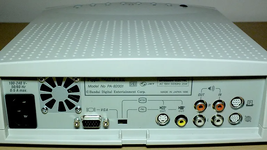
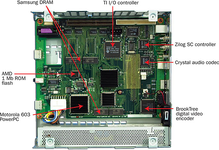
Pippin uses Grand Central instead of O'Hare/Heathrow/Paddington. MESH is a discrete in all the Grand Central machines that have MESH (includes TNT/PowerSurge machines such as the Power Mac 9600).The internal CD-ROM is SCSI, not IDE. Pippin is (as far as I know) the only machine with a discrete MESH SCSI controller (it's built-in to O'Hare/Heathrow/Paddington).
That's a real surpriseThe internal CD-ROM is SCSI, not IDE.
 ! A low-cost IDE controller is barely more than a 16-bit latch.
The ROM on the CD, because there's a 1MB AMD Flash.<snip> And the ROM is a pretty standard 4 MB SuperMario build. <snip>
Aaaah, I was expecting DingusPPC.<snip> Now that Pippin games boot in MAME <snip>
For me that's the least surprising thing ;-) . I was just checking on HD costs in mid 1996.I've been surprised at how little it hides that it's a Mac. <snip>
Oh, I thought it had 128kB of battery-backed RAM for saving game state. I should have thought about whether the ROM was on CD, because it only had 6MB of System RAM as standard, and a 4MB ROM would eat nearly all of that.The AMD flash is for game saves. Pippin isn't a New World system.
Yes, we used GALs for a PC-based, IDE-based PCMCIA card storage system in the mid 1990s. And this was for 386-class PCs. I suspect that a 66MHz PowerPC really was fast enough to do it entirely in software, with just a couple of latches ( a 23-bit output latch and a 17-bit input latch). I don't think this has been done on any Mac, but some MCU IDE interfaces for retro systems have, I think.Remember, IDE is a pin reduced ISA bus, so it isn't too much logic to begin with! Commodore implemented it with some GALs on the Amiga 4000.
Checking this. StarDot covers Archimedes IDE interfaces using a few latches and a single GAL.Remember, IDE is a pin reduced ISA bus, so it isn't too much logic to begin with! Commodore implemented it with some GALs on the Amiga 4000.
| Step | Rd [drive=d] | Wr |
|---|---|---|
| 1 | DbLo=A0..A2 + CS01=11, RW=10. | DbLo=A0..A2 + CS01=11, RW=01. |
| 2 | nLatch=0 | nLatch=0 |
| 3 | nLatch=1 | nLatch=1 |
| 4 | DbLo=A0..A2 + CS01=2-d, RW=10. | DbLo=A0..A2 + CS01=2-d, RW=01. |
| 5 | nLatch=0 | nLatch=0 |
| 6 | nLatch=1 | nLatch=1 |
| 7 | DbLo.DDR=input, DbHi.DDR=Input | Out DbLo, Out DbHi |
| 8 | Op=1 (forces nRd low) | [Delay?] |
| 9 | [Delay?] | Op=1 (forces nWr low) |
| 10 | In DbLo, In DbHi | [Delay?] |
| 11 | Op=0 (nRd.= high now). | Op=0 (nWr.= high now). |
| 12 | DbLo.DDR=output, DbHi.DDR=output | DbLo=A0..A2 + CS01=11. RW=00. |
| 13 | DbLo=A0..A2 + CS01=11. RW=00. | nLatch=0 |
| 14 | nLatch=0 | nLatch=1 |
| 15 | nLatch=1 |