
Thanks for the tips! First step is to get it up and running at all. 



Rethinking your original statement about emulating a PPC Mac at realistic speeds on a PI 4. Although DingusPPC (as it stands) can't emulate even the slowest PPC used in a Mac (a 603/75 or 601/60) a JIT could. Let's do the math again.<snip> This is a reboot of a two decades old project aimed at lavishing unending love upon my very first laptop, a brand spankin' new, remaindered PowerBook 100 <snip> I just asked up front if my decades old OS of choice for all my Graphics/CAD/CAM applications and equipment might be a possibility. OS9 is not a necessity!<snip>
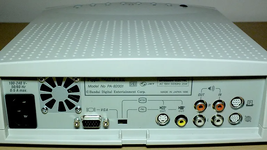
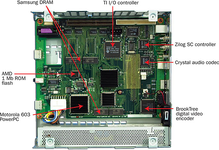
Pippin uses Grand Central instead of O'Hare/Heathrow/Paddington. MESH is a discrete in all the Grand Central machines that have MESH (includes TNT/PowerSurge machines such as the Power Mac 9600).The internal CD-ROM is SCSI, not IDE. Pippin is (as far as I know) the only machine with a discrete MESH SCSI controller (it's built-in to O'Hare/Heathrow/Paddington).
That's a real surpriseThe internal CD-ROM is SCSI, not IDE.
 ! A low-cost IDE controller is barely more than a 16-bit latch.
The ROM on the CD, because there's a 1MB AMD Flash.<snip> And the ROM is a pretty standard 4 MB SuperMario build. <snip>
Aaaah, I was expecting DingusPPC.<snip> Now that Pippin games boot in MAME <snip>
For me that's the least surprising thing ;-) . I was just checking on HD costs in mid 1996.I've been surprised at how little it hides that it's a Mac. <snip>
Oh, I thought it had 128kB of battery-backed RAM for saving game state. I should have thought about whether the ROM was on CD, because it only had 6MB of System RAM as standard, and a 4MB ROM would eat nearly all of that.The AMD flash is for game saves. Pippin isn't a New World system.
Yes, we used GALs for a PC-based, IDE-based PCMCIA card storage system in the mid 1990s. And this was for 386-class PCs. I suspect that a 66MHz PowerPC really was fast enough to do it entirely in software, with just a couple of latches ( a 23-bit output latch and a 17-bit input latch). I don't think this has been done on any Mac, but some MCU IDE interfaces for retro systems have, I think.Remember, IDE is a pin reduced ISA bus, so it isn't too much logic to begin with! Commodore implemented it with some GALs on the Amiga 4000.



