So the 7200 was known to be a little unreliable and crash prone back in the day, as well as being a disappointment as the only upgrade Apple offered was an overpriced motherboard replacement. By the time Sonnet's curious PCI card based CPU upgrade came along the 7200 was already very long in the tooth.
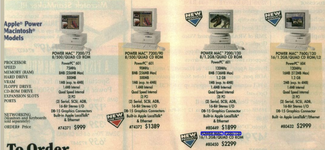
There were a few versions of the 7200 at various speeds... the 75, 90 and 120MHz versions? So, other than obviously the 7200/120 is slightly different in that it has a bus tripped CPU, and that the 75 uses the 601 while the 120 and probably also the 90 use the dieshrunk 601v... Did the 120 get an updated logic board? Or updated ROM version? The reason I ask was that I was reading the readme for the Radius Thunder 3D and in the compatibility section, it says that it is not compatible with the 7200/75, 7200/90 and other clones based on the Catalyst platform, while specifically saying it is compatible with the 7200/120.
I'm curious why the distinction exists and whether this might mean 120MHz machines are more reliable or otherwise interesting. I actually quite like the 7200 - it is potentially one of the fastest 601 based machine with bonus PCI. Good fast video, quirky as it is one of the only beige macs with built in QuickDraw Acceleration.
My own experiments with a 7200 found that they progressively get more stable the newer the OS you install. By 8.6 they're pretty usable, but I think I saw a further improvement with 9.1. I wouldn't usually install such a new OS on a 601, but it might actually be worthwhile on these.
Anyway. Regardless, back to the point. Does anyone know what, other than the CPU speed itself makes a 7200/120 different compared to a 7200/90?
There were a few versions of the 7200 at various speeds... the 75, 90 and 120MHz versions? So, other than obviously the 7200/120 is slightly different in that it has a bus tripped CPU, and that the 75 uses the 601 while the 120 and probably also the 90 use the dieshrunk 601v... Did the 120 get an updated logic board? Or updated ROM version? The reason I ask was that I was reading the readme for the Radius Thunder 3D and in the compatibility section, it says that it is not compatible with the 7200/75, 7200/90 and other clones based on the Catalyst platform, while specifically saying it is compatible with the 7200/120.
I'm curious why the distinction exists and whether this might mean 120MHz machines are more reliable or otherwise interesting. I actually quite like the 7200 - it is potentially one of the fastest 601 based machine with bonus PCI. Good fast video, quirky as it is one of the only beige macs with built in QuickDraw Acceleration.
My own experiments with a 7200 found that they progressively get more stable the newer the OS you install. By 8.6 they're pretty usable, but I think I saw a further improvement with 9.1. I wouldn't usually install such a new OS on a 601, but it might actually be worthwhile on these.
Anyway. Regardless, back to the point. Does anyone know what, other than the CPU speed itself makes a 7200/120 different compared to a 7200/90?
Last edited: