• Hello MLAers! We've re-enabled auto-approval for accounts. If you are still waiting on account approval, please check this thread for more information.

Undervolt MDD?

65a

6502
I have had a few MDDs over the years, both FW400 and FW800 models. The most consistent things about them have been that the PSUs are not very happy and dying of the capacitor plague, the 7455(s) run really hot, and they are loud. An ATX swap helps with the first thing at least.

I can find lots of info about overclocking and overvolting the MDD, but I wonder if anyone has tried lowering the core voltage at default clocks? Motorola bins always seemed pretty wide to me, so it's possible we could be running these cooler.

I found: https://thehouseofmoth.com/ppc-overclocking-station/1-600v/

But I don't think I can reconcile that (at least the B[n...] values) with the datasheet https://www.analog.com/media/en/technical-documentation/data-sheets/3732f.pdf (page 17 or so)

Has anyone tried undervolting successfully?
 
I figured it out, the data sheet seems to be showing active low logic, so a zero means a resistor is present.
 
Yes, this is possible. I have removed MDD chips and put them onto Quicksilver boards at lower voltage. Then 7447/7448 chips can go onto MDD boards and also run cooler. The later 7455 chips work better at lower voltage than earlier revisions. For example, a 733MHz 7455 chip on a QS board can be replaced with a 7455B at 1.2GHz, using less power. It seems like around this time apple liked to set the voltage to max spec. At least the powerbooks were set lower...
 
The MPC7455 datasheet recommends an astoundingly lower 1.3v nominal core voltage for this chip: https://www.nxp.com/docs/en/data-sheet/MPC7455EC.pdf

This was a 300mV factory overvolt, which is probably why they ran hot and cooked PSUs.

Then 7447/7448 chips can go onto MDD boards and also run cooler.

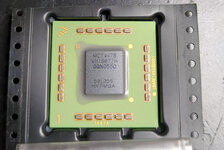
I have two new tray 7448s that I think are preballed with the weird semi-meltable solder balls. Are they pin compatible with 7455s? I always thought there was something weird with them and the caches.
 
Ugh, I take it back. 7447Bs not 7448. Definitely pre-balled. eBay find from years ago for cheap (and weird that the pcb says 7447a and the die 7447b).

Still, this would run much cooler indeed...I don't trust my rework skills enough yet. I may try lowering core voltage first :)

7447b_cropped.jpeg
 
The speed/voltage/power relationship is not linear. So compared to a top speed setting, you may find that you can get 80% of the speed at half the power. There can be a lot of iterative testing involved, depending on your goals. You could reduce the voltage in increments at a given speed until you get instability. Or you could do something like set the lowest voltage and increase speed in increments, etc. With a few chips I have installed switches to make this easier, and then mapped out the complete operational envelope while measuring power draw.

One other thing to look into, is enabling NAP mode. This can drastically reduce the power usage of an idle CPU and might also achieve what you're looking for.
 
Ugh, I take it back. 7447Bs not 7448. Definitely pre-balled. eBay find from years ago for cheap (and weird that the pcb says 7447a and the die 7447b).

Still, this would run much cooler indeed...I don't trust my rework skills enough yet. I may try lowering core voltage first :)
The "B" die used the same substrate. It would have been an unnecessary expense to do a revision to change the marking.
 
Back
Top