
-
 Hello Guest! We're hosting a challenge to welcome vintage Intel macs to the MLA during the month of July! See this thread for more information.
 -
We've made some quality of life improvements to the Trading Post. More info here.
You are using an out of date browser. It may not display this or other websites correctly.
You should upgrade or use an alternative browser.
You should upgrade or use an alternative browser.
ultimate SE/30
- Thread starter uniserver
- Start date



Just put the tinfoil in your shorts if you're going to fire that thing up after using a Dremel Tool on it, you may need the protection. :
Use a flat bastard metal file to carefully shape the cut side of the board to a wedge shaped edge. You should be able to clearly see the ends of all layers (be they signal traces or big slabs of power or ground planes) cleanly sheared off on the edge of the FRP substrate like the layers of sedimentation on a Paleological Dig.
THEN clean it up and fire it up.
Use a flat bastard metal file to carefully shape the cut side of the board to a wedge shaped edge. You should be able to clearly see the ends of all layers (be they signal traces or big slabs of power or ground planes) cleanly sheared off on the edge of the FRP substrate like the layers of sedimentation on a Paleological Dig.
THEN clean it up and fire it up.


99 percent of the time, the inner layers contain the ground and VCC routes. Thats usually rule of thumb, although not always. But I have been rebuilding boards long enough to know that this is the case.
Yes they are, and they follow exactly pin-for-pin the DB15 layout of standard mac video.ok i will but first i have to make the db 15 cable… so where is pin one… and they are in order 1-15? seems to easy.
So yeap, its that easy.
Trash:
If you file the edges as a V, I dont see why it wouldnt work. Just be careful, thats all Im sayin, although for 3 dollar video cards who cares, but 150 dollar ethernet cards, not so much. ;-)
BTW, Off topic: I wonder if LC PDS ethernet cards which are still plentiful, would work in an SE/30. Technically the PDS is the same. Well not the same pinning, but same architecture.
Thanks, and yep, that was my point in the main thread, the Riser and VidCard costs will remain negligible until we can get this to work in the SE/30. At that point demand will likely go up, etc . . .Trash: If you file the edges as a V, I dont see why it wouldnt work. Just be careful, thats all Im sayin, although for 3 dollar video cards who cares, but 150 dollar ethernet cards, not so much. ;-)
It wouldn't surprise me too much if you could make an adapter to dot it. A lot would depend upon the address the LC cards use and whether it's available in the SE/30 spec/ROM. We know that NuBus Cards can be implemented in a SecondWave expansion box for the SE/30 where Apple never intended it to be. So why not an LC 10bT PDS Card adapter for the SE/30?BTW, Off topic: I wonder if LC PDS ethernet cards which are still plentiful, would work in an SE/30. Technically the PDS is the same. Well not the same pinning, but same architecture.
I'd start by checking the available drivers from all the usual prospects before taking a look at the hardware . . . if I could, that is.
:-/
Now my eyes went crosseyed, but it looks like the LC-PDS. The lower 96-pin portion of it can directly swap over to the SE/30. All the signals are the same, however the pinouts are ENTIRELY different so a remap PCB would be needed.
Only thing that i can see from a quick glance, is A28 to A30 arnt included in the lower PDS. Only the expanded PDS, whereas the SE/30 contains all address lines. Also the LC PDS contains a function code 3 (FC3) which the SE/30 doesnt have. But i dont think ethernet cards use this control pin. Also the LC only has /PDS.BG (bus grant), whereas the SE/30 has both a /PDS.BG and a /BG. No idea what impact this would have.
I believe that LC Ethernet cards, given a pinout-remap would directly swap over, They both map into Slotspace $E
Only thing that i can see from a quick glance, is A28 to A30 arnt included in the lower PDS. Only the expanded PDS, whereas the SE/30 contains all address lines. Also the LC PDS contains a function code 3 (FC3) which the SE/30 doesnt have. But i dont think ethernet cards use this control pin. Also the LC only has /PDS.BG (bus grant), whereas the SE/30 has both a /PDS.BG and a /BG. No idea what impact this would have.
I believe that LC Ethernet cards, given a pinout-remap would directly swap over, They both map into Slotspace $E

looks like I'm partially done with the video cable.i would assume pin one is the one to the outside of the card? Where the loped off bit is… i took the dremel to it… its nice and smooth.. more of rounded then v.
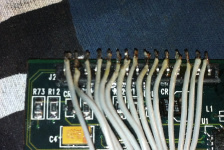
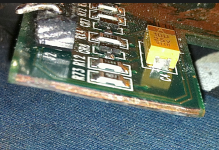
ill try it in there first.
not to worry i have 3 IIsi's one of them is crap and wouldn't care if it set firePostby techknight » 20 Dec 2013, 22:34Just be careful, thats all Im sayin, although for 3 dollar video cards who cares, but 150 dollar ethernet cards, not so much. ;-)
ill try it in there first.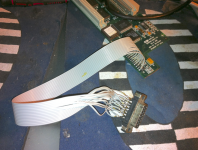
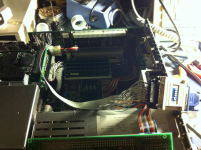
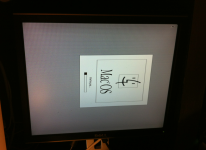
ok so cool the se/30 has the maccon + video card into it.
here is first boot up.. success!

wow the dual screen feature works!
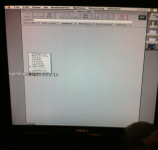
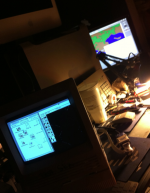
ok so anyways… i put it all back together, for the final test… to show you it all fits like a glove with my PCB Trim job.
All the screws in and tight.
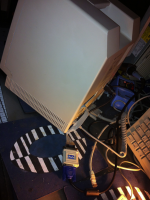
and of corse it still works fine after its all together!
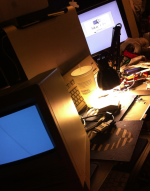
here is first boot up.. success!
wow the dual screen feature works!
ok so anyways… i put it all back together, for the final test… to show you it all fits like a glove with my PCB Trim job.
All the screws in and tight.
and of corse it still works fine after its all together!
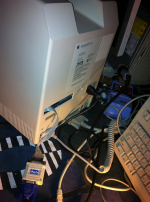
TA DA!!!!!!!!!!!!!!!!!!  Fabulous hack, uni. The only thing I might have done differently would be to desolder the connector pins and do the wire soldering right into the thru-holes.
If you do the "wrong angle" adaptation, is there any chance of having a second RCPII/IIsi fit across there for a side of external, big screen color? A lot will depend on which address interrupts are available on the SE/30.
Edit: it looks to me like you've only taken off about the same amount of PCB that you'd get from one PDS adapter offset unit. Is there room forward of the your installed card in the SE/30 for the front end of another, unmodified Pivot Card?
Fabulous hack, uni. The only thing I might have done differently would be to desolder the connector pins and do the wire soldering right into the thru-holes.If you do the "wrong angle" adaptation, is there any chance of having a second RCPII/IIsi fit across there for a side of external, big screen color? A lot will depend on which address interrupts are available on the SE/30.
Edit: it looks to me like you've only taken off about the same amount of PCB that you'd get from one PDS adapter offset unit. Is there room forward of the your installed card in the SE/30 for the front end of another, unmodified Pivot Card?
I can help in alleviating the Mk.I eyeball side effects of this process. After I get back from my Christmas road trip I can whomp up a pinout worksheet based upon the ones I did for the SuperMac riser card hacks.Now my eyes went crosseyed, but it looks like the LC-PDS. The lower 96-pin portion of it can directly swap over to the SE/30. All the signals are the same, however the pinouts are ENTIRELY different so a remap PCB would be needed.
Methinks you need to start your own thread for this project, I'm likin' it the more I think about it . . .Only thing that i can see from a quick glance, is A28 to A30 arnt included in the lower PDS. Only the expanded PDS, whereas the SE/30 contains all address lines. Also the LC PDS contains a function code 3 (FC3) which the SE/30 doesnt have. But i dont think ethernet cards use this control pin. Also the LC only has /PDS.BG (bus grant), whereas the SE/30 has both a /PDS.BG and a /BG. No idea what impact this would have.
I believe that LC Ethernet cards, given a pinout-remap would directly swap over, They both map into Slotspace $E
. . . even if it will adversely affect the value of my stash of IIsi/SE/30 NICs. I'm a sucker for a good hack. :
< . . . wonders what will happen to the value of his pile-o-LC NICs? :?: >


Nice job uniserver!
Hard to tell from the photo of the cut-off piece, but it looks like maybe the Pivot board is only 2 layers, not 4.
Hard to tell from the photo of the cut-off piece, but it looks like maybe the Pivot board is only 2 layers, not 4.
Nice job uniserver!
Hard to tell from the photo of the cut-off piece, but it looks like maybe the Pivot board is only 2 layers, not 4.
Its 4. I can tell right away, As I can see 2 layers in the center. One of them is indubitably the ground plane, Whilst the other might be VCC.
Oh yea.. That it is Now I wanna see what I can fabricate up when I get mine.
Now I wanna see what I can fabricate up when I get mine.
Nice work Uni!
Just trying to make sure I understand this correctly:
The Radius card is driving the internal CRT and is set for 512x342 resolution and a refresh rate that works with the internal display. The card produces vsync, hsync etc signals which are passed into the analog board, which then takes care of vertical and horizontal deflection. The video output from the card goes to the video amp board (probably through the analog board).
So did you have to change the settings for the video card or did it just work?
And if the above is right, I would assume that all that is required for a grey scale mod is a new video amp board that will have a transistor set up to work in it's linear region (IIRC the video board on compacts are set up with a transistor as a switch so it can only do on/off or white/black). In other words something like circuit on the Micron greyscale patent that can be found on the internet?
Does that sound right?
Just trying to make sure I understand this correctly:
The Radius card is driving the internal CRT and is set for 512x342 resolution and a refresh rate that works with the internal display. The card produces vsync, hsync etc signals which are passed into the analog board, which then takes care of vertical and horizontal deflection. The video output from the card goes to the video amp board (probably through the analog board).
So did you have to change the settings for the video card or did it just work?
And if the above is right, I would assume that all that is required for a grey scale mod is a new video amp board that will have a transistor set up to work in it's linear region (IIRC the video board on compacts are set up with a transistor as a switch so it can only do on/off or white/black). In other words something like circuit on the Micron greyscale patent that can be found on the internet?
Does that sound right?
Similar threads

- Replies
- 4
- Views
- 675


- Replies
- 4
- Views
- 1K

