Re "expansion" -- the tbolt port on the back of my mini is faster and will accomodate up to like eight total peripherals. (all concurrently connected to this one machine) -- PCI slots are now two standards back in terms of internal computer expansion, and although they still get used sometimes, I'm imagining it's not as common anymore, and it's to add old standards back into new computers.
A Quick Examination of "Powerful" Horizontal Desktop Computers
I'm conflicted on the "midrange mac desktop" topic because while I would buy one almost instantly, all it is is removing the display from the iMac and putting the rest of the guts in an enclosure much like the OptiPlex 790. Plus, the whole internet (at least: the part of the internets that aren't dedicated to hating Steve Jobs) is basically in agreeance that Apple has probably investigated the existence of that machine as a possibility, and then dismissed it because it either costs too much to build, or will be impossible to build in such a way that actually pleases any of the people who want it to exist. For example: It's maybe safe to say that a bunch of us in this thread would prefer it to be a horizontal desktop than a tower, and a lot of people have their notions of what numbers and types of drives it must have, and what numbers and types of slots it must have. The guy who thinks it should hold three 2.5-inch hard disks hooked to a RAID controller and have a pair of PCIe x16 slots will be pretty disappointed if that's not exactly what it has.
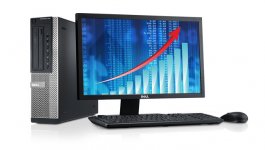
I have the tower version of this machine at work and realistically I can't think of anything I would ever do on it that would require an expansion slot. (Of course, there are higher end Precision machines that I can imagine doing work on that would need an expansion slot. No Dell Precision machines currently on sale, to my knowledge, are horizontal desktop computers.) My 790
happens to have some expansion cards in it -- a graphics processor, a USB 3 card, and a second gigabit ethernet port, but those are not things I put in it myself, nor would I have ordered it that way, if I'd been given the opportunity to do so.
In that way, I think that Apple's lack of the "Mythical Midrange Mac Minitower" (Or in this case, the less alliterated Mythical Midrange Mac Desktop) makes sense. They have a small computer you can set on a desk (or mount to the back of a monitor or the bottom of a desk or a bookshelf or a tv or put on top of another computer) and they have a large workstation with oodles of expansion options.
Machines of the horizontal desktop format have almost always been mid-range or low end at best (1) and in most cases have been sold as boxes for bean-counters, or low end educational computers. The '90s had a few horizontal desktops for homes, but I haven't seen one of those in forever. I would be unsurprised if very few were really built and targeted at home users after 1998 or so. I have seen a few convertibles (Dell Inspiron 530s for example(2)) -- but those seem to be the exception rather than the rule, and they tend to be more optimized for horizontal use anyway. There are a few slim towers, such as those from HP, which are no longer even convertible to horizontal desktop status. Dell's Inspiron 620s still is, though.
How many of you have heard of the Lenovo C20? It occurred to me just before I hit submit and it's one of the very few high-performance horizontal computers in recent memory. Lenovo has a buuuunch of photos of it, but only shows it positioned horizontally in two of them -- one is in a rack, because you're meant to be able to rack a bunch of them if you need something a little bit more workstation-class, but to put in a rack. However, why you'd buy a C20 when the Dell R5500 is the same, computationally, but is skinnier and includes a remote access card, I do not know. The other is a photo of it just sitting there in space, underneath the logos of its green certifications. It's cute, but the positioning of the handle makes me question whether or not Lenovo actually planned on these having monitors placed on top of them.
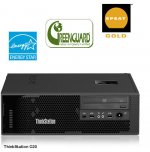
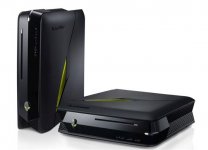
My point is that the C20 is the only horizontal computer on sale today that's not either an excelbox, a granny letter-writing box, or the Alienware X51, which also doesn't look like it's meant to sit horizontally or have a monitor on top of it anyway, even though it's technically capable of doing so. The Alienware X51 only achieves performance in its relatively diminuitive size by putting the power supply outside of the box, and accomodating only one slot: the slot that holds the graphics processor. It saves size by using a laptop optical drive, and I see no information about putting a second hard disk inside, meaning that for all intents and purposes, it has the same expandability as a 2009 Mac Mini, save a socketed CPU and a slotted GPU. But you're probably not going to kit it out with much better in those departments, because, well, heat. (and also physical size -- the best GPUs these days are huuuuge.)
And so there you have it. As detailed as I want to get this evening with a quick study into horizontal desktop computers that are powerful. There aren't many of them, and most of them make huge compromises to be the way they are. The one that's actually reasonable has about half of its use cases done better by a rack server from another vendor.
It'll be interesting to see whether or not "horizontal desktop" as a form factor ever really recovers. It enjoyed a great amount of success in the 1980s and 1990s, while cables were short and computers were considered new and extremely delicate pieces of equipment, and when they moved into a more common role, but retained their physical positioning for ergonomic reasons, and of course, because until LCD monitors became popular and computer-focused desks got smaller, nobody thought they looked out of place, or like a waste of space that could have been used for whatever else.
Footnotes:
(1) with the obvious exception of the six-slot Mac II family, which it's already been said
should have been a vertical tower. In fact, there was a third party accessory vendor which sold a vertical mounting kit for it. It was essentially a pair of plastic legs you could buy for it which held it stable vertically next to a desk, and held it a few inches above the ground, for ventilation reasons if I remember correctly.
(2) Actually, I had a Dell 530s for about three years and I've got to admit, even though I like the way a lot of computers look when they're laying flat, I rarely used it this way. I only did so when it served as a headless server and lived under my bed, and once when I had a corner-L desk, and thus a copious amount of desk space to waste because it was otherwise useless. The only computer I lay flat at work is a Dell 745 tower which I have underneath a hanging file drawer in my desk, and although I've considered asking for a desktop next time I come up for an upgrade (which is probably going to be in four or five years) -- I really don't think I'd use that hypothetical machine horizontally either. Just some random thoughts.







 sitting on there and I've always had a Radius TPD sitting next to it, so no real for a second Display. However, when I built my rolling three sided workstation, the MPD sat on the Q605 next to the TPD and the DuoDock went into the "rack" section of the desk. This made for a much better matchup with the TPD.
 )
) 


