


I had originally posted this in Trag's trading post thread, but since both he and I believe it would find a larger audience here, I figured I'd re-post.
I have a Classic I, manufactured in August 1990, that I'm looking to restore for the long haul. I'm not the most experienced solderer on this board, nor am I a foremost expert on caps themselves, so I'm looking for advice/guidance here and will be sending the board off to another forum member for the soldering part. (I'll perfect the art of soldering some day, but right now am too busy educating future generations; I figure I should learn if I want to keep all my older Macs in top shape but just need to find the time to do so).
I looked up the caps and found nothing on the original Classic, just the more popular or more trouble-prone models. Looking at Trag's list of caps for sale and my Classic board, my goal was to come up with a list so I'd know what to order.
Examining the board, I see the following, all surface mount caps:
-Four 47/16 caps near the analog board connector (labeled as C5 through C9)
-Two 47/16 caps near the sound chip (labeled as C1 and C2)
-A 47/16 cap near the reset button (labeled as C4)
-A 1/50 cap (which will be replaced by the 1/35 cap as stated in the previous post) next to C4 (this one is C3)
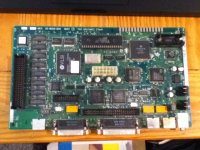
Can anyone verify these as correct? Are there any additional caps I'd need? Does it have any axial caps? (I have included a picture of my board below; it's an iPod Touch photo so I apologize for the lower quality).
Also, the board has some dark gunk on it near J8 and especially around C8. Is this cause for concern? Should I use another Classic board instead of this one? (The big problem with this particular board is a lack of sound; video problems are also an intermittent issue). I'll probably run it through a dishwasher or a shower on my next day off.
The board in question has not been used since 2009. At that point, I replaced it with another Classic board from a discarded computer. This one works fine but does emit the fishy smell associated with bad capacitors. The substitute board is another candidate to be re-capped, although I'd rather send off the original board. Somewhere, I also have one or two other Classic boards pulled from machines which have died in some way or another over the years.
I want to keep this Classic going for a long time; hopefully it will outlive me, so I want to make sure everything is done correctly. I also figure this will help the board in general (since we have no resources on Classic I recaps).
I'd like to get this board refurb taken care of in the next month since I'm not sure how much longer the substitute board will be able to work correctly.
I have a Classic I, manufactured in August 1990, that I'm looking to restore for the long haul. I'm not the most experienced solderer on this board, nor am I a foremost expert on caps themselves, so I'm looking for advice/guidance here and will be sending the board off to another forum member for the soldering part. (I'll perfect the art of soldering some day, but right now am too busy educating future generations; I figure I should learn if I want to keep all my older Macs in top shape but just need to find the time to do so).
I looked up the caps and found nothing on the original Classic, just the more popular or more trouble-prone models. Looking at Trag's list of caps for sale and my Classic board, my goal was to come up with a list so I'd know what to order.
Examining the board, I see the following, all surface mount caps:
-Four 47/16 caps near the analog board connector (labeled as C5 through C9)
-Two 47/16 caps near the sound chip (labeled as C1 and C2)
-A 47/16 cap near the reset button (labeled as C4)
-A 1/50 cap (which will be replaced by the 1/35 cap as stated in the previous post) next to C4 (this one is C3)
Can anyone verify these as correct? Are there any additional caps I'd need? Does it have any axial caps? (I have included a picture of my board below; it's an iPod Touch photo so I apologize for the lower quality).
Also, the board has some dark gunk on it near J8 and especially around C8. Is this cause for concern? Should I use another Classic board instead of this one? (The big problem with this particular board is a lack of sound; video problems are also an intermittent issue). I'll probably run it through a dishwasher or a shower on my next day off.
The board in question has not been used since 2009. At that point, I replaced it with another Classic board from a discarded computer. This one works fine but does emit the fishy smell associated with bad capacitors. The substitute board is another candidate to be re-capped, although I'd rather send off the original board. Somewhere, I also have one or two other Classic boards pulled from machines which have died in some way or another over the years.
I want to keep this Classic going for a long time; hopefully it will outlive me, so I want to make sure everything is done correctly. I also figure this will help the board in general (since we have no resources on Classic I recaps).
I'd like to get this board refurb taken care of in the next month since I'm not sure how much longer the substitute board will be able to work correctly.








 ] ]'> I started a thread on board modding S.O.P. If you have any more info about on the subject, please post it there!
