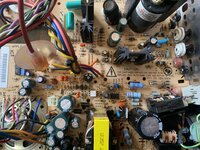
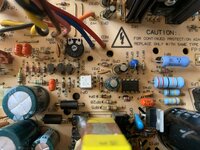
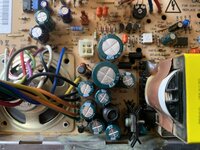
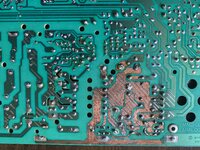
It makes me giggle when I imagine that you guys try to picture me with a straw in my mouth blowing on random legs and pins of components![]()
I don’t try to picture anything!
I could try using a straw too…
It makes me giggle when I imagine that you guys try to picture me with a straw in my mouth blowing on random legs and pins of components![]()
I believe there is no point in replacing those resistors as they shouldn't really be that heat sensitive. If you apply heat, the resistance increases a little but that is definitely not noticeable if the changes are only in units of degrees. You could try cleaning the AB with an IPA spray. It might also be worth it to check the CP24.
Did you replace those DP5 and DP7 with new ones?
Have you tried blowing on the DP6 (MBRI045) near the transformer? That one is also on the 5V rail. I don't believe the slight breezes from your straw contraption would reach all the way to it though.
This is for sure a cap or a semiconductor. What soldering technique/tools are you using by the way? According to the datasheet, these optocouplers' soldering temperature should never exceed 260°C applied for more than 10s.
Four macs experiencing the same thing..... this tells me it is likely not a random fault like a crack somewhere but more of a faulty component issue. Were all four macs affected by bad capacitor leakage or are some very clean and dint need heavy cleaning?I don’t try to picture anything!I’ll be just so happy when you find the cause (although it seems there are many causes for the same problem) - I have four Classics waiting for me to fix the same fault on all of them. I’ve spent so long replacing caps, optocouplers, etc.
I could try using a straw too…
I didnt replace DP5 and DP7 (dont have the new ones - will buy them).
With the optocoupler, I soldered at 260c and each pin for 1s - 1.5s. I usually solder at 300c.
I didnt blow on DP6 but I did replace it during my initial recapping.
CP24 has already been replaced - I forgot to mark it.
I am only starting with radio electronics and dont know enough to actually understand reasons of why this and that components are there (still learning) to actually logically try and troublshoot. What would the behaviour I am experiencing (slight air application to areas of curcuit) be likely caused by ... like a list of possible causes. Or can it be just anything? Since it is affecting a 5V voltage it should be on the 5V rail - this one a get but what else?
Could this be loose electrolyte sitting somewhere and shorting something?
Running out of ideas here.
Tbh I'm also starting to run out of ideas. If the other voltages are stable, the fault should be on the 5V rail. Or do they also fluctuate a bit? I don't think that the spilled cap gunk could be that temperature sensitive either. Or maybe there's a fault somewhere else which could lead to failure of the replaced components in the heat sensitive area. I believe this could even be caused by the gunk if that's the case.
If you don't mind cheating, maybe you could use a cheap DC-DC converter to generate stable 5V from the 12V line and hook it up somehow. I'm not sure if there's enough power on the 12V line for that though.
And to the integration of a different power supply... I've seen people doing that with SE/30s but the analog board there is a bit more modular and it's simple to perform. In your case you'd have to solve the CRT part of the PSU somehow.
If I remember right, the optocoupler stabilizes all of the voltages, not just the 5V line. But the 5V one seemed to be the most sensitive to the failure in my case.
And one more thing. Would you mind taking a photo of your AB and posting it here in case you might be missing something? Different eyes see different things.
Edit: You really should try cleaning the board. Use either alcohol or IPA and try cleaning it with a toothbrush. In extreme situations I even let the PCB soak in a box filled with alcohol for several hours and then let it dry for another hour.
I think the owner has even more, I just have four of them to deal with for now. All had leaked capacitors and, except for one, would not turn on at all until the capacitors were replaced. Now they turn on, but with wobbling screens/low voltage.Four macs experiencing the same thing..... this tells me it is likely not a random fault like a crack somewhere but more of a faulty component issue. Were all four macs affected by bad capacitor leakage or are some very clean and dint need heavy cleaning?
I think the owner has even more, I just have four of them to deal with for now. All had leaked capacitors and, except for one, would not turn on at all until the capacitors were replaced. Now they turn on, but with wobbling screens/low voltage.
I haven’t replaced the TDA4605. Have you?
Since it is the controller for the main switching MOSFET QP2, it seems to me that all these TDA4605s could be faulty. Maybe the replacement of diodes DP3/4, optocoupler, QP2, small capacitors etc. just helps the faulty TDA4605 to limp along for a bit longer.
I had another suggestion for the one component that I think is supposed to be temperature-sensitive: RP2 at the power input. The schematic says ‘20 ohm cold’ and I think this resistance is supposed to increase as it warms up - isn’t it intended to give a little jumpstart to the regulation circuit, to avoid the chicken-and-egg situation of no output to regulate? I wonder if that part is faulty, perhaps the jumpstart remains for too long and interferes with the output.

Never mind, sorry. I edited my message - I was confused with the schematic for the Plus. I have one of those with a wobble too, which goes away as it warms up. I think RP2 in the Classic is just a safety device. I’ve noted DP2 and DP12 in my message above as possibly being the ‘jumpstart’ for the Classic’s output regulation. I think someone in this forum mentioned DP12 before, I haven’t replaced that one yet.Yeah I have replaced TDA4605. I will check out the RP2
Hehe - I’ve had similar - the funny thing is that we’ve both used the same dark-green-coloured ‘low-ESR’ caps, which I bought locally from Jaycar. What if they’re our culprit?
I shall order a replacement for DP12 from Mouser this week.
If you don't mind cheating, maybe you could use a cheap DC-DC converter to generate stable 5V from the 12V line and hook it up somehow. I'm not sure if there's enough power on the 12V line for that though.

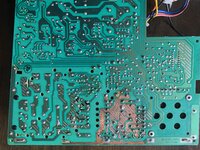
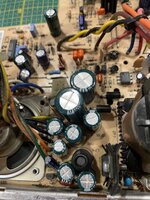
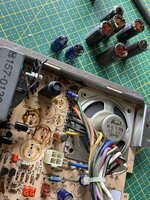
A lot of these symptoms are caused by cracked or cold solder joints on plug connectors. BD1 needs re-flowing on almost every Classic I've fixed up. I see some evidence of that in these pictures.Posting photos of AB as promised. The caps leak damage was big - I had to scrape down to copper and then cover it with protective layer.
Glad to hear it has stabilized. You're smart to re-flow the connectors.
A lot of these symptoms are caused by cracked or cold solder joints on plug connectors. BD1 needs re-flowing on almost every Classic I've fixed up. I see some evidence of that in these pictures.
This also happens (less frequently) the series of wire connections surrounding the speaker, and the ones that connect to the neck board. Again, I see strong evidence of this in the pics you posted. If you haven't done so already, I recommend removing the old solder entirely, not just reflowing, especially in the areas that received cap damage.