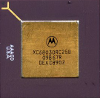
No, the Q/C 610 (or later 660av) cannot support the Apple IIe card, primarily because this computer uses either a 68040 PDS or NuBus (if you have the proper adapter, as noted above). The most common thing plugged into a 610's expansion slot was the 66MHz 486-based PC Compatibility Card, which ran off of the 68040 PDS in a right-angle adapter.
The Apple IIe card was specifically designed for the Macintosh LC and its 16-bit, 16MHz LC PDS. It will run in many other computers that have an LC PDS but requires the host computer be able to support 24-bit addressing. I believe the LC 475 and LC 575 are able to use it but I'm not sure about the LC 630 or other IDE-based 040 Macs. None of the Power Macs can use it.
As noted, there were many Processor Direct Slots, and most of them were not interchangeable. There are the machine-specific slots for the SE, SE/30, IIsi, IIci, IIcx, IIvi, IIvx, and a handful of derivative models. The multi-model PDSes were used in basically three machines: the 68040 PDS in the high-end Centris/Quadras, the 601 PDS in the NuBus Power Macs, and the LC/LC III PDS. I think the original Comm Slot was configured as some sort of psuedo PDS/serial port pass-through but I'm not sure; it was only used on 68040 boxes with slide-out logic boards like the 630 and 575. If used, it was usually filled with a modem; the only other option was an Ethernet card. Same with the CS II, only it was PCI-based so it was much faster if used for Ethernet.
The LC PDS is the only widely used multi-generational PDS. Introduced with the Macintosh LC (hence the name), it was originally a 16-bit interface connected directly to the bus of the 68020. When the LC II was introduced, it kept the PDS with no changes, since none were necessary. The Color Classic also adopted the LC PDS slot for expansion. The LC III was introduced with essentially the same slot but with an extra set of pins on the back, which when used provided a full 32-bit path to the processor, but otherwise was completely compatible with the original LC PDS. The LC 520 and Color Classic II also adopted the LC III PDS, and it was still directly connected to the processor bus.
This changed with the introduction of the 68040: the new processor had a different bus, so nothing that ran on the 030 bus would run properly on the 040 bus. However, Apple wanted to keep compatibility for older devices on the consumer/education-level machines, so they built a custom chip that emulated the 030 bus and interfaced with both the LC PDS and new Comm Slot devices.
The introduction of PowerPC didn't change much of anything: Apple simply tweaked the 030 bus emulation chip and connected it to a new chip that bridged PowerPC to an 040 bus (which is why the 52/62/53/63xx machines are so slow: there are three different buses talking through two bridge chips).