
-
 Hello Guest! We're hosting a challenge to welcome vintage Intel macs to the MLA during the month of July! See this thread for more information.
 -
We've made some quality of life improvements to the Trading Post. More info here.
You are using an out of date browser. It may not display this or other websites correctly.
You should upgrade or use an alternative browser.
You should upgrade or use an alternative browser.
Q840av gets a make over
- Thread starter SophieRose
- Start date


@SophieRose can you provide info on the picoPSU. I too have working q840av and q800 I believe both use same PSU. I have been thinking of recapping the PSU. Maybe I will go with picoPSU for longevity.


I like it too - a functional and useful, custom hot-rod!
Its projects like this that have helped me to break out of the restoration-only mindset and start using mods to bring some of my pieces back to life! Great job, SophieRose!

Its projects like this that have helped me to break out of the restoration-only mindset and start using mods to bring some of my pieces back to life! Great job, SophieRose!
And isn't that what it's all about?it’s getting used now rather than being a broken motherboard in a draw.
The silver looks great.
For those who don't know, this is actually a pretty old hack, at least in certain locations. I've seen several of these types of machines crop up on Buyee (proxy for Yahoo auctions Japan), but usually they are either 650 or 7100 logicboards inside a IIci case.
I made my own as I had a spare 650 board and the IIci case is my favourite. Did exactly the same, cut out the rear ports, and some of the stand offs to make the 650 board fit.
For those who don't know, this is actually a pretty old hack, at least in certain locations. I've seen several of these types of machines crop up on Buyee (proxy for Yahoo auctions Japan), but usually they are either 650 or 7100 logicboards inside a IIci case.
I made my own as I had a spare 650 board and the IIci case is my favourite. Did exactly the same, cut out the rear ports, and some of the stand offs to make the 650 board fit.

I like the cutout solution too. Wouldn’t be hard to 3D print, paint, and glue on a port-specific strip later on, if desired.
I too have a couple of 840av boards waiting to be restored, plus one very battery bombed board and case. So this is interesting.
I too have a couple of 840av boards waiting to be restored, plus one very battery bombed board and case. So this is interesting.



What happens if you remove the jumper?the id is normal 840av as I’ve put a jumper on the led connector


I seem to remember it just ids as a macintosh, could be wrong tho.
Have checked this yesterday while I had my case open and the jumper makes no difference, it IDs as an 840AV (ID 78) either way. Curious.I seem to remember it just ids as a macintosh, could be wrong tho.

The 8100 was wired without the ID loop back, the 840av might be the same. Where there isn't a desktop and tower version I guess the ROM doesn't need to know.Have checked this yesterday while I had my case open and the jumper makes no difference, it IDs as an 840AV (ID 78) either way. Curious.
The 9600 has the loop - I should check what it thinks it is without, given there isn't a 9600 desktop.


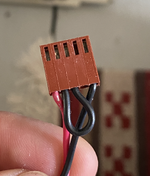
840AV has the loop as well
Last edited:
On the logic board? I.e. are the middle pins on the male connector wired to anything?840AV has the loop as well
@croissantking - they likely made the LEDs as a standard part, so it is whether the logic board has those pins wired to anything that is the interesting bit - on the 8100 they're not wired to anything, on the Q800 and PM9600, 8600 and various others like the IIvx (!) they are.
On the logic board? I.e. are the middle pins on the male connector wired to anything?
they likely made the LEDs as a standard part, so it is whether the logic board has those pins wired to anything that is the interesting bit - on the 8100 they're not wired to anything, on the Q800 and PM9600, 8600 and various others like the IIvx (!) they are.
Just pulled out my spare board to look. I can't see any traces leading off from the middle pins of J29. It's possible the traces are internal but more likely they're not wired to anything given the ID doesn't change.
Makes sense, like the 8100 it doesn't have a desktop version of the PCB.Just pulled out my spare board to look. I can't see any traces leading off from the middle pins of J29. It's possible the traces are internal but more likely they're not wired to anything given the ID doesn't change.
The weird one is the IIvx/vi. There is only the desktop version, but they considered making a tower - the IDs for it are in the SuperMario source. I wonder if the Finder shows a tower icon on my IIvx if I plug an LED harness in? (In 7.1).
Makes sense, like the 8100 it doesn't have a desktop version of the PCB.
The weird one is the IIvx/vi. There is only the desktop version, but they considered making a tower - the IDs for it are in the SuperMario source. I wonder if the Finder shows a tower icon on my IIvx if I plug an LED harness in? (In 7.1).
Guess you'll have drag a IIvx out and try. Mind your fingers on the metal lol

This explains something that has puzzled me for 25 years. Whenever I've put a PM8600 logic board in a PM7300 case, the reported gestalt number was undefined. For some reason, the most recent transplant kept the proper ID - I must have used an 8600 LED connector this time instead of the 7300 connector.

That is one lovely hack @SophieRose! I've been doing much the same thing with my Quadra 700 Triplets, G3 for one:
And I think I think the latest one is a PCI beast of an 8500 for a G4 Quadra 700?
Three processor families in one case form factor, one remaining a stock Quadra 700, of course.

This is a hack I did quite some time ago and, like almost all of my hacks, it has never quite been finished! :-/
I was going to post this after having welded and cleaned up the @$$graft, but another member is looking into doing a similar hack, so here goes:
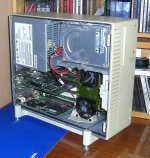
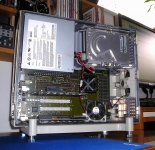
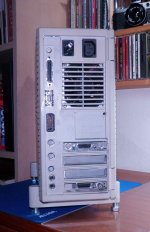
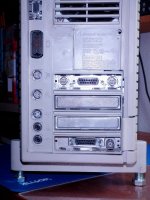
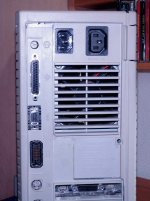
This shot I'll revisit after completing the Quadra 7100/G3/HPV upgrade . . . [ ] ]'>
] ]'>
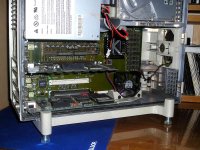
. . . adding a more appropriate selection of NuBus Cards . . .
. . . and...
I was going to post this after having welded and cleaned up the @$$graft, but another member is looking into doing a similar hack, so here goes:
This shot I'll revisit after completing the Quadra 7100/G3/HPV upgrade . . . [
] ]'>. . . adding a more appropriate selection of NuBus Cards . . .
. . . and...
And I think I think the latest one is a PCI beast of an 8500 for a G4 Quadra 700?
Three processor families in one case form factor, one remaining a stock Quadra 700, of course.
Last edited:
Does the motherboard have a label for the connector in your Power Mac 8600? Is it J20?This explains something that has puzzled me for 25 years. Whenever I've put a PM8600 logic board in a PM7300 case, the reported gestalt number was undefined. For some reason, the most recent transplant kept the proper ID - I must have used an 8600 LED connector this time instead of the 7300 connector.
In the Power Macintosh 9600 schematics, J20 is called "Product LED" and has 5 pins.
https://www.macdat.net/repair/apple_schematics.html
J20 has a couple
BoxID bits connected to a board register that is connected to Grand Central. It looks like the DingusPPC emulator doesn't have values for these (they are set to 0 for TNT machines) but I did add them for Apple Network Server in my fork (value set to 1). Catalyst machines also have these two bits (DingusPPC sets them to 0).This reads the board register:
F301A000 rw@ .It would be helpful if anyone with TNT/PowerSurge/Catalyst/Apple Network Server used that command to get the bits for their Mac model and report it here.
The result on my 8600 is
CBA2 =
Code:
1111 1100 0000 0000
5432 1098 7654 3210
---- ---- ---- ----
1100 1011 1010 0010

From LSB on the right to MSB on the left, the bits are:
1,0   = 10 : PCI1PRSNT2A_I,PCI1PRSNT1A_I (00=7.5W, 01=15W, 10=25W, 11=No connection)
3,2   = 00 : PCI1PRSNT2B_I,PCI1PRSNT1B_I (00=7.5W, 01=15W, 10=25W, 11=No connection)
5,4   = 10 : PCI1PRSNT2C_I,PCI1PRSNT1C_I (00=7.5W, 01=15W, 10=25W, 11=No connection)
6     = 0  : GCRTSA_I (I have not tested this) (RTS from SCC modem port of GC to DS8925 ; RTS is a signal that enables TXD± )
7     = 1  : GCRTSB_I (I have not tested this) (RTS from SCC printer port of GC to DS8925 GeoPort transceiver IC or LocalTalk™ Dual Driver/Triple Receiver )
8     = 1  : factory tests (active low) (emmo) (Serial Test Manager)
9     = 1  : MicSense_I = (connecting long PowerTalk Microphone doesn't change this on my pm8600? What does?)
10    = 0  : ETH10BT_LINK = 0 connected, 1 = not connected (I tested this on my pm8600)
12,11 = 01 : BoxID(1),BoxID(0); 00 = pm9500? 01 = pm8500?
13    = 0  : IO1_PU composite video out (active low) (sixty6) (1 on pm9500)
14    = 1  : IO2_PU fast SCSI (active high) (mesh)
15 = 1 : IO3_PU unused (pulled high)Similar threads


- Replies
- 13
- Views
- 465

- Replies
- 12
- Views
- 857


- Replies
- 6
- Views
- 464
