• Hello MLAers! We've re-enabled auto-approval for accounts. If you are still waiting on account approval, please check this thread for more information.

pram cap instead of pram battery?

uniserver

68LC040
After seeing this guys vid's, looks like cap technology has came along way.

I would assume all i would need is a big enough cap and a voltage regulator for 4.5v or maybe skip that just power it right from the +5v rail.

but i might need to isolate the cap from the 5v rail once the computer is off.

next what size cap to choose, how many UF or F's?

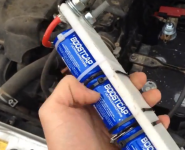
check out this video where this guy gets rid of this car battery and just uses caps to start / run his car every day.

holy moli 350 F!
Screen Shot 2013-11-15 at 12.12.34 PM.png

 
Should work, the original xbox used a super capacitor to keep time

Depending on how much current the macs need will depend on the size of the cap, my guess would be to use something around the 10F mark, i have one of those in the keyboard of my mediacenter and it lasts around 5 or 6 days with 10-20min of chargeing

 
ah i get it… the higher the F the longer it would take to charge.

The only thing about supercaps, seems like its a rather new product, I wonder what they are going to do in 10/20 years, hopefully not explode or leak.

 
I worked for a company years ago that used this concept in an actual marketed product (a touchscreen PC-based device for a dedicated purpose). The use case involved being plugged and unplugged from power repeatedly during the day, requiring a quick charge time, relatively short autonomy time, and zero battery memory.

The idea of a giant capacitor seemed crazy, but it fulfilled the need perfectly!

 
These ultra or supercaps are pretty cool alright, had been playing around with them a bit some time ago.

They are indeed used as backup instead of batteries and would seem ideal, but here are a few things to consider:

- they are low voltage components and most of them only work up to about 2.5V. They are really fragile when it come to overvoltage too, so be careful. I suppose using two in series would give the 3.6V used by many Macs.

- most Macs (I think???) aren't able to charge backup batteries, so you'd have to manually charge the cap /wire the correct voltage to the battery holder. Like normal caps they can be charged virtually instantly if the resistance of the charging circuit is low.

- this would probably only work if the computer is used relatively frequently, having a Mac sitting in the attic for years will most likely drain the cap quicker than a battery (even though caps have high energy densities, the capacities are usually lower than batteries).

- biggest problem though is that the voltage across the cap drops as it discharges so at what point will the circuit stop working? At 3V? I have no idea but you would probably need a voltage regulator as well. How long will a 1F cap last? I have measured the current draw in an LC to be 20uA, but it depends on the resistance of the load / circuit and the cut-off voltage at which point the circuit / voltage reg stops working. Would be interesting though!

Would be a nice project :)

 
Yep, my medicenters keyboard has a 10F cap in it now in place of 2 AA's

but thats nothing, 20F in not a uncommon super capacitor size, i think i have seen ones up to about 200F aswell (but those are huge industrial size caps, not your typical radial 'lytic like 1he 10 and 20F ones)

 
well the caps in the top post of this thread are 350F each and they are the size of a D cell battery, about 12 bucks a piece. mouser.com

watch the video he starts and runs his car off just these… completely omitting the lead acid battery. ( car battery )

 
Wow, I had no idea the technology had come so far in such a short span of time. I remember just 10-15 years ago you'd only find a 10F cap in a laboratory setting.

350F in a D size battery is amazing. Not to mention, extremely dangerous. If someone promptly discharged just one of those I can't imagine the amount of damage it would do.

It would be really easy to turn a bunch of these into a portable HERF weapon for electronic warfare, you'd just need a vacuum tube or magnetron that would be able to withstand that kind of power dump.

If the capacity of super-capacitors has gotten so high, why aren't they used in more applications? (or is this leading into the area of conspiracy theories involving "Big Battery"...)

 
oh no you are right, but maybe this thread should be moved to lounge….

all it takes is one dude + evil plan, for them to be outlawed i'm sure.

Luckily no member of this forum has any evil plans, We're all upstanding responsible vintage mac liberators!

 
I remember getting about 5 mins off of a 4400 uF capacitor array. After that the clock lost time and I had to double-flick it to start it.

300 F should last about a week without recharging.

 
I remember getting about 5 mins off of a 4400 uF capacitor array. After that the clock lost time and I had to double-flick it to start it.
That's interesting 8-) . So a 10F cap should last nearly 8 days. That's actually not great.

How did you test this? Did you install a charged cap instead of the battery?

PS: if I did my calculations right, a 300F cap would last nearly 34 weeks, still nothing compared to a battery.

 
The problem is, charging would need a circuit modification? I believe the battery only powers the RTC circuit (on some macs/standby on others). What you would need is a diode between the capacitor bank and the +5V supply rail in order to charge them up. But the diode dis-allows the 5V to remain powered up from the caps on power-off.

 
What you would need is a diode between the capacitor bank and the +5V supply rail in order to charge them up. But the diode dis-allows the 5V to remain powered up from the caps on power-off.
I did exactly that :) ! I used a diode and stole some power from the 5V rail to charge the cap up. I could then leave the Mac off for up to 5 minutes and still be able to turn it on again without a double-flick (and the clock kept the correct time as well).
 
Back
Top