• Hello MLAers! We've re-enabled auto-approval for accounts. If you are still waiting on account approval, please check this thread for more information.

Packing list for the original M0001 Macintosh

Ok I have searched, but cannot find this.......

Can anyone tell me please what is the complete list of items that was included with an original 1984 Macintosh?

* M0001 system unit

* M0100 mouse

* M0110 keyboard

What accessories, disks, books were also included?

Guided tour cassette and disk,

System, Finder disk

MacPaint / MacWrite disk, manuals as well?

Programmers switch?

stickers

warranty card?

Owners manual

What else?

I am sorry if this has been covered before, I have searched, I would like to collect up everything overtime, mostly from ebay all the items that were included

 
ok thanks, that helps a bit

So there should only be one audio tape?

What disks should be in there?

I can see 4 in this photo:

origmaca.jpg.41f1a84ff9ad974fd6b68856912d3be4.jpg


Guided Tour, MacPaint, MacWrite and a system disk?

There also exists a disk that has both MacPaint, MacWrite on it

As I've seen MacPaint guided tour tapes as well, wondering how that fit into things, same with the MacPaint, MacWrite manuals, they wouldn't all fit into that accessories box.

thanks for any help

 
huh?

you lost me there?

it says "Macintosh" on the tape.

but thanks,

that second link cleared everything up for me, thanks. That's what I was getting at, from your first post I thought that's all that came with the 128k, what was in the accessory box, now I see from that second link that there was another box:

MacWrite and MacPaint came in a separate box that included:
690-5009A "MacWrite MacPaint" disk [2]: MacWrite 1.0, MacPaint 1.0

690-5006A "MacWrite MacPaint: A Guided Tour" training disk

[A Guided Tour of MacWrite MacPaint] audio tape


thanks!

 
Yeah.....its ok, I found out in the last link you posted it is for the 128k

I wasn't sure if it was for the 128k, 512k, plus etc...

I didn't realise that there was a separate box with MacPaint, MacWrite, etc...as I thought from your first post there was just the accessories box included,

its all good, thanks.

you see I want to collect up all the bits and pieces that were included with the 128k

 
That's because it wasn't just for the 128K. And as of September 1984, it was bundled in the same box with the system software. By 1986 it was sold separately to appease third party developers.

Based on prices I've seen, you may end up paying as much for the individual items as you would for a complete bundle, including the 128K. Good luck.

I personally don't see the need to own all the components that originally shipped inside the original box. I have a few original boxes and they sit in the garage taking up a huge amount of space, collecting dust. Even in 1985, I thew all of that stuff away. Disks were kept in a disk box on the desk, the audio cassettes were kept with my cassette collection, and all of the other stuff was either on a bookshelf, in a file cabinet, or in use on the computer, all of the plastic and cardboard boxes discarded. The same is true today. The only reason I would want all of that stuff is if I built a shrine in my house for the 128K, which holds no appeal for me. Otherwise, my 128K exists pretty much in the same state as it did in 1985, and is just as useful, and actually inspires the same sort of awe in people as it did then, though for different reasons.

 
picassobox.jpg.ff9bfe670a97f15df825a80116fed7fb.jpg


tape.jpg.f1ab94408dc2e0e0ef5f6f44cce6ae34.jpg


This posting remembered me of my own Picasso box. It came with a Macintosh 128K I recently bought. I had a look at it and was wondering what was on the tape. I made a copy to MP3 so I could listen to it while biking. The tape tells about the guided tour disk and you should use it while working with this disk. Every item on the disk is synchronised with the tape, so you see the movement and hear what it is all about.

To do other people also a favour I digitalised the tape and made a copy of the cover. I also made a Disk Copy 4.2 image of the Guided Tour disk so you can “do it at home”

http://macintosh.vanegten.com/wp-content/uploads/2011/01/Macintosh-Guided-Tour-side-A.mp3

Cover:

guidedtour.jpg.63eaece5ed2861721b32f4d6b5c85ffe.jpg


400k disk Disk Copy 4.2 HQX and BIN

http://macintosh.vanegten.com/GuidedTour.image.hqx

http://macintosh.vanegten.com/GuidedTour.image.bin

If you want to see how the Guided Tour looks in combination with sound you should have a look at this You Tube movie one of our forum members made:

 
I could never understand why Apple recorded the guided tour on an audiocassette. Wouldn't a videocassette demonstration have been more ideal, especially for a product as advanced as the Mac (for its time anyway)?

Just my $0.02

 
I could never understand why Apple recorded the guided tour on an audiocassette. Wouldn't a videocassette demonstration have been more ideal
Hahahahahaha ... This was January 1984. There were still two major platforms, Beta & VHS, The cost of blank cassettes were as much as a buying a movie on DVD today, and less than a third of the country owned a VCR - which were quite expensive, including those who could afford frivolous luxury items like a Mac. My family did not get a VCR until 1989. Movie nights were limited to being invited to one of a few friend's houses who had one. Apple would have had to raise the cost of the Mac to provide both Beta & VHS tapes, as well as a cassette for those who did not own a VCR, all in the same box - and handing out the correct tape at point of purchase would have almost certainly been botched, not to mention a less than elegant solution for Jobs. Moreover, it would have taken the user experience away from the Mac, and not allowed the interaction with the demo, plus Apple IIs could be used with TVs as monitors, and the screen resolution of the TV was inferior to that of the actual Mac - all of which would have been perceived as negatives, even if video cassette technology had been more affordable and widespread.

 
which were quite expensive, including those who could afford frivolous luxury items like a Mac.
Indeed they were back then, and I will accept your argument that videocassettes were expensive when they were first introduced/gaining popularity (I still have one in the original shrinkwrap with the cost on the cover- $7.95 for a single Maxell HGX-Gold T-120 tape). My father purchased the first consumer Hi-fi VCR, which was a JVC HR-D725U back in late 1983/early 1984 for just over $2 500. We still have the unit today, although it requires new belts/caps after many hundreds of hours of use.

Moreover, it would have taken the user experience away from the Mac, and not allowed the interaction with the demo,
I still think a video demonstration would have been more appealing. A lot of people learn better through the help of visual aids. Either way, a videocassette would have lasted far longer than an audiocassette in terms of deterioration- those 84 guides must be completely brittle by now, and tape decks tend to eat more than conventional VCRs.

 
I still think a video demonstration would have been more appealing... a videocassette would have lasted far longer than an audiocassette in terms of deterioration- those 84 guides must be completely brittle by now, and tape decks tend to eat more than conventional VCRs.
That may be in terms of a video demonstration, but it also would have disenfranchised the user from the experience. Having the demo on the Mac actively engages the user, which Jobs knew was key to marketing any new product. Also, most people I know toss such things aside as a video has nothing to do with the product you're unpacking. And, the computer was not likely to be in the same room as the TV. In 1984 we had one TV. so consumers would be trotting off tot he TV and VCR, taking them away from the computer.

As for longevity? I totally disagree. The spinning head on the VCR is hell on magnetic tape. It's also much thinner than the average 60 min. cassette tape, making it much more venerable to being eaten by all the spinning capstans and heads than the single one in a cassette deck. There is also much more audio information proportionately encoded on a cassette tape than on a video tape. So with normal degradation the audio will be much better on a 25 year old audio cassette than a VHS tape, but the picture will be much worse, making the experience today much more vivid with a real Mac, and slightly degraded audio, than a grainy video tape on antiquated equipment - I don't know anybody who still owns a VCR, but I do know a few people who still have cassette decks. Then there's my own experience. I still have cassette tapes from 1982 that sound great. VHS tapes from 1989 look and sound terrible. Even movies I bought. In addition, I probably only had about 4-6 cassette tapes over my life eaten by tape decks. I have lost over a dozen VHS tapes to VCRs in the 15 years I used them, mainly in the early days when they were cutting corners to sell them for less. The problem was made worse, because renting all those tapes that had been in so many other machines, actually increased the risk of tapes being eaten due to dirt buildup and previously damaged tapes spoiling the delicate alignment. Remember the tracking adjustment knob!? LOL So under the circumstances, I think the audio tape was the correct solution. Plus, that was a fairly common instructional method in those days. There were even instructional LPs in the 70s, so people would not have found this unusual. By the time VCRs might have made sense, at least economically, the Mac was capable of running A/V demos, and thats the directional Apple chose, which kept them user experience directly connected to the Mac.

 
I don't know anybody who still owns a VCR, but I do know a few people who still have cassette decks.
VHS is still the main method of recording television programs in my family (Beta was also the main method of recording, and my Dad would still be recording on Beta if the fuse on his SL-2400 didn't blow on the PS), although my parents are considering going the way of the PVR later this year. I have a video library spanning over 600 tapes from 1996 (when I started recording programs) to current date, and some early BASF/Scotch tapes from the 80s, which I inherited from my grandfather after he passed away in 2004. My mother has loads of radio recordings from the late 70s onwards- even those from when my grandfather would broadcast from CHIN radio (a multicultural station based in Toronto). Many seem to have withstood the test of time, and play well, although the Ampex Educator-series tapes seem to have become brittle, and some of the Scotch-branded tapes are sticky. The Maxell UD-XLII (now just XLII), TDK SA+SA-X, and the BASF Chrome Series (even some of the Type-1 LH series) work fine, and still play. I have a good stereo system (a early-80s Sony system- I will get back to you on the model numbers), and the cassette deck has never given me any problems, as it is maintained on a consistent basis.

VHS tapes from 1989 look and sound terrible. Even movies I bought. In addition, I probably only had about 4-6 cassette tapes over my life eaten by tape decks. I have lost over a dozen VHS tapes to VCRs in the 15 years I used them, mainly in the early days when they were cutting corners to sell them for less.
Well, my father has always owned a Hi-fi recording deck, and his tapes, which consist of mainly high-grade JVCs, BASFs, Maxells, Sonys, etc. all work perfectly. The sound/picture quality is still very good, and it is remarkable when I play them on my AG-1980.

With my experience in recording tapes, I have only lost two VHS tapes (this was caused by a cheap, but somewhat reliable RCA VCR from the mid-90s, which lasted until 2002), and about five, or six audiocassettes (all eaten during playback- not caused by the Sony, but my portable Realistic Minisette-18, now retired).

Remember the tracking adjustment knob!?
TBC baby! But yes, I do recall manual tracking (I still use it). I should take a picture of the tracking knob on my 1979 Quasar. It's big, but I've never had severe tracking issues with any of my tapes. Same with my parents, and my grandparents. It kind of begs the question what recording deck you were using in 89 to have so many problems.

There were even instructional LPs in the 70s, so people would not have found this unusual.
I forgot to mention LPs. Why didn't Apple stick with vinyls? Now that would have been something!

By the time VCRs might have made sense, at least economically, the Mac was capable of running A/V demos, and thats the directional Apple chose, which kept them user experience directly connected to the Mac.
Weird, because I still have some instructional/promotional VHS tapes from Apple circa 1995-96.

 
Weird, because I still have some instructional/promotional VHS tapes from Apple circa 1995-96.
I have never seen a VHS tape that shipped with a Mac. A promotional VHS is one thing. An instructional VHS obtained from a re-seller makes sense too. But shipped in the computer case? Definitely not by 1995 when CD-ROMs were standard. Every Mac I have from 1990s has either a CD-ROM guided tour or a pre-installed software guided tour. What is the source and content of such videotapes?

Also, your family obviously took the VCR movement seriously and bought only the best equipment, and treated it with respect. Indeed your problems tended to occur with the cheaper equipment you used, which was by far the most common for everyone else, and was also mistreated and taken for granted. My cassettes were mostly eaten by car stereos and auto-reversing decks ... And oh yes, Radio Shack products. My video tapes were eaten by my most expensive Super VHS decks as well as the cheapest I've used. by comparison, I have a top of the line 1996 Panasonic DAT recorder which is much more like a VCR than a cassette deck. I have lost far more DATs in it than any cheap cassette deck - on par with my VCRs.

I got rid of the last of the bulk of my VHS tapes 3 years ago. Take up waaaaaaaay to much room. Combined with the fact they don't even make blank VHS tape anymore, makes the format deader than a doornail, while the same cannot be said for audio cassettes. In fact some Indy labels still issue commercial cassettes to help combat piracy.

 
I have never seen a VHS tape that shipped with a Mac. A promotional VHS is one thing. An instructional VHS obtained from a re-seller makes sense too. But shipped in the computer case?
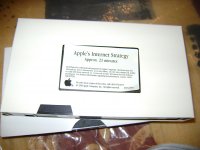
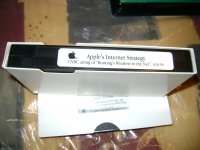
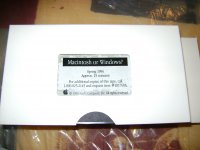
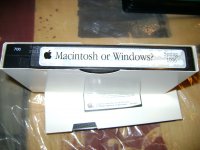
I'll post some pics of the Apple tapes I have on-hand later tonight. One is entitled: Macintosh, or Windows (a promotional tape of Apple's Spring 96 lineup), and the other is Apple's Internet Strategy (a informative tape). They both have authentic Apple labels, and have the Apple service hotline number on the label as well, so they're not some third-party mashups. Btw, I cannot confirm, or refute if these were actually shipped with a Mac computer, as I found these two in my school's abandoned computer lab. Go figure.

Also, your family obviously took the VCR movement seriously and bought only the best equipment, and treated it with respect.
It was my Dad that had to invest heavily in the early VCR movement because he owned his own video editing business for about 20 years, so naturally he required a good Hi-fi recording deck, and a good VHS camcorder to complete the job. He was also in post-production at CFTO for a number of years, so he knew which units to buy, and how to maintain them. My mother's parents were Quasar/GE people. My grandfather was more into audio recordings (reel-to-reel mind you, not standard cassettes), and still photography, while my mother/grandmother loved recording from the radio/TV. My prosumer equipment, like my AG-1980, came from my school board's IT department, where I know quite a few of the staff, and where I work part-time doing a number of post-production tasks for special event recordings, setup for special events, and so on. A lot of this equipment is unfortunately going in the trash, and I am trying to get as many units as possible (plus their peripherals- like editing controllers, BNC monitors, and other things like Video Toaster for my Amiga 2000, camcorders, lenses, projectors, etc.). They're free, and most of the units still operate.

Combined with the fact they don't even make blank VHS tape anymore,
Maxell, JVC, TDK and Fuji still make blank VHS tapes, and I believe Sony is still on board. I order both high-grade tapes for my standard VHS camcorder, and Super VHS for my AG-1980 (although these are becoming harder to find as production is rapidly dwindling for these tapes) through various company distributors. My TDK T-120 QHG tape had a copyright date of 2009 on the back, and Maxell recently had a refresh on their tape packaging. Besides, a lot of people (like myself) prefer analogue recording over digital, as it is far more reliable, and easier to use. DVDs, although great for playback, are easily prone to scratches, although I have not yet lost recorded media on a digital disc due to this (probably because I know how to safely store, and protect my discs).

while the same cannot be said for audio cassettes.
There is still a market for audiocassettes, although it is fairly small. I recently purchased a batch of Studio XLII 60s, and standard XLII Maxell tapes about a month ago from my local Pharma Plus, although they are becoming more difficult to track down in retail stores, hence the need to know a few good distributors. And you're right- in the developing world, audiocassettes are the medium for recording storage. A friend of mine from New Delhi told me they still sell TDK MA series tapes, and BASF is still around too, although it is now under the Emtec label.

The bottom line is I don't see magnetic storage completely fading away anytime soon. Although it's not as dominant as it once was, it's still around, and some people still appreciate it.

 
Back
Top