
-
 Hello Guest! We're hosting a challenge to welcome vintage Intel macs to the MLA during the month of July! See this thread for more information.
 -
We've made some quality of life improvements to the Trading Post. More info here.
You are using an out of date browser. It may not display this or other websites correctly.
You should upgrade or use an alternative browser.
You should upgrade or use an alternative browser.
nubus scsi card any benefit?
- Thread starter jholt5638
- Start date





Until the Q950 and Q840AV, SCSI performance on the Mac was uniformly pathetic and only achieved "barely" acceptable in those models. I'd think even a standard SCSI card would blow the doors off the crappy implementation of SCSI on the Mac, so it certainly can't hurt to try!
Which Mac?
Is the card Fast/Narrow SCSI II or Fast/Wide SCSI II like the JackHammer?
Which Mac?
Is the card Fast/Narrow SCSI II or Fast/Wide SCSI II like the JackHammer?
Doesn't sound like a SCSI card part number, especially from NatInt. They made Digital I/O cards and the like for the Mac. If it's an IDC50M header connector like a MoBo or internal SCSI device that's sticking out the backplane, it's definitely not a SCSI card.
NatInt used that connector, but it's for hooking up all sort of lab equipment/sampling and digitizing analog inputs etc.
edit:
Bingo!
http://www.ni.com/pdf/manuals/320640.pdf
http://www.datasheetarchive.com/NB-MIO-16X/Datasheets-UD1/DSAUD003430.html
Sounds like a typo or simple mistake substituting an "M" for the "N" for the NuBus designator, but "MIO" would be NatInt's Model Number terminology for a Multifunction I/O Card.
NatInt used that connector, but it's for hooking up all sort of lab equipment/sampling and digitizing analog inputs etc.
edit:
Bingo!
http://www.ni.com/pdf/manuals/320640.pdf
http://www.datasheetarchive.com/NB-MIO-16X/Datasheets-UD1/DSAUD003430.html
Sounds like a typo or simple mistake substituting an "M" for the "N" for the NuBus designator, but "MIO" would be NatInt's Model Number terminology for a Multifunction I/O Card.
Last edited by a moderator:


Here are the official SCSI transfer rates for given Mac models according to Apple:
http://support.apple.com/kb/TA29470?viewlocale=en_US
Most of them really suck, of course, since many of them are based on the 53C80, this is no surprise.
Also, for the PB 500 series, when it says "Custom IC" they really mean it's a 85C80 derivative smashed together with the serial controller into one chip, probably to save space/money/etc...
For the PB 500 series, if one can get a Rev C card cage, your system will be far better off booting from a decent CF card than the internal SCSI Bus.
http://support.apple.com/kb/TA29470?viewlocale=en_US
Most of them really suck, of course, since many of them are based on the 53C80, this is no surprise.
Also, for the PB 500 series, when it says "Custom IC" they really mean it's a 85C80 derivative smashed together with the serial controller into one chip, probably to save space/money/etc...
For the PB 500 series, if one can get a Rev C card cage, your system will be far better off booting from a decent CF card than the internal SCSI Bus.
Last edited by a moderator:
Interestingly, the tech note doesn't mention the second Fast Internal Bus in the 8100. Only the external/internal bus is mentioned. The "custom" chip starting with the AV Quadras and running through the NuBus PowerMacs and on into the PCI PowerMacs is the AMD AM79C950 which Apple called CURIO. It containsthe equivalent of a 53C94, an 85C30 and some kind of ethernet MAC. It was a custom job from AMD for Apple and the datasheet is not available.Here are the official SCSI transfer rates for given Mac models according to Apple:
http://support.apple.com/kb/TA29470?viewlocale=en_US
Most of them really suck, of course, since many of them are based on the 53C80, this is no surprise.
Also, for the PB 500 series, when it says "Custom IC" they really mean it's a 85C80 derivative smashed together with the serial controller into one chip, probably to save space/money/etc...
The 8100 was the first Mac with a Fast SCSI bus in addition to the regular slow bus. While the Q900/950 had dual SCSI busses, they were both based on the 53c96. The 8100 used the 53CF96 for it's internal Fast bus.
After the 8100, Apple switched to their "MESH" chip for the internal Fast SCSI busses in the PCI PowerMacs. I suspect, but don't know, that MESH is really just a licensed 53CF96. One of these days, maybe I'll try replacing one with the other to prove or disprove it.

In discussing this with dad, is it possible to replace the 53C96 chip with the 53CF96 and automatically improve performance? Or does the ROM has something to say about the speed limits the buss can have? He has been wondering for months, what if he replaced the old slow 5380 from the old Macs with a faster chip like the 53C96. Pin to pin compatibility would be an issue but an adapter could fix that. But would ROM slow down the data transfers?The 8100 was the first Mac with a Fast SCSI bus in addition to the regular slow bus. While the Q900/950 had dual SCSI busses, they were both based on the 53c96. The 8100 used the 53CF96 for it's internal Fast bus.
After the 8100, Apple switched to their "MESH" chip for the internal Fast SCSI busses in the PCI PowerMacs. I suspect, but don't know, that MESH is really just a licensed 53CF96. One of these days, maybe I'll try replacing one with the other to prove or disprove it.
In the 8Bit days, dad has swapped out older 6502s from various machines with faster ones and managed to get some improvement out of the old machine.

Trag,
This is super interesting, but not surprising. You're not the first to have such musings! If one searches the mailing lists of the netbsd project and linux kerel there was much speculation about it. Since the two chips are so similar in package and driver spec, I'd say your hunch is right on the money. The MESH chip is likely a licensed and improved version of the earlier chip.
//wthww
This is super interesting, but not surprising. You're not the first to have such musings! If one searches the mailing lists of the netbsd project and linux kerel there was much speculation about it. Since the two chips are so similar in package and driver spec, I'd say your hunch is right on the money. The MESH chip is likely a licensed and improved version of the earlier chip.
//wthww

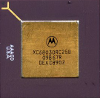
jholt5638: Will switching to nubus scsi controller give any boost over the onboard one?
In my experience, the advantage of a NuBus SCSI card is firstly to give access to the very (well, relatively very) new SCA drives that are very large, quiet, fast and hot. As has often been discussed in these fora, many SCA drives will not work on an 8-bit SCSI bus. All Mac internal SCSI-buses are 8-bit. LVD-SCSI is 16-bit and it would almost usually allow the use of 146GB SCA drives. Such a drive is useful in Quadras and above, which can run Mac OS 8.1. Your Q700 mightn't be able to read a 127GB volume quickly, but with 8.1 it *will* be able to do it.
The second advantage is speed. With the newer drives with their larger caches and faster spin times, 8-bit SCSI can access only so much data per second. 16-bit SCSI can access much more. Whether that is useful or not is another matter.
As a matter of reference, I ran Speedometer 4.02 on my IIfx. The rating for disk for the 50-pin HD in there at the time was 1.3 while the equivalent rating for a SCA-drive with 80-pin-to-68-pin adapter connected to a NuBus FWB JackHammer was 2.8
In my experience, the advantage of a NuBus SCSI card is firstly to give access to the very (well, relatively very) new SCA drives that are very large, quiet, fast and hot. As has often been discussed in these fora, many SCA drives will not work on an 8-bit SCSI bus. All Mac internal SCSI-buses are 8-bit. LVD-SCSI is 16-bit and it would almost usually allow the use of 146GB SCA drives. Such a drive is useful in Quadras and above, which can run Mac OS 8.1. Your Q700 mightn't be able to read a 127GB volume quickly, but with 8.1 it *will* be able to do it.
The second advantage is speed. With the newer drives with their larger caches and faster spin times, 8-bit SCSI can access only so much data per second. 16-bit SCSI can access much more. Whether that is useful or not is another matter.
As a matter of reference, I ran Speedometer 4.02 on my IIfx. The rating for disk for the 50-pin HD in there at the time was 1.3 while the equivalent rating for a SCA-drive with 80-pin-to-68-pin adapter connected to a NuBus FWB JackHammer was 2.8
The FWB JackHammer ROCKS! I'ce got the PLI QuickSCSI NuBus card in the pet IIfx, never thought to test it against the JackHammer in the Radius 81/110 though.
Not sure I'd bother with it IRL because it likely (certainly?) requires NuBus 90 to give it free rein.
After the recap, gotta do time trials of both on both now!
Not sure I'd bother with it IRL because it likely (certainly?) requires NuBus 90 to give it free rein.
After the recap, gotta do time trials of both on both now!



On Macs with double SCSI buses like the 8 and especially 9 series machines, usually they had the standard MESH cell (providing internal and external SCSI) integrated into whatever combo I/O chip they were using, and the fast SCSI bus (internal only) was implemented on a licensed copy of the 53CF96 (usually it was branded as LSI or VLSI). It has the same physical footprint and everything.After the 8100, Apple switched to their "MESH" chip for the internal Fast SCSI busses in the PCI PowerMacs. I suspect, but don't know, that MESH is really just a licensed 53CF96. One of these days, maybe I'll try replacing one with the other to prove or disprove it.
I'm not sure why people sometimes ignore the fast SCSI bus. I've bought 8100s and later boxes more than once and most of them just have everything daisy-chained to the slow SCSI bus, leaving the fast SCSI bus just sitting there empty. So I go in and swap the hard disk to the fast SCSI and leave the rest on the slow bus (unless the CD drive is 12x or faster and/or a burner, it's not worth putting on fast SCSI. Most MOs are also too slow to bother with on fast SCSI, but maybe some internal Zip drives are good enough for it).
I have a couple FWB JackHammer cards that I'm looking forward to playing with. In addition to fast/wide SCSI, they should support the faster NuBus-90 standard which will really give performance a boost.
From what I've read in Apple's developer notes, SCSI cells integrated into Apple ASICs never supported anything over 5MB/s (as explained in this dev note for the beige G3 that uses the Heathrow I/O controller) whereas the 53CF96 and its clones could do up to 10MB/s.
Maybe it's a terminology thing that has been mixed up and/or supplanted, but none of the I/O controller-integrated SCSI cells (as used in Curio, Grand Central, Heathrow, etc., sometimes to as "MESH") ever went over 5MB/s. That's why they had the secondary fast SCSI bus on the high-end models.
Maybe it's a terminology thing that has been mixed up and/or supplanted, but none of the I/O controller-integrated SCSI cells (as used in Curio, Grand Central, Heathrow, etc., sometimes to as "MESH") ever went over 5MB/s. That's why they had the secondary fast SCSI bus on the high-end models.
The SCSI Manager software architecture had the implementation details of the 53C80 baked in, so the 539x, MESH, and IDE (!) drivers all had to pretend to be a 53C80 in various ways. That was not a recipe for high performance; I would assume OS X and Linux get better performance on the same hardware. (Assuming PPC there, the 68K machines didn't have DMA and so that was their ultimate bottleneck).
For 7500/8500/9500/73007600/8600/9600 etc. I thought the fast SCSI (SCSI II) 10 MB/s MESH for internal SCSI was built into Grand Central but the developer notes (9500, 9600) and schematics show it's a separate chip. The Curio SCSI (SCSI I) 5 MB/s 53C94 is built into Grand Central for external SCSI (and external SCSI on the 7200).From what I've read in Apple's developer notes, SCSI cells integrated into Apple ASICs never supported anything over 5MB/s (as explained in this dev note for the beige G3 that uses the Heathrow I/O controller) whereas the 53CF96 and its clones could do up to 10MB/s.
Maybe it's a terminology thing that has been mixed up and/or supplanted, but none of the I/O controller-integrated SCSI cells (as used in Curio, Grand Central, Heathrow, etc., sometimes to as "MESH") ever went over 5MB/s. That's why they had the secondary fast SCSI bus on the high-end models.
For 5500/6500, OHare has MESH built-in but it's only 5 MB/s because it's used for external SCSI (but I can't find specs that say 5 MB/s is the limit). The developer note says "Asynchronous 5 MB per second, synchronous 10 MB per second". Is that the same as Fast SCSI? It might be describing the CD-ROM drive instead of the MESH controller.
For Beige Power Mac G3, Heathrow has MESH at 5 MB/s (per the developer note).
The Curio SCSI (SCSI I) 5 MB/s 53C94 is built into Grand Central for external SCSI (and external SCSI on the 7200).
CURIO is a physically separate chip from Grand Central. However, CURIO interfaces to the PCI bus through Grand Central.
CURIO is a custom chip from AMD, designated AM79C950. Grand Central is a custom Apple chip marked 343S1125.
CURIO contains a 53C94/96 SCSI cell, 85C30 SCC (serial) controller, and some form of Ethernet MACE.
On Macs equipped with a Fast SCSI Bus, they used either a 53CF96 (PM8100) or the very similar Apple MESH chip, which on the 7500, 8500, 9500 is a separate chip (100 pin QFP) which also interfaces through Grand Central.
I'm not sure what's going on with Apple embedding MESH in later chips and then limiting the performance to 5 MB/s, except that they seemed to have an internal rule to never allow external SCSI devices to interface at better than 5 MB/s.
FWIW, MESH is based on the 53CF96 but is not 100% compatible. Apple removed the features they didn't care about and added a few extras that they did.
Can you elaborate on this? Sources? Details?
Similar threads


- Replies
- 6
- Views
- 375

- Replies
- 8
- Views
- 704