



The day that I've dreaded has come – my PowerBook 170 has started to give up… 
Since I got it back in 2001, I've experienced more or less all common failures over the years, but this far I've managed to resolve all of them (internal connector issues, ground faults, failed hard drives, broken AC adapters, broken fuses, failed backlight, trackball/keyboard issues, damaged interconnect and flex cables, damaged plastics etc.), with all of the major issues occurring between 2001 and 2008, and only minor things thereafter. However, I've dreaded the day any ICs or other PCB components would fail, as that would be beyond my ability to repair. (For those of you who are not aware of it, I use my PowerBook more or less daily for all kinds of things, so I very much rely on it working.)
Fortunately, I realized my dependence on it already back in 2018 and purchased an extra PB170 to have as a spare. However, since that's the only spare I have, I would prefer to keep it intact and instead fix the issue if possible.
I've determined that the problem is with the daughterboard (where the CPU/FPU and other logic chips reside). On the positive side, there are much fewer components on the daughterboard than on the motherboard. But on the other hand, the daughterboard is populated almost entirely with large, surface mount ICs…
The problems began already in December/January, but it has mostly been working since then, and up until just yesterday I thought the problems were related to the drive that I'm using (a Stratos CF PowerMonster II from 2013 – more on that below).
At present, the issue manifests itself as follows:
I've done just some basic troubleshooting:
If I'm going to be doing any desoldering of the larger ICs though, I'll definitely have to invest in a heat gun as well…
Also, having known that I might have to do board level diagnostics someday, I've gathered some useful tidbits over the years. In particular this post by register on this forum a long time ago:
I only have one of those cheap multimeters that are powered by a standard 9V battery. Does anyone know if these are safe to use? I guess, when I get my oscilloscope I could use that to determine the voltage applied to the probes during resistance/continuity measurements.
I really hope there's someone with expert knowledge here who can point me in the right direction
Since I got it back in 2001, I've experienced more or less all common failures over the years, but this far I've managed to resolve all of them (internal connector issues, ground faults, failed hard drives, broken AC adapters, broken fuses, failed backlight, trackball/keyboard issues, damaged interconnect and flex cables, damaged plastics etc.), with all of the major issues occurring between 2001 and 2008, and only minor things thereafter. However, I've dreaded the day any ICs or other PCB components would fail, as that would be beyond my ability to repair. (For those of you who are not aware of it, I use my PowerBook more or less daily for all kinds of things, so I very much rely on it working.)
Fortunately, I realized my dependence on it already back in 2018 and purchased an extra PB170 to have as a spare. However, since that's the only spare I have, I would prefer to keep it intact and instead fix the issue if possible.
I've determined that the problem is with the daughterboard (where the CPU/FPU and other logic chips reside). On the positive side, there are much fewer components on the daughterboard than on the motherboard. But on the other hand, the daughterboard is populated almost entirely with large, surface mount ICs…
The problems began already in December/January, but it has mostly been working since then, and up until just yesterday I thought the problems were related to the drive that I'm using (a Stratos CF PowerMonster II from 2013 – more on that below).
At present, the issue manifests itself as follows:
- Endlessly repeating four-tone sequence as soon as the computer is turned on, directly at the checkerboard pattern (no Sad Mac-screen)
- After a cold start, the computer just sits at the checkerboard pattern without the tone sequence. Same thing happens any time the restart button is pressed. As soon as the computer is restarted with the power button the above symptom resumes.
I've done just some basic troubleshooting:
- Inspected the board – everything looks good visually
- Tried cleaning the board thoroughly with IPA and a brush – no change
- Left the computer running for a while and looked for warm chips – nothing unusual
- Tried pressing down on each IC before/during startup (only top side since the bottom is inaccessible when it's connected to the motherboard) – no change
If I'm going to be doing any desoldering of the larger ICs though, I'll definitely have to invest in a heat gun as well…
Also, having known that I might have to do board level diagnostics someday, I've gathered some useful tidbits over the years. In particular this post by register on this forum a long time ago:
[…] Be sure to use proper ESD protection when pointing a soldering iron towards the board! Also be careful when using a multimeter. Several circuits of the 180 do not like high test voltages; use a multimeter that is appropriate for use with old CMOS electronics. Some tell the 180 is built solid as a tank. This is true for the housing, but I already ruined one motherboard just by measuring a line and one daughterboard by fixing a connection.
I only have one of those cheap multimeters that are powered by a standard 9V battery. Does anyone know if these are safe to use? I guess, when I get my oscilloscope I could use that to determine the voltage applied to the probes during resistance/continuity measurements.
I really hope there's someone with expert knowledge here who can point me in the right direction
Last edited:
 (and a much slower computer…)
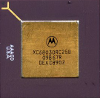



 That certainly makes diagnosing the board a whole lot easier.
 ). But maybe, if I get good at desoldering large ICs, I could grab the processor and crystal from one of the faster PowerBooks
  Happy to hear that!

