Need help diagnosing my PowerBook 170…

PB170

6502
The day that I've dreaded has come – my PowerBook 170 has started to give up… 😢

Since I got it back in 2001, I've experienced more or less all common failures over the years, but this far I've managed to resolve all of them (internal connector issues, ground faults, failed hard drives, broken AC adapters, broken fuses, failed backlight, trackball/keyboard issues, damaged interconnect and flex cables, damaged plastics etc.), with all of the major issues occurring between 2001 and 2008, and only minor things thereafter. However, I've dreaded the day any ICs or other PCB components would fail, as that would be beyond my ability to repair. (For those of you who are not aware of it, I use my PowerBook more or less daily for all kinds of things, so I very much rely on it working.)

Fortunately, I realized my dependence on it already back in 2018 and purchased an extra PB170 to have as a spare. However, since that's the only spare I have, I would prefer to keep it intact and instead fix the issue if possible.

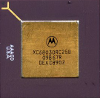
I've determined that the problem is with the daughterboard (where the CPU/FPU and other logic chips reside). On the positive side, there are much fewer components on the daughterboard than on the motherboard. But on the other hand, the daughterboard is populated almost entirely with large, surface mount ICs…

The problems began already in December/January, but it has mostly been working since then, and up until just yesterday I thought the problems were related to the drive that I'm using (a Stratos CF PowerMonster II from 2013 – more on that below).

At present, the issue manifests itself as follows:
  • Endlessly repeating four-tone sequence as soon as the computer is turned on, directly at the checkerboard pattern (no Sad Mac-screen)
  • After a cold start, the computer just sits at the checkerboard pattern without the tone sequence. Same thing happens any time the restart button is pressed. As soon as the computer is restarted with the power button the above symptom resumes.
Does anyone have any idea what faults this symptom could be an indication of?

I've done just some basic troubleshooting:
  • Inspected the board – everything looks good visually
  • Tried cleaning the board thoroughly with IPA and a brush – no change
  • Left the computer running for a while and looked for warm chips – nothing unusual
  • Tried pressing down on each IC before/during startup (only top side since the bottom is inaccessible when it's connected to the motherboard) – no change
Coincidentally, I just recently ordered an entry level oscilloscope, which might come in handy in examining the board (though the fact that the underside of the board is inaccessible when the computer is running limits the troubleshooting to the top side…).

If I'm going to be doing any desoldering of the larger ICs though, I'll definitely have to invest in a heat gun as well…

Also, having known that I might have to do board level diagnostics someday, I've gathered some useful tidbits over the years. In particular this post by register on this forum a long time ago:
[…] Be sure to use proper ESD protection when pointing a soldering iron towards the board! Also be careful when using a multimeter. Several circuits of the 180 do not like high test voltages; use a multimeter that is appropriate for use with old CMOS electronics. Some tell the 180 is built solid as a tank. This is true for the housing, but I already ruined one motherboard just by measuring a line and one daughterboard by fixing a connection.

I only have one of those cheap multimeters that are powered by a standard 9V battery. Does anyone know if these are safe to use? I guess, when I get my oscilloscope I could use that to determine the voltage applied to the probes during resistance/continuity measurements.

I really hope there's someone with expert knowledge here who can point me in the right direction 🙏
 
Last edited:
Some additional details of the gradual failure (that I thought was drive related), which may or may not give some clues:


December 23

Sudden Sad Mac screen at startup (0000000F/00000003). Then goes away.


December 23 – January 9

No issues (daily use, 2–4 hours/day)


January 9

Occasional random crashes/freezes, eventually followed by Sad Mac screen at startup

I suspect the disk (PowerMonster II / CF card) may be at fault. I open the computer and try to simply disconnect and reconnect the CF card and HD ribbon cable, after which the computer starts working normally again (used it for an hour or so).

Later that day, I'm greeted by this corrupt alert box (Swedish system):

Skivan "Macintosh CF" kan inte användas,
räff`d▯Dtt ovänt`t fdl uppstod, -127. ▯
B▯▯▯ ▯ø†©▯▯ ▯▯-™▯▯ ▯(x´▯▯ ▯\P¨▯▯
▯_≠▯▯ ▯i.


Which probably should have read:
Skivan "Macintosh CF" kan inte användas,
?????? ett oväntat fel uppstod, -127.


In English, roughly:
The disk "Macintosh CF" cannot be used,
?????? an unexpected error occurred, -127.


I start up the computer from an external drive to run a check on the drive with Norton Disc Doctor (routine thing after repeated system crashes). I then notice that the volume name is shown as "L`bhntnrh BF" rather than "Macintosh CF", but the check surprisingly completed without any errors.

At this point I assume the CF card must have started to fail.


January 10

I back up all the files on my main volume that had changed since the last backup (fortunately just 9 days old). As I'm about to backup the second of two extra volumes that I have, the copy fails almost immediately due to disk errors. Try it a few more times, but same result.

Later during the day, I try to start the computer again but is greeted with the flashing disk icon. I start up from the external drive and fire up Lido which now shows "No volumes" on the drive.


January 11

I decide to swap out CF card for an old one that I used a couple of years ago. This all seems to work fine, but after using it for a couple of hours at a café, to my great dismay, the computer freezes again.

When I get home I try to copy over an old version of the aforementioned failed volume that I had left on the old card. It chugged on for a while, but then failed with the same drive errors. The situation deteriorates further during the evening, and the computer once again starts up to the flashing disk icon. This time, Lido doesn't even recognize the CF card, and freezes when it reaches the drive (ID 0). At this point I suspect the PowerMonster itself. I open the computer once again, and try to clean all the connectors on the PowerMonster with IPA, partly reassemble the computer, but same thing.

Later during the troubleshooting process, I decide to push on the one socketed chip on the PowerMonster board (a flash memory chip in a PLCC socket) in case there might be some issue with the connections there. After that, all the issues went away, the volumes came back and the entire, previously failing 1 GB volume copied without issue! Problem solved, I thought.

I go on to reinstall the original (newer) CF card, format and partition it, and restore everything from backup.

To verify, I made a new backup and compared it with the original a week later, which showed no differences.


January 12 – February 5

No issues (daily use, 2–4 hours/day)

However, I notice that when I connect the external drive and try to start the computer, it crashes with the Sad Mac screen (same 0000000F/00000003). After a second attempt it starts up normally. So I suspect there may be two separate issues.


February 6

Sudden random crashes. After a few restarts, the computer starts up to the same Sad Mac screen (0000000F/00000003, and sometimes 0000000F/0000000A). I naturally suspect the socketed chip may be at fault again. Since I didn't have a PLCC chip remover at hand, I resorted to pouring IPA over the socket while pressing down on the chip repeatedly. After this the problems went away again and the computer started normally.


February 7

No issues


February 8

Apps begin to quit randomly and computer freezes at shorter and shorter intervals. After a couple of restarts, it eventually gets stuck at the checkerboard pattern and repeatedly plays the 4-tone sequence, as described above.

I assumed the socketed chip still had a bad connection, so I created an ad-hoc chip remover in order to properly clean the contacts. Before I did that though, I tried to disconnect the hard drive ribbon cable just to see what happened (totally thinking it would fix the issue). To my surprise it remained unchanged. I went on to disconnect the floppy drive, but same thing. At this point Apples Service Source suggest replacing the motherboard. Before I tried that though, I swapped the daugherboard with one from a PowerBook 140 that I've used as a parts machine, which got the computer working again.

And so, here I am with an apparently faulty daughterboard… 🙁 (and a much slower computer…)
 
Last edited:
Nice diary, very thorough - definitely helps with diagnosis.

At this point I would try using the PB with a different drive entirely, taking the PowerMonster out of the equation. Do the problems go away?

Edit: Ah, you say that you disconnected the hard drive ribbon cable entirely and the issues persisted.

Here’s a thought (if your soldering skills are up to it): transfer the FPU chip from the 170 daughtercard to the 140 daughtercard and it becomes a 170 :)
 
You've got a very unique case here due to just how many hours you've put on that thing. You're into the territory where even things like tantalum and ceramic capacitors are likely long past their rated hours, so any number of things could be slightly out of spec enough to cause random flaky issues like this. Given how much you use the 170, and how long you've had it, I'd honestly just recommend buying a parts 170 and replacing the daughtercard. Probably isn't worth the time to troubleshoot the original card.
 
it looks like you did the homework, and since you rely on this computer so much it would be great if you knew exactly what was wrong with it. There will be experienced people replying to tell you which chip needs replacing or what else to check. All you need to do is decide whether you want to bring it back to new-like or if you just want to get it going again. If you just want it going again then just get a working replacement daughter board knowing that it too will probably fail in the near future.
if you’re going to do the job yourself you may need to find the specs and replace everything. This seems expensive to me and risky but no more risky than shipping it off to an unknown party in hopes they can repair it and return it for a reasonable charge.
If you already know what to do and just need encouragement then you came to the right place. The good thing is you’re organized, thorough, and patient.
 
Thank you all for your input!

I definitely want to try to fix the board. (If I'd manage to repair it and it would keep failing, I'd probably try to get a replacement board. But at the same time, as these computers continue to age, just getting a replacement board feels less and less like a future-proof solution.)

The good thing is, it feels like it's very close to working. Since the failure happened slowly over several weeks and the computer is still mostly running (plays the tone sequence, displays the video etc.), there doesn't seem to have been any major or cascading failure.

Considering how the problems all seemed to be drive related, my immediate guess would be that the SCSI chip has started to fail. After looking into it though, it turns out that it sits on the motherboard, which sort of rules that out.

I was about to ask if any schematics for the PB140/170 have emerged yet, but after a quick search I discovered that schematics for both the daugtherboard and motherboard exist online! Hooray! 🙌 That certainly makes diagnosing the board a whole lot easier.

Looking at the main chips on the daughterboard, I'd say it seems unlikely that there would be anything wrong with the CPU, FPU, RAM, ROM, video interface or the keyboard interface. This leaves the "Memory decode & CPU glu", memory data buffer and I/O data buffer. In particular the glu chip and the I/O data buffer feel interesting, since these deal with the SCSI signals. Unfortunately, the I/O data buffer is one of the few chips that are located on the underside of the daughterboard, which makes it difficult to probe…

@3lectr1cPPC, I guess you have a point in that it may also be that caps and other passive components have started to fail. What is the most common failure mode for tantalum caps and ceramic caps? Do they usually drift out of spec, short or become open?

Anyway, before I start replacing any parts, I want to identify where the problem most likely lies.

I tried connecting to the built-in diagnostic tools in the ROM via serial port from my spare PB170 (as covered by Adrian of Adrian's Digital Basement in his video "Use Apple TechStep without TechStep hardware: Mac's built in diagnostic") with the hope of obtaining the current error code, but unfortunately I'm not getting any response from the computer (my setup works fine with the PB140 daugterboard installed), so I guess the problems occur very early on in the process, or it's stuck in some loop (as indicated by the repeating four-tone sequence) which prevents it from responding. In a way, if the problem is related to the communication with the SCSI chip, I suppose this makes sense, since it also handles the serial ports. Also, I didn't mention it before, but nothing changes when pressing the interrupt button (other than a short pause).

In short, what I'm asking for is for some help in identifying possible causes, and which components can be ruled out, considering the current state of the machine and the issues I experienced up until it stopped working.

My main questions at this point are:
  1. Is the current state of the machine (no startup chime / endlessly repeating four tone sequence) and the drive issues leading up to it indicative of any particular problems?

  2. From what I can tell, the 0000000F/00000003 and 0000000F/0000000A Sad Mac errors also appear to be software/data/disk related. Or do they point at something else being wrong?

    Also:

  3. Is the 80-pin connector that connects the daughterboard to the motherboard a standard connector, so that it's possible to get a cable to connect the two to allow for better access during troubleshooting?


By the way, I found the documentation for my multimeter, which states that the "Maximum open circuit voltage" for resistance measurements is "approximately 2.8 V". Is this safe for doing measurements on these PowerBooks? @register, I see that you're still active here since that old (2008!) post. Perhaps you could chime in? :)
 
@3lectr1cPPC, I guess you have a point in that it may also be that caps and other passive components have started to fail. What is the most common failure mode for tantalum caps and ceramic caps? Do they usually drift out of spec, short or become open?
Usually tantalum and ceramic caps fail by shorting out. If that were happening here, you’d probably have no power. I’m just saying that because of how many hours of use those boards have seen, anything could be suspect because you’re sort of in uncharted territory. I would say though that it is more likely that a chip has failed than a passive, given the symptoms.
From doing brief research, it seems tantalum caps don’t tend to drift due to high hours, but other characteristics may change. Unlikely that it’s the cause of your failure, but I just thought it was worth noting.
 
Back
Top