• Hello MLAers! We've re-enabled auto-approval for accounts. If you are still waiting on account approval, please check this thread for more information.

My iBook clamshell LCD is degrading

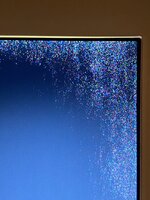
Am I right in thinking It looks like mould growth between the layers, rather than vinegar syndrome? I opened up my iBook after a few weeks and saw this, it was fine before.


IMG_1886.jpeg
 
I've often assumed mould too but after peeling back some of these it's basically the adhesive degrading on the top layer. Maybe with some gentle heat you might be able to get it back, but ultimately the top adhesive polarizing layer will need to be replaced.
 
Are there any laptops immune from this / vinegar syndrome ? I don’t know much about display panels. How come we don’t see this with the desktop displays? Has anyone seen Pismos affected?
 
No vintage LCD panels are immune, but it appears related most to climate and storage conditions (humidity, high seasonal temperature extremes and possibly gravity) causing the issue. For example, the issue appears to be more prevalent in humid countries, and if you import an item unaffected from such regions there is higher chance the delimitation of layers will occur more quickly in time. Panel type can also be a consideration - it appears less common in DSTN panels but high quality TFT displays have it occurring more often. Some very basic LCD panels do nothing.

Yes, I've seen the issue in Pismos (items sold in Japan), and vintage desktop LCD panels but not nearly as prevalent. Old desktop LCDs are much thicker, ?more glue and perhaps more immune to climate and storage conditions.

Vinegar syndrome is a bit of a misnomer, it's the glue degrading in one or more layers of the LCD panel which can sometimes give off a vinegar or chemical style odor, but in most there is no smell.
 
As an anecdotal experience, my home has always been air conditioned/dehumidified, and of all the LCDs I’ve ever had, Ive never seen this even once.
 
Vinegar syndrome is a bit of a misnomer, it's the glue degrading in one or more layers of the LCD panel which can sometimes give off a vinegar or chemical style odor, but in most there is no smell.

It's not named that because it smells like vinegar, it's named that because the deacytation of the cellulose acetate used in the polarizer literally produces acetic acid, the main ingredient of vinegar.
The issue is mostly known in movie film, as those are made with cellulose acetate as the base, but other uses of cellulose acetate are susceptible too.

Note that in LCD panels, it's not the adhesive failing on its own, rather the acetic acid is reacting with it and causing it to fail.
In movie film, it's known to also cause issues beyond the physical shrinkage and warping, due to the acetic acid reacting to the film's chemicals, which can cause things like dye fading or instability.
 
I’m honestly a bit alarmed that this has happened. The backstory is that about six weeks ago I moved it out of the cupboard it’s been stored in for the last two years, and had placed it on my desk under a window in my bedroom at my parents’ flat. I’ve not been here the whole time and that side of the room isn’t very well heated. It’s a typical damp British winter, and we have the typical rattly old single-glazed Victorian sash windows, so the humidity levels might have been just a bit too much.

It’s not too big a loss. This panel is already suffering from pixel rot on the right hand side that gets worse the longer it’s on for. Just like the degradation that’s recently appeared, it’s most visible against black.

IMG_9982.jpeg

Another bit of good news is that earlier this year I acquired an identical Blueberry iBook G3/300 for free. The case plastics are in poor condition — but the LCD is perfect. I will swap them over and it will become a parts machine.
 
Are there any laptops immune from this / vinegar syndrome ? I don’t know much about display panels. How come we don’t see this with the desktop displays? Has anyone seen Pismos affected?
No unfortunately, nothing is immune. It can happen to any laptop, desktop, or even car infotainment systems. The PVA film is to my knowledge still used today, or at least up till very recently. The newest system I’ve heard an account of this happening to was a 2011 MacBook Pro, I believe owned by someone in Brazil.
I have a more detailed page explaining it here: https://macdat.net/repair/kb/vinegar_syndrome.html
 
I’ve started swapping LCDs over. The donor has a Samsung LT121SU-123 whereas the original degraded display is an IBM 03L5040. The display cables are different, which unfortunately means I’ll have to open up the main housing. If the panels had been the same, I would have only needed to open up the display housing.
 
This has, as far as I know, not happened to any of my machines. The climate here in California (relatively warm to hot and dry summers, cool and intermittently wet winters) likely helps.

The only cases of it I've seen are where affected displays come to me with the condition already present.

Hopefully it doesn't begin to happen en masse, as I'm really not too keen on replacing the polarizers on ALL my displays.

c
 
Supposedly, since the LCD is still functional, you can just replace the polarizer film. There are discussions about it in multiple forums. Apparently you can get the film from various online stores. Then you carefully peel off the old film, clean the bare LCD, and reapply (in the correct orientation). I have several LCDs with this problem and I need to try doing a polarizer replacement at some point. It's getting hard to find good panels to fit these old machines so a swap isn't always feasible and is almost never cheap.

If anyone else has this problem, it's best to leave the machine out in the open to air out. I have several machines where, when the computer has been stored closed and sealed in a package, the vapors from the degraded LCD have caused corrosion to the internal metal parts of the machine. One is a Key Lime iBook SE, one a Duo 2300c, and one a Duo 280c. They need full disassembly and cleaning once the LCD is dealt with.
 
I’ve bought a replacement IBM LCD for a decent price. Supposedly grade A. The degraded panel is in my parts machine so when I’m done I’ll have two good machines.
 
FWIW, I have also heard stories of it spreading amongst computers. I'm not sure if that is just a function of storage methods (i.e. if they are stored similarly, then similar things will happen) or if they are truly contagious.
 
My iBook developed this just recently. I want nothing more than to repair it. Is anyone out there skilled in the polarizer film replacement?

Also, how hard is it to check the brand of the display? Even if I go the polarizer film route, I might have to get a spare display as a backup.
 
Back
Top