• Hello MLAers! We've re-enabled auto-approval for accounts. If you are still waiting on account approval, please check this thread for more information.

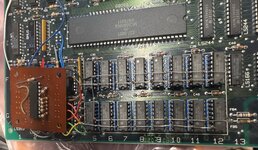
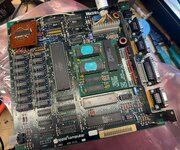
Macintosh 128K board with custom 512KB upgrade

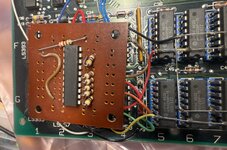
I bought a Mac 512 on eBay recently which had a spare upgraded 128 board thrown in - complete with new sockets, chips, and a hand-wired PCB in the corner.

Basic testing shows that it appears to boot to the floppy OK, albeit I haven't actually tested the memory - but does anyone recognize the upgrade before I reverse engineer it? It looks different to the Dr Dobbs article. Thanks!
 

Attachments

  • IMG_4784@0.5x.jpg
    IMG_4784@0.5x.jpg
    414.5 KB · Views: 73
  • IMG_4783@0.5x.jpg
    IMG_4783@0.5x.jpg
    486.9 KB · Views: 73
  • IMG_4785@0.5x.jpg
    IMG_4785@0.5x.jpg
    272.7 KB · Views: 70
The differences you've observed compared to the Dr. Dobbs article are expected, as your LB is an earlier revision and lacks some components layout like there is no footprint for U13G and R42. Additionally, RP3 has been removed to provide clean access to /CAS0 and /CAS1. Please note that RP1 is not a DIP package, as in later LB revisions, and its routing is different. If you intend to reverse engineer this upgrade, please ensure you use the correct schematics, specifically the handwritten one that does not include U13G or R42.
 
Last edited:
Thanks! It turns out that it's actually a 1MB board, which I haven't seen a mod for before - the 256 x 1 memory chips are doubled up in the sockets. Furthermore, the IC on the floating board has no markings at all, so I'm wondering if I can have my chip tester determine what it actually is...
 
Thanks! It turns out that it's actually a 1MB board, which I haven't seen a mod for before - the 256 x 1 memory chips are doubled up in the sockets. Furthermore, the IC on the floating board has no markings at all, so I'm wondering if I can have my chip tester determine what it actually is...
Consider identifying the input and output signals directly from the logic board (LB) and the floating board.
 
I believe those *are* Plus ROMs, as it also has a MacSnap SCSI card installed and I was able to boot System 6.0.8. Anyway, this is a little bit of a curio for me as I haven't seen another board wired like this before - I'm definitely interested if somebody recognizes it.
 
Definitively the IC on the floating board is a custom chip (PAL) for demultiplexing and for /CAS signals generation.

For 1MB of RAM with 32 256Kb x 1 bit ICs it needs 2 pairs of CAS signals. Each pair controls a 512KB memory bank of 16 bit address bus.

Identify the inputs from the LB. For sure among those inputs are C2M, A19, A20, /RAS, /CAS0, /CAS1, and VID\/u. I wonder if also it is generating RA8.. for that it would need also A17, A18.

Quite interesting!, Never saw before a home-brew 1MB RAM upgrade on the earliest LB revision of the Macintosh 128K
 
Last edited:
Bump!
Old thread, but this seems to be the only thread on the interwebs about a 1MB upgrade to the original Mac.
Was this ever reverse engineered?
Or does anyone know if there is more info about this mod somewhere else?
Thanks!
 
@Epictronics Woo! Big fan of your channel. :D

I think it's in reference to the original "Dr. Dobb" who wrote an article called "Dr. Dobb's Journal." He did several DIY tutorials on how to upgrade your original Mac. Here's the 512K upgrade I found just Googling around, but I believe it can be expanded to 1MB.


The one mentioned in this thread appears to be different from the one from Dr. Dobb's Journal for the reasons stated above.

I'll tag some of our local hardware gurus, I bet they could tell you. @Tashtari @Bolle @trag @Builder68
 
@Epictronics Woo! Big fan of your channel. :D

I think it's in reference to the original "Dr. Dobb" who wrote an article called "Dr. Dobb's Journal." He did several DIY tutorials on how to upgrade your original Mac. Here's the 512K upgrade I found just Googling around, but I believe it can be expanded to 1MB.


The one mentioned in this thread appears to be different from the one from Dr. Dobb's Journal for the reasons stated above.

I'll tag some of our local hardware gurus, I bet they could tell you. @Tashtari @Bolle @trag @Builder68
Thanks, I'm glad you enjoy the show :)
Yes, my research led me to Dr. Dobbs journal too. So, I had actually decided to do the 512k mod to the "Mac Harward" project.
However, today I read that the 68k could potentially handle up to 4MB, so I continued my search, and this thread was the only mention I could find of a 1MB mod. it would be supercool if we could get it reverse engineerd.
 
I wonder if one or two static RAM chips could replace all that, or maybe a static RAM chip and a level shifter.
 
Thanks. I had missed that thread. That's exactly what I was hoping for :) The project seems to be on hold though.
You might be happy to know that the project isn't on hold. It's live and completed! The 4MB expansion board for the Mac 512K is available here and fully working.

My current ongoing project is to create a single board for the Macintosh 512K that integrates a 68030 accelerator(Bolle's Performer), the SCSI interface (Demik's MacSnap SCSI interface), the ROMINATOR I (BMOW), and a 4MB 32-bit wide zero wait state expansion board (based on the schematics Bolle reverse-engineered). So far, the 68030 accelerator, ROMINATOR, and SCSI work like a charm, and the PCB has been shaped to allow it to be installed along with the 4MB expansion board I made previously. See a picture of it here.

The latest iteration that I'm working on that integrates the 32-bit 4MB RAM is still not functional. Bolle recently shared in this other thread an unconfirmed schematic of a 32-bit RAM expansion board for the Total Systems Mercury 030 accelerator board. This 32-bit RAM board is particularly ingenious; it replaces the entire 4MB RAM space of the host machine with the fast RAM, except for the slow RAM (System RAM) region where the ROM locates the screen buffers. The logic implemented on the accelerator board side is almost identical to that of the Mercury 030 accelerator board.

 
Last edited:
You might be happy to know that the project isn't on hold. It's live and completed! The 4MB expansion board for the Mac 512K is available here and fully working.

My current ongoing project is to create a single board for the Macintosh 512K that integrates a 68030 accelerator(Bolle's Performer), the SCSI interface (Demik's MacSnap SCSI interface), the ROMINATOR I (BMOW), and a 4MB 32-bit wide zero wait state expansion board (based on the schematics Bolle reverse-engineered). So far, the 68030 accelerator, ROMINATOR, and SCSI work like a charm, and the PCB has been shaped to allow it to be installed along with the 4MB expansion board I made previously. See a picture of it here.

The latest iteration that I'm working on that integrates the 32-bit 4MB RAM is still not functional. Bolle recently shared in this other thread an unconfirmed schematic of a 32-bit RAM expansion board for the Total Systems Mercury 030 accelerator board. This 32-bit RAM board is particularly ingenious; it replaces the entire 4MB RAM space of the host machine with the fast RAM, except for the slow RAM (System RAM) region where the ROM locates the screen buffers. The logic implemented on the accelerator board side is almost identical to that of the Mercury 030 accelerator board.

That's supercool. Love the project. I'll order some boards and try it out on my original 128k (128/512k shared board)
I'll share the build on YT.
Thanks!
 
That's supercool. Love the project. I'll order some boards and try it out on my original 128k (128/512k shared board)
I'll share the build on YT.
Thanks!
That's great. Videos modding the Early Macs are almost non-existent on YT, probably because until very recently, no one had published open-source upgrades reverse-engineered from original boards that were intended for these machines.

The only options until recently were the cool upgrades from BMOW like the ROMINATOR I (open source) and FloppyEmu. For example, we now have the option to install a SCSI interface thanks to Demik, who reverse-engineered the MacSnap SCSI board (Open Source). And as you mentioned, until very recently, there were no 'modern,' open-source projects for a full 4MB RAM board expansion for these machines.

The TS Mercury 030 or the Micromac Performer (Open Source) are likely the only accelerator boards that can be easily cloned to a PCB that fits in an early Mac today. Bolle published the schematics (MM) and the PLD logic (MM & TSM). I've been testing this logic on a Macintosh 512Ke, making a prototype PCB specifically shaped to fit, and with some very minor changes to the MacSnap SCSI interface logic, the accelerator works great when installed concurrently with the 4MB expansion board.

You definitely have a lot of material to work with when it comes to making YouTube videos about modding these machines!
 
Last edited:
I did the 128k->512k (chip upgrade)->1Mb (second row of chips piggy backed on the first) back in the day (and a hard disk with an interface that sat in the eprom socket under the eprom), it's been a while, but I seem to remember there was a TTL jellybean to decode the RAS signal for the piggybacked chips
 
Back
Top