• Hello MLAers! We've re-enabled auto-approval for accounts. If you are still waiting on account approval, please check this thread for more information.

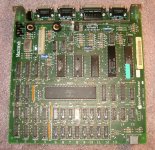
is this original 128k Mac logic board?

Do you mean a first edition 1984 128k board?

Just a guess, but I'd say no to both the one you posted and the Wiki board, because of the CPU's Package.

IIRC, the earlier 128k had a Ceramic Package that was Killy Klip compatible. Later boards had this "standard" package, which required soldering a piggybacked thru-hole socket's legs to all the upper sections of the legs on the CPU, a real PITA.

If your question is related to it being a downgraded Fat Mac board, that's a different story entirely.

 
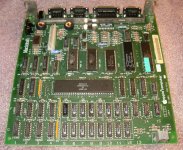
While this is a non-upgraded 1984 128K design, it is definitely not a "first edition". A couple of key indicators are the ROMs are Rev. B - granted they could have been upgraded after the fact, however, the RAM chips also have the large Apple logo which were not included in the 128K boards until later (it does appear that at least one 64 RAM chip has been repaired with a 256). Another indicator is the piggy-backed resitor array at D15 - again this could have been added after the fact. And finally there's Trash's observation that the cpu is a standard chip, not the ceramic variety used in the earliest boards. Again, in the early boards Apple sourced their chips from several vendors so this is not an absolute indocator, but the presence of all four of these things suggests a later run board, though not a guarantee. As far as I know, aside from the ROMs, there is absolutely no functional difference between the first production run 128K boards and the later ones. Besides sourced components, for which there is no consistent set of rules, the boards are otherwise identical. So the only reason to search for an early "stock" board would be bragging rights. In fact the lack of the D15 resistor array could lead to random crashes. Again I don't think this board has ever been upgraded ... But a sure fire way to know is to look at the reverse and check for a severed trace at E3.

Giolicious, out of curiosity, would you mind listing the differences you see between the boards?

Trash, that is the first I have read about the Killy Klip compatibility between the ceramic CPUs chips and the plastic ones. So you are saying a Kily Klip won't work on a plastic CPU, or just not as reliably as on the earlier ceramic ones? I ask because I have seen several Killy Klips mounted on such chips.


 
When I got my NewLife Card to upgrade my FatMac, it came with a Killy Klip and a standard socket, the instructions said to use the KK if I had the ceramic package. The instructions were to solder the standard socket onto the CPU if it wasn't the ceramic package. IIRC the KK worked, but I wasn't happy with the reliability of the connection to the plastic package.

If I run across the instructions for the NewLife Card, I'll throw them into one of the scan dumps. So far, I haven't scanned a tenth of what I've decided to scan and I haven't looked through anywhere near a tenth of the docs I have available for the scanning project.

Too many toys, too many hacks, too many docs and never enough time! :approve:

Priceless! [:D] ]'>

 
Do you mean a first edition 1984 128k board?
Oh sorry i should have been more specific with my question. Im just really new to this whole vintage Mac and learning a lot from this forum. Guess I was wrong to assume that the 128k logic board picture at http://en.wikipedia.org/wiki/Macintosh_128K is one of the earliest or first editions 1984 128k board. Although as Mac128 said:

... in the early boards Apple sourced their chips from several vendors so this is not an absolute indocator, but the presence of all four of these things suggests a later run board, though not a guarantee.
Do you know any site/picture of the Ceramic Package you're talking about? i want to see.

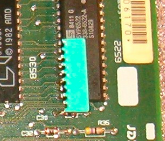
Is this the "piggybacked thru-hole socket's" you mean?

Screen Shot 2011-10-23 at 11.07.58 AM.png

Giolicious, out of curiosity, would you mind listing the differences you see between the boards?
I mean this Screen Shot 2011-10-23 at 11.06.00 AM.png being different from the Wikipedia 128k logic board picture I mentioned.

What about this board?

2391525089_8bbf29e2ea_b.jpg.4db07553822e0e8cfa906129c4de7e8e.jpg


Thank you guys for the info. :b&w:

 
Your last picture is the ceramic package. Typically this is on early versions of the logic board. But since Apple sourced components from a variety of vendors, anything is possible. This appears to be a later board due to the large Apple logos on the RAM chips.

The blue resistor is the piggy back fix I was mentioning. It was first applied in the field during repairs, and then kludged onto the OEM boards at the factory.

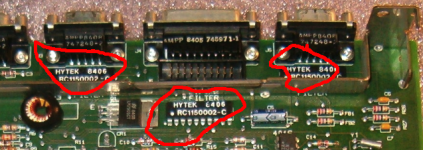
The Hytek chips are similar explanation, the orange chips on the Wikipedia pic likely supplied by another vendor. There may be a way to date boards by specific components, but to date nobody has done a comprehensive survey of the individual components across the manufacture dates.

 
Now that I think about it, it may actually have been the ceramic package that was Killy Klip resistant.

Dunno, we're talking about memories from 20 years ago! :-/

 
NICE PICS, JDW!!!! 8-o

This is the first time I remember seeing the DayStar SE/30 adapter at all. Having the ArtMix adapter together for comparison is very enlightening. Has anyonetried the PowerCache or a PDS Card installed in the unimplemented second slot? It looks like cloning the DayStar adapter so it puts the TurboCache in the same position as the Artmix adapter and using the top slot for a stack of PDS Cards would be the optimal configuration and not violate any Artmix copyrights.

Very interesting indeed! :approve:

p.s. may I have your permission to use copies of your pics to look into this hack? :?:

 
Back
Top