


Hi folks!
I have a IIcx that refuses to boot with its recapped Astec AA15830 power supply, or the AA15831 that I borrowed out of a IIci. After painstakingly rechecking all of the caps I replaced for accidental shorts between pads and traces, feeding the board a current-limited input on +5 and seeing if anything got warm (nope), and then learning that 16 ohms between +5 to ground is not a sign of trouble, I took the plunge of putting a recapped IIsi APS06 on it, and it booted. We had a little instability on our first trip around, but I am inclined to blame that more on my uhhhhh imperfect bench setup:
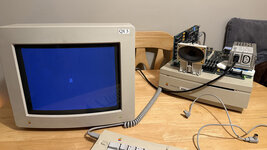
than on the PSU, board, or graphics card. It froze when I opened the Monitors control panel the first time, but no such issue the second time. Anyway, hooray! Board at least mostly works, yet another old boy cared for.
So the question of the power supplies sets in... the AA15830 that was in this machine, when installed and regardless of how much stuff is plugged into the board (all of it? none? doesn't matter), will just click/chunk somewhere between once and twice a second - I'd guess about 700ms. The IIci's AA15831 does basically the same thing, but faster - somewhere between two and three times a second. That AA15831 *does* power the IIci on; I can check if the AA15830 works that machine, but have not done so yet.
Since I know the board can respond to voltage by working, I decided to throw a scope at points on +12 and +5 on the IIcx board with the AA15830 installed:
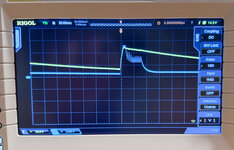
Yellow trace is the +12; it just does the nice even ramp down about 8ms after charging, what I would assume is just cap discharge following the supply entering internal protection. The blue trace is +5. A quick blip up to 5v, then 5ms later it starts that rapid charge/discharge behavior down to 3V, and after about 25ms, it drops into cap discharge territory. I have not run this test with the AA15831 yet. The fans in both supplies do spin while the click disco is taking place.
In anyone's experience, is it going to be worth even trying to troubleshoot these supplies beyond this? It seems like these two supplies are going to be a phenomenal pain to run while open, and while it appears whatever drama is happening is taking place on +5, beyond looking for a visible short, I've not had enough experience with power supply diagnostics to have any idea what would be causing the supply behavior beyond "idk I guess a voltage regulator has failed?" And then there's the complication of the AA15831 powering the IIci's board, RAM, and network card...
Thanks!
I have a IIcx that refuses to boot with its recapped Astec AA15830 power supply, or the AA15831 that I borrowed out of a IIci. After painstakingly rechecking all of the caps I replaced for accidental shorts between pads and traces, feeding the board a current-limited input on +5 and seeing if anything got warm (nope), and then learning that 16 ohms between +5 to ground is not a sign of trouble, I took the plunge of putting a recapped IIsi APS06 on it, and it booted. We had a little instability on our first trip around, but I am inclined to blame that more on my uhhhhh imperfect bench setup:
than on the PSU, board, or graphics card. It froze when I opened the Monitors control panel the first time, but no such issue the second time. Anyway, hooray! Board at least mostly works, yet another old boy cared for.
So the question of the power supplies sets in... the AA15830 that was in this machine, when installed and regardless of how much stuff is plugged into the board (all of it? none? doesn't matter), will just click/chunk somewhere between once and twice a second - I'd guess about 700ms. The IIci's AA15831 does basically the same thing, but faster - somewhere between two and three times a second. That AA15831 *does* power the IIci on; I can check if the AA15830 works that machine, but have not done so yet.
Since I know the board can respond to voltage by working, I decided to throw a scope at points on +12 and +5 on the IIcx board with the AA15830 installed:
Yellow trace is the +12; it just does the nice even ramp down about 8ms after charging, what I would assume is just cap discharge following the supply entering internal protection. The blue trace is +5. A quick blip up to 5v, then 5ms later it starts that rapid charge/discharge behavior down to 3V, and after about 25ms, it drops into cap discharge territory. I have not run this test with the AA15831 yet. The fans in both supplies do spin while the click disco is taking place.
In anyone's experience, is it going to be worth even trying to troubleshoot these supplies beyond this? It seems like these two supplies are going to be a phenomenal pain to run while open, and while it appears whatever drama is happening is taking place on +5, beyond looking for a visible short, I've not had enough experience with power supply diagnostics to have any idea what would be causing the supply behavior beyond "idk I guess a voltage regulator has failed?" And then there's the complication of the AA15831 powering the IIci's board, RAM, and network card...
Thanks!








